Band 6.5 IELTS Writing Task 1 Model Answer
Overall Band Score: 6.5 · Cambridge IELTS 21 · 2026-11-18
IELTS Writing Task 1 question
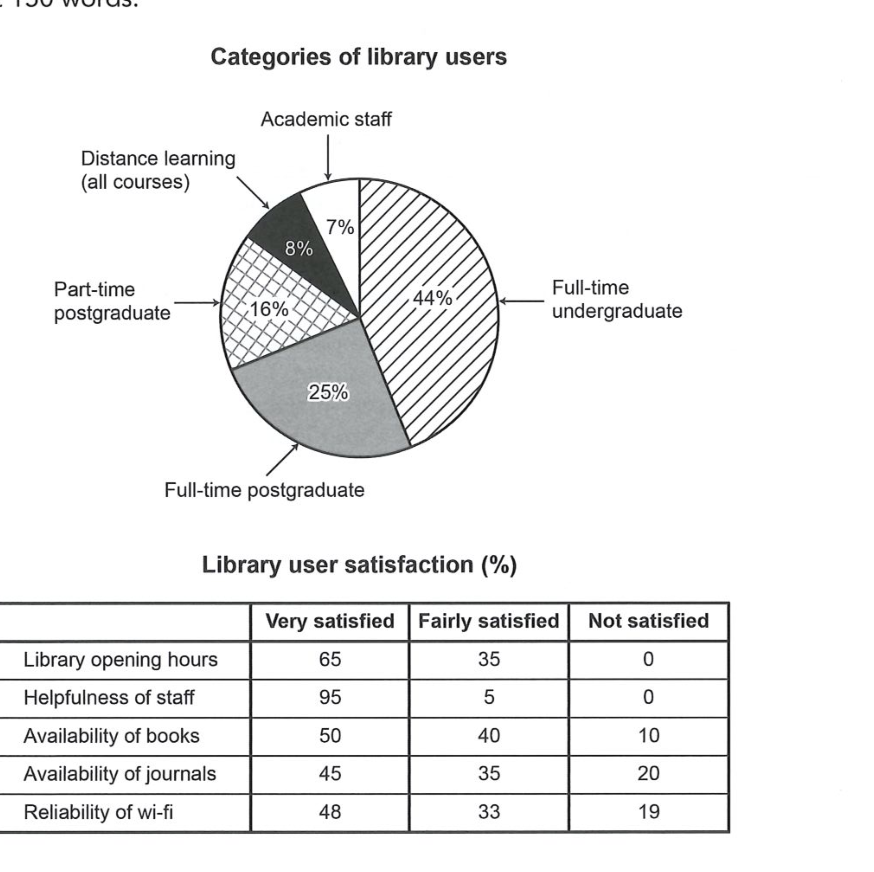
The chart and table below show the results of a survey of library users at a university.
Summarise the information by selecting and reporting the main features, and make comparisons where relevant.
Categories of library users
Student answer (Band 6.5)
The pie chart and table shows the results of a survey of students and academic staffs who use library at a university.
Overall, majority of library users are full-time undergraduate students and a very small number of library users are academic staffs. Most of the library users are very satisfied with the helpfulness of staffs there.
Full-time undergraduate students cover 44% of the total library users and full-time postgraduate students cover 25%. Part-time postgraduate students are 16% and remote students are 8% of the library users. Only 7% of the library users are academic staffs.
More than half of the library users are evry satisfied with the library opening hours (65%) and helpfulness of staffs (95%). Half (50%) of the users are very satisfied with the availability of books. Availability of journals have satisfied 80% of the users, of them, 45% are very satisfied and 35% were fairly satisfied. Finally, 48% of the users are very satisfied with the reliability of wi-fi and 33% are fairly satisfied.
AI examiner evaluation
| Criterion | Band |
|---|---|
| Task Achievement / Task Response | 7.0 |
| Coherence and Cohesion | 7.0 |
| Lexical Resource | 6.0 |
| Grammatical Range and Accuracy | 6.0 |
| Overall | 6.5 |
Task Achievement / Task Response: Band 7.0
The response covers both visuals and gives a clear overview: undergraduates form the largest group, academic staff the smallest, and satisfaction with staff helpfulness is especially high. The user-category figures are accurately reported, and the comparisons for opening hours, books, journals and Wi-Fi are mostly well selected. The statement that 80% are satisfied with journals correctly combines the very and fairly satisfied groups. However, the overview could capture more of the table’s main pattern, such as the high satisfaction with opening hours and the comparatively lower ratings for journals and Wi-Fi. The response also omits the 10% and 20% not-satisfied figures for books and journals, and the 19% for Wi-Fi, so some comparisons are less complete than they could be.
Coherence and Cohesion: Band 7.0
The information is organised clearly into an introduction, an overview and two detail paragraphs. The progression from user categories to satisfaction results is logical, and sequencing expressions such as “Overall,” “Finally” and “of them” help the reader follow the report. The figures are generally grouped sensibly, with the user proportions presented together and the satisfaction categories discussed afterwards. To make the cohesion more flexible and precise, avoid relying on repeated sentence openings such as “Full-time…,” “Part-time…” and “More than half…”. The phrase “of them” also has an unclear reference: it would be clearer to state directly that 45% were very satisfied and 35% fairly satisfied. These are small issues within an otherwise coherent structure.
Lexical Resource: Band 6.0
Vocabulary is adequate for describing the chart and table, and terms such as “availability,” “reliability,” “very satisfied” and “fairly satisfied” are appropriate to the task. The response also uses some useful variation, including “cover” and “remote students.” However, several choices are imprecise or unnatural: “academic staffs” is not the usual plural form, “remote students” does not match the chart’s specific category, and “have satisfied 80% of the users” is an awkward collocation. “Evry” is a spelling error, while repeated use of “library users” and “students” limits flexibility. Aim for accurate category labels and natural reporting phrases, for example “account for,” “were satisfied with,” and “distance-learning students.”
Grammatical Range and Accuracy: Band 6.0
The response uses a mix of simple statements and more developed structures, including “Most of the library users are very satisfied…” and the sentence combining the journal satisfaction figures. Meaning remains clear throughout, but some grammatical errors persist. In the opening, “The pie chart and table shows” has a subject–verb agreement error; the compound subject requires “show.” Articles and plurals also need attention in “use library at a university,” which would be more naturally expressed as “use the library at a university.” In “Availability of journals have satisfied 80%,” the subject–verb relationship is incorrect, and the construction itself is awkward. Check agreement, articles and sentence patterns when describing categories and percentages to improve accuracy while retaining the current range of structures.
See this exact question answered at other band scores. The same prompt compared across bands.
Browse more IELTS Writing model answers or get your own writing scored by the same AI examiner.