Band 6.5 IELTS Writing Task 1 Model Answer
Overall Band Score: 6.5 · Cambridge IELTS 21 · 2026-11-18
IELTS Writing Task 1 question
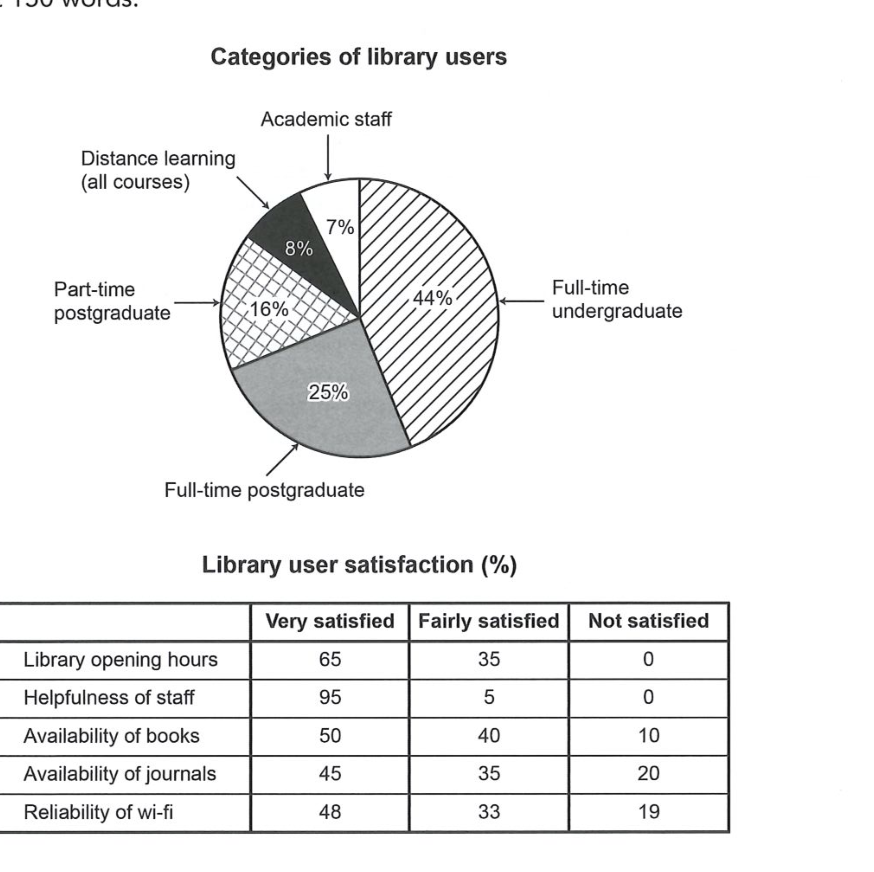
The chart and table below show the results of a survey of library users at a university.
Summarise the information by selecting and reporting the main features, and make comparisons where relevant.
Categories of library users
Student answer (Band 6.5)
The graph shows the outcomes of a survey of the library users at a university.
Overall, full-time undergraduate is the largest number of users, followed by full-time postgraduate. Most of the users are very satisfied by the library facilities, and only a few people are not satisfied.
There are five categories of library users, and full-time undergraduate accounted for the biggest portion of 44%, followed by full-time postgraduate category with the share of 25%. Part-time postgraduate has a average proportion of 16%, whereas, distance learning and academic staff stood at 8% and 7%, respectively.
For the user satisfaction table, helpfulness of staff and library opening hours have more very satisfied users: 95% and 65%, with 5% and 35% of fairly satisfied, respectively, and 0 non-satisfied users at all. Availability of journals has the lowest number of very satisfied users and 20 non-satisfied. Availability of books and reliability has relatively average number of users, from very satisfied to fairly satisfied.
AI examiner evaluation
| Criterion | Band |
|---|---|
| Task Achievement / Task Response | 6.5 |
| Coherence and Cohesion | 6.5 |
| Lexical Resource | 6.5 |
| Grammatical Range and Accuracy | 6.0 |
| Overall | 6.5 |
Task Achievement / Task Response: Band 6.5
You identify the main user group accurately (full-time undergraduates, 44%) and compare it with the next largest group, full-time postgraduates (25%). You also report the smaller categories and highlight the strong satisfaction with staff helpfulness and opening hours, including the absence of dissatisfaction in those two areas. This covers both visuals and gives a relevant overview. However, some features are less fully reported: the overview’s claim that only “a few” users are dissatisfied is too broad, since dissatisfaction reaches 20% for journals and 19% for wi-fi. The final comparison of books and wi-fi is vague, and the table’s figures for these categories are not clearly stated. More precise comparisons across all satisfaction levels would make the summary more complete.
Coherence and Cohesion: Band 6.5
The response has a clear overall arrangement: an introduction, an overview, a paragraph on user categories, and a final paragraph on satisfaction. This logical progression makes the two sets of information easy to follow, and linking phrases such as “Overall,” “followed by,” and “whereas” help signal comparisons. The organisation is effective, though cohesion is not always precise. In the final paragraph, “Availability of books and reliability” does not clearly identify reliability of wi-fi, and “relatively average number of users” makes the comparison difficult to interpret. The satisfaction paragraph also moves from two strong results to journals and then groups the remaining categories without a clear numerical link. Use explicit references to each facility and connect comparisons more directly.
Lexical Resource: Band 6.5
You use an adequate range of task-related vocabulary, including “accounted for,” “share,” “proportion,” “satisfaction,” and “availability.” These choices allow you to describe the chart and table, and the meaning is generally clear. There are also attempts at more formal reporting language, such as “stood at.” Some word choices and collocations are less natural or imprecise, however: “the largest number of users” refers to a category’s share, “satisfied by the library facilities” is awkward, and “average proportion” does not accurately convey that 16% is a middle-sized share. “Non-satisfied” and “reliability” are also imprecise in context. More consistent use of terms such as “proportion,” “dissatisfied,” and “wi-fi reliability” would improve precision and naturalness.
Grammatical Range and Accuracy: Band 6.0
You use a mix of simple and more developed sentence forms, including comparisons with “followed by” and a clause introduced by “whereas.” Most sentences communicate the intended information, and errors rarely prevent understanding. Some grammatical inaccuracies remain. For example, “full-time undergraduate is the largest number” has a singular/plural mismatch in meaning and structure; “Part-time postgraduate has a average proportion” has an article error; and “Availability of books and reliability has” has unclear coordination and agreement. In the final paragraph, the long sentence listing satisfaction figures would be clearer if divided or structured with parallel clauses. Continue practising articles, agreement, and parallel construction while retaining the range of sentence forms you already attempt.
See this exact question answered at other band scores. The same prompt compared across bands.
Browse more IELTS Writing model answers or get your own writing scored by the same AI examiner.