Band 6.0 IELTS Writing Task 1 Model Answer
Overall Band Score: 6.0 · Cambridge IELTS 21 · 2026-11-19
IELTS Writing Task 1 question
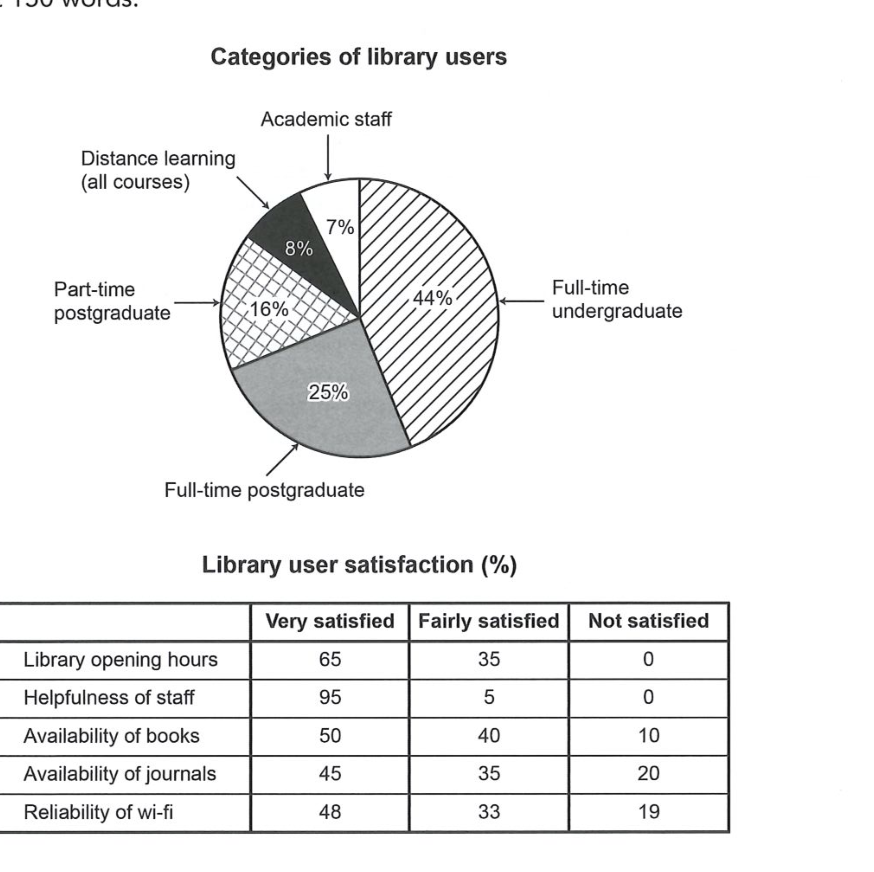
The chart and table below show the results of a survey of library users at a university.
Summarise the information by selecting and reporting the main features, and make comparisons where relevant.
Categories of library users
Student answer (Band 6.0)
The pie chart and a table illustrate the outcomes of a survey carried out among university library users.
Overall, full-time undergraduates are the largest group of library users, the distance learning and academic staff accounts among the lowest. The user satisfication is analyzed by very satisfied, fairly satised and not satisfied.
full-time undergraduates account for about 44% of the library users, which is the highest share, followed by full-time postgraduate, at exactly a quarter. Part-time graduates constitute 16%, while distance learners of all courses represnted 8% and academic staff were the smallest group, at 7%
in terms of satisfication among library users, the helpfulness of was rated the highest with 95% being very satisfied while the remaining 5% were fairly satisfied. Library opening hours also scored well with 65% being very satisfied and 35% fairly satisfied. In contrast, the availability of journals and availibility of wi-fi recieve weaker ratings only 45% and 48% of users are very satisfied, while 20% and 19% rare not satisfed
AI examiner evaluation
| Criterion | Band |
|---|---|
| Task Achievement / Task Response | 6.5 |
| Coherence and Cohesion | 6.5 |
| Lexical Resource | 6.0 |
| Grammatical Range and Accuracy | 5.5 |
| Overall | 6.0 |
Task Achievement / Task Response: Band 6.5
You identify the main user group accurately (44% full-time undergraduates) and compare it with the quarter who are full-time postgraduates and the smaller categories. The overview also recognises that satisfaction is being compared across three ratings, and your discussion correctly highlights staff helpfulness and opening hours as strong areas, with journals and Wi-Fi less positive. This covers the task, but some features are less fully reported: books are omitted, and the satisfaction overview does not clearly summarise the overall pattern. For example, books received 50% very satisfied, while journals had the highest dissatisfaction at 20%. Also, “distance learning and academic staff accounts among the lowest” is imprecise because academic staff are the smallest group. A fuller overview and inclusion of the books result would make the key comparisons more complete.
Coherence and Cohesion: Band 6.5
The response has a recognisable structure: an introduction, an overview, a paragraph on user categories, and a final paragraph on satisfaction. This gives the reader a generally logical route through the two visuals, and phrases such as “Overall,” “followed by,” and “In contrast” help signal relationships. However, progression is not fully controlled. The overview repeats the categories without summarising the main satisfaction pattern, and the final paragraph stops after discussing journals and Wi-Fi rather than completing the comparison across all rows. Several paragraphs also begin with lowercase letters, which weakens the presentation of the sequence. To strengthen cohesion, group the satisfaction results by stronger and weaker ratings, and use clear references such as “these two services” only when the referent is unmistakable.
Lexical Resource: Band 6.0
You use a reasonable range of task-related vocabulary, including “account for,” “constitute,” “share,” “rated,” and “in contrast.” These choices help describe proportions and compare satisfaction levels, and the meaning is generally clear. However, some word choices and collocations are inaccurate or awkward: “the distance learning and academic staff accounts among the lowest” is not a natural construction, and “the helpfulness of was rated” is incomplete. There are also spelling errors in “satisfication,” “satised,” “represnted,” “availibility,” and “recieve.” These slips do not prevent understanding, but they limit precision and control. Check spelling carefully and prefer standard chart language, for example “the smallest groups” and “received weaker ratings.”
Grammatical Range and Accuracy: Band 5.5
You attempt a mix of simple and more developed sentences, including a relative clause in “which is the highest share” and a contrast structure beginning “while.” Most of the intended comparisons remain understandable, but some grammatical errors affect accuracy. For example, “the distance learning and academic staff accounts” has faulty agreement and sentence construction, while “the helpfulness of was rated” is missing a noun after “of.” The final sentence also shifts from past reporting (“rated”) to present forms (“are” and “rare”), and its punctuation makes the comparison difficult to follow. Capitalisation at the starts of paragraphs is inconsistent. Aim to keep the reporting tense consistent and proofread each sentence for complete clauses, agreement, and punctuation.
See this exact question answered at other band scores. The same prompt compared across bands.
Browse more IELTS Writing model answers or get your own writing scored by the same AI examiner.