Band 6.5 IELTS Writing Task 1 Model Answer
Overall Band Score: 6.5 · Cambridge IELTS 21 · 2026-11-21
IELTS Writing Task 1 question
The chart and table below show the results of a survey of library users at a university.
Summarise the information by selecting and reporting the main features, and make comparisons where relevant.
Categories of library users
Student answer (Band 6.5)
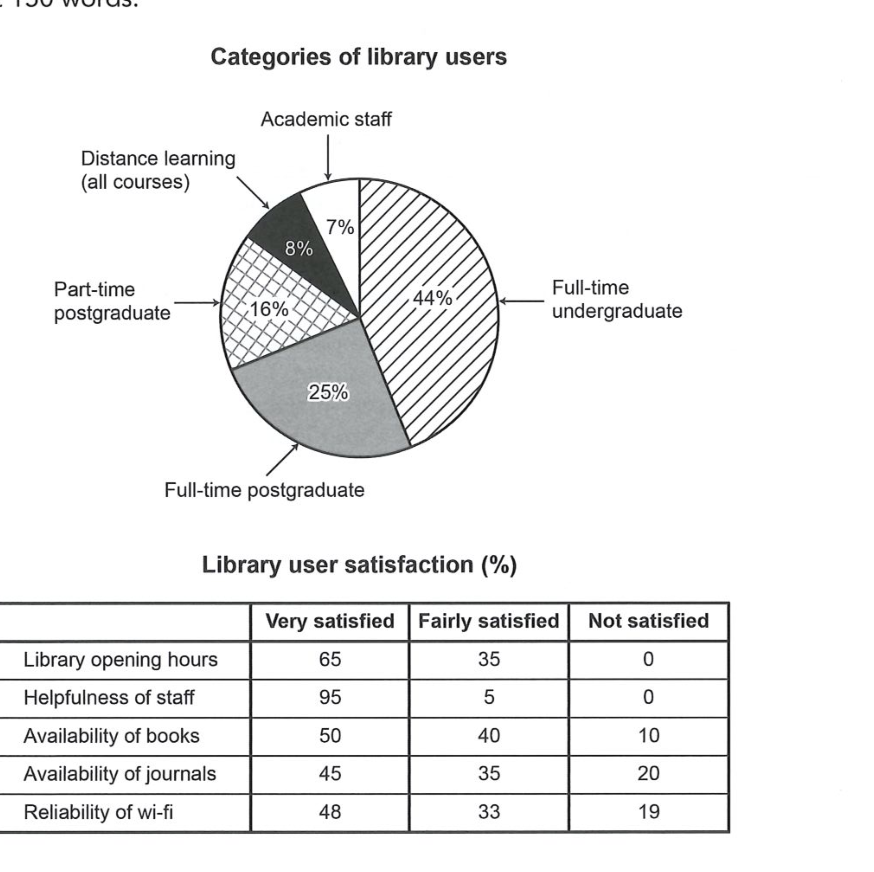
The pie chart illustrates the proportion of five categories of library users and the table provides information about the library user satisfaction.
Overall, full-time undergraduate accounted for the largest proportion of library users, while academic staff represented the smallest share. Meanwhile,majority of the users most satisfied with the helpfulness of staff whereas least satisfied with availabilty of journals.
Regarding categories of library users,full-time undergraduate accounted for the largest share, at 44%, followed by full-time postgraduate representing just 25% of the total. Part-time postgraduate library users shared the figure 16%. While distance learning (all courses) and academic staff represented 8% and 7% respectively.
95% library users very satisfied with the helpfulness of staff, and 65% users satisfied with the opening hours of library. Whereas only 48% users very satisfied with the reliability of wi-fi. On the other hand, 20% users not satisfied with availabilty of journals while 10% users not satisfied with the availability of books.
AI examiner evaluation
| Criterion | Band |
|---|---|
| Task Achievement / Task Response | 7.0 |
| Coherence and Cohesion | 7.0 |
| Lexical Resource | 6.5 |
| Grammatical Range and Accuracy | 5.5 |
| Overall | 6.5 |
Task Achievement / Task Response: Band 7.0
The response identifies the main features accurately: undergraduates form the largest user group (44%), academic staff the smallest (7%), and helpfulness of staff receives the strongest satisfaction rating. It also reports several relevant comparisons, including the figures for opening hours, Wi-Fi, books and journals. This gives the reader a clear overview and addresses both visuals. However, the satisfaction overview is somewhat broad: journals have the highest dissatisfaction (20%), but Wi-Fi is close at 19%, and the response does not compare the full satisfaction patterns across categories. Also, “65% users satisfied” for opening hours is imprecise because 65% were very satisfied, with another 35% fairly satisfied. More precise reporting of these distinctions would strengthen the coverage and support the key comparisons more fully.
Coherence and Cohesion: Band 7.0
The information is organised in a clear sequence: an introduction and overview are followed by a paragraph on user categories and one on satisfaction. This makes the response easy to follow, and linking expressions such as “Overall,” “Regarding,” and “On the other hand” help signal shifts and comparisons. The progression is generally logical, with the two visuals treated separately. Some connections are less smooth, however: “While distance learning … and academic staff represented…” is a fragment rather than a complete sentence, and “Whereas only 48%…” is also left without a main clause. A few transitions, including “On the other hand,” suggest contrast where a more direct comparison would be clearer. Joining these clauses and varying transitions more precisely would make cohesion more controlled.
Lexical Resource: Band 6.5
There is an adequate range of task-appropriate vocabulary, including “proportion,” “largest share,” “represented,” “satisfied,” and “reliability.” The writer also varies some descriptions of the figures rather than relying entirely on “was.” Meaning remains clear throughout. At this level, however, some word choices and collocations are imprecise: “shared the figure 16%” is not natural, and “users most satisfied” does not express the intended idea idiomatically. “Availabilty” is misspelled twice, and “majority” would normally need an article in this context. Greater accuracy with common reporting phrases, alongside careful proofreading of spelling, would make the vocabulary more flexible and precise.
Grammatical Range and Accuracy: Band 5.5
The response attempts a mix of simple and more complex forms, including the overview contrast beginning “while” and the comparison introduced by “whereas.” The main information is usually understandable, but grammatical control is uneven, and several sentences are not complete or lack necessary verb forms. For example, “majority of the users most satisfied” needs a subject construction and a verb, while “95% library users very satisfied” also omits the verb “were.” The clauses beginning “While distance learning…” and “Whereas only 48%…” are fragments. There are also missing articles and inconsistent spacing after punctuation. Focus on complete clauses, accurate subject–verb structures, and articles; then proofread punctuation and sentence boundaries.
See this exact question answered at other band scores. The same prompt compared across bands.
Browse more IELTS Writing model answers or get your own writing scored by the same AI examiner.