Band 5.5 IELTS Writing Task 1 Model Answer
Overall Band Score: 5.5 · Cambridge IELTS 21 · 2026-11-23
IELTS Writing Task 1 question
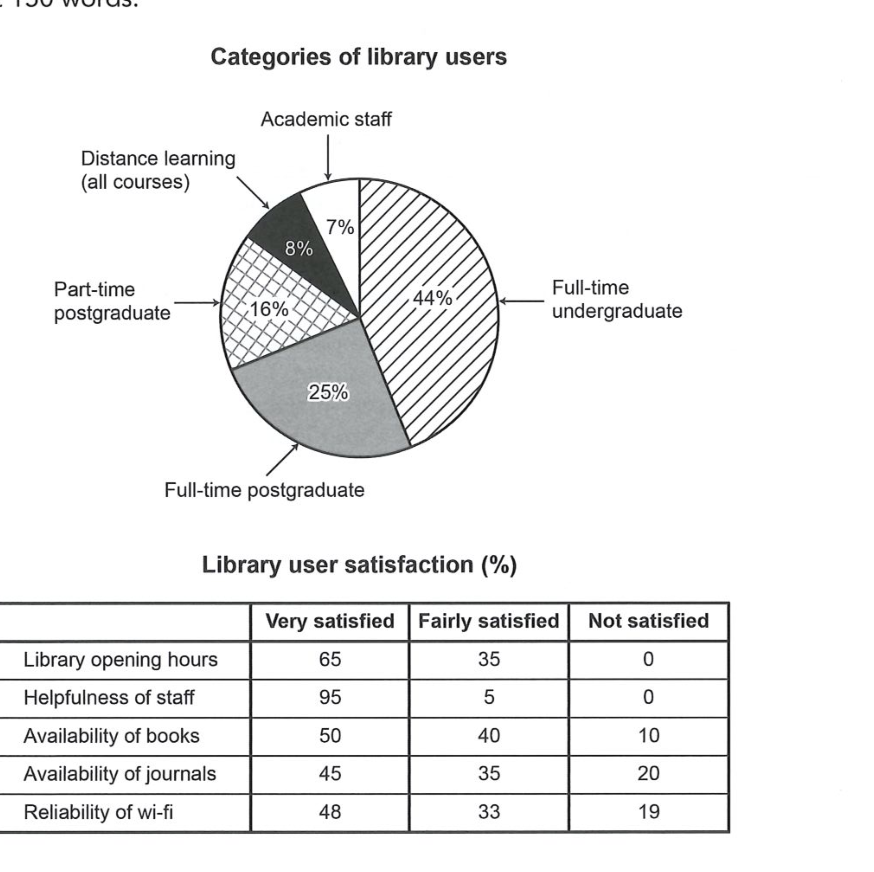
The chart and table below show the results of a survey of library users at a university.
Summarise the information by selecting and reporting the main features, and make comparisons where relevant.
Categories of library users
Student answer (Band 5.5)
The pie chart and and the table illustrates the data extracted from a survey of university students who visit library.
Overall, full-time undergraduate are the largest category of library users by far and the academic staff are the smallest section. It's clear that most of the library users are satisfied with the different services of the library while a small group of people are not satisfied.
44% of library users are full-time undergraduate as the biggest category, then full-time post-graduate comes with 25%. While part-time postgraduate get the 3rd place with 16% of users, the smallest category of users are 8% distance learning and 7% academic staff.
Most of library users are satisfied with the opening ours and the helpfulness of stuff as well. However, even though most of the users have no issues with the availability of journals and the reliability of the wifi, 20 users and 19 users are not satisfied, respectively.
AI examiner evaluation
| Criterion | Band |
|---|---|
| Task Achievement / Task Response | 5.0 |
| Coherence and Cohesion | 6.0 |
| Lexical Resource | 5.5 |
| Grammatical Range and Accuracy | 5.5 |
| Overall | 5.5 |
Task Achievement / Task Response: Band 5.0
You identify the main user groups and give a useful overview that undergraduates form the largest group, while academic staff are the smallest. The satisfaction overview also captures the generally positive picture. However, the report only partially covers the table: it gives no figures for the strongest result, staff helpfulness (95% very satisfied), or for books, and it describes opening hours and helpfulness without reporting their percentages. The statement that “20 users and 19 users” are dissatisfied misreads percentages as counts; these are 20% for journals and 19% for Wi-Fi. More precise comparisons across all five services, especially the high satisfaction with staff and the lower ratings for journals, would make the key features clearer and better supported.
Coherence and Cohesion: Band 6.0
The response has a coherent overall arrangement: an introduction and overview are followed by a paragraph on user categories and one on satisfaction. This makes the two parts of the visual easy to follow, and linking phrases such as “Overall,” “then,” and “However” help signal relationships. Cohesion is sometimes less controlled, though. The final paragraph groups opening hours and staff helpfulness, then shifts to journals and Wi-Fi without giving a clear, systematic comparison of the services. “While” at the start of the category comparison also leaves the relationship between the clauses awkward. To strengthen progression, organise the table details from highest satisfaction to lower satisfaction and use clear references to each service.
Lexical Resource: Band 5.5
You use relevant vocabulary for describing proportions and comparisons, including “largest category,” “smallest,” “satisfied,” and “availability.” These choices make the general meaning understandable. However, some word choices and collocations are inaccurate or informal for an academic report: “get the 3rd place,” “no issues,” and “a small group of people” are less precise than language describing survey responses. “20 users and 19 users” also confuses percentages with people, while “opening ours” and “stuff” are spelling or word-choice errors that reduce precision. Aim for consistent terms such as “respondents,” “proportion,” and “very satisfied,” and use the exact service labels from the table where possible.
Grammatical Range and Accuracy: Band 5.5
You attempt both simple and more complex sentence forms, including the contrast in “even though most of the users have no issues…”. The main ideas remain understandable, but errors in agreement, articles, and sentence construction are noticeable. For example, “The pie chart and and the table illustrates” has a repeated conjunction and a plural subject with a singular verb; “full-time undergraduate are” also needs plural agreement. “Survey of university students who visit library” is missing an article and does not match the full range of library users shown. The sentence beginning “While part-time postgraduate…” is a fragment, and “the smallest category of users are” has a subject–verb mismatch. Check agreement and articles, and avoid starting a sentence with a dependent clause unless it is joined to a main clause.
See this exact question answered at other band scores. The same prompt compared across bands.
Browse more IELTS Writing model answers or get your own writing scored by the same AI examiner.