Band 6.5 IELTS Writing Task 1 Model Answer
Overall Band Score: 6.5 · Cambridge IELTS 21 · 2026-11-23
IELTS Writing Task 1 question
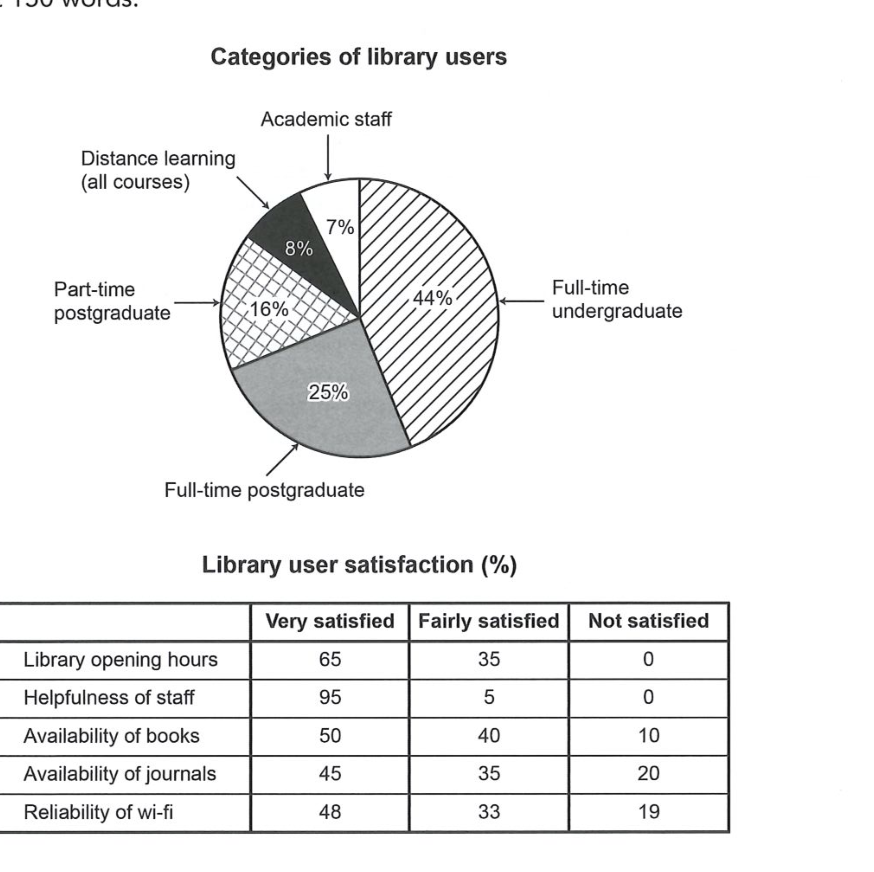
The chart and table below show the results of a survey of library users at a university.
Summarise the information by selecting and reporting the main features, and make comparisons where relevant.
Categories of library users
Student answer (Band 6.5)
The provided pie chart and table illustrate the result of a questionare about library users at a university. Overall, it is obvious that the most category of library users is the full- time users, while the lowest proportion is the academic staff, and the most satisfied service was the helpfulness of staff.
Firstly, the full-time undergraduate users represent 44% of total users, and the full-time postgraduate users accounted for quarter of total users, the part-time postgraduate proportion was 16%, and the distance learning (all courses) users were 8%, while the academic staff represent the least proportion of the library users by only 7%.
According the survey, the user satisfaction has a great variation, as 65% of users were very satisfied to library opening hours and 35% were fairly satisfied to it, all users were almost very satisfied to helpfulness of staff. Regarding the availability of books, half of users were very satisfied to it and 40% were fairly satisfied, about half of users were also very satisfied to availability of journals. However, 20% of them were not satisfied. Finally, around half of users were very satisfied to the reliability of wi-fi, and 33% of them were fairy satisfied, while 19% of users were not satisfied.
AI examiner evaluation
| Criterion | Band |
|---|---|
| Task Achievement / Task Response | 7.0 |
| Coherence and Cohesion | 7.0 |
| Lexical Resource | 6.0 |
| Grammatical Range and Accuracy | 6.0 |
| Overall | 6.5 |
Task Achievement / Task Response: Band 7.0
The response covers both the user categories and satisfaction results, and its overview identifies the largest and smallest user groups as well as the strongest-rated service. Most figures are reported accurately: undergraduates are 44%, academic staff 7%, and staff helpfulness receives 95% very satisfied and 5% fairly satisfied. The account also selects useful contrasts, including the 20% dissatisfied with journals and the 19% dissatisfied with wi-fi. However, “full-time users” in the overview is imprecise because the chart distinguishes full-time undergraduates and postgraduates, and “all users were almost very satisfied” is less exact than reporting the 95% figure. A clearer overview of the broader satisfaction pattern would make the key features more fully developed.
Coherence and Cohesion: Band 7.0
The response is organised in a clear sequence: an introduction and overview are followed by a paragraph on user categories and one on satisfaction. This gives the reader a logical route through the two visuals, and linking expressions such as “Firstly,” “Regarding,” “However,” and “Finally” help signal shifts between points. The progression within the satisfaction paragraph is also easy to follow. To make cohesion more flexible, avoid relying on a list-like sequence of service categories and connect comparisons more explicitly—for example, contrast the high ratings for staff and opening hours with the more mixed views of books, journals, and wi-fi. Some references such as “it” are repeated and could be made more precise by naming the service again.
Lexical Resource: Band 6.0
The vocabulary is adequate for describing the visuals, with useful terms such as “proportion,” “accounted for,” “availability,” and “reliability.” The response also uses relevant satisfaction language to distinguish “very satisfied,” “fairly satisfied,” and “not satisfied.” However, several word-choice and collocation problems reduce precision: “the most category” is not idiomatic, “satisfied to” should be expressed differently, and “fairy satisfied” appears to be a spelling error for “fairly satisfied.” “Full-time users” is also too broad for the two separate full-time groups shown. Aim for accurate, natural collocations and check spelling carefully; this will make the otherwise clear descriptions more precise.
Grammatical Range and Accuracy: Band 6.0
There is a mix of simple and more complex sentence forms, including clauses linked with “while” and “as,” and the main information remains understandable. Some grammatical errors are present, particularly in articles, sentence construction, and prepositions. For example, “the most category of library users” has an incorrect superlative construction, while “accounted for quarter of total users” needs articles. The sentence beginning “Firstly” joins several independent points with commas, making it a run-on; divide it or use clearer clause structure. In “According the survey,” the preposition is missing, and “satisfied to library opening hours” uses an incorrect grammatical pattern. Revising these recurring structures would improve accuracy while preserving the range of sentences attempted.
See this exact question answered at other band scores. The same prompt compared across bands.
Browse more IELTS Writing model answers or get your own writing scored by the same AI examiner.