Band 6.0 IELTS Writing Task 1 Model Answer
Overall Band Score: 6.0 · Cambridge IELTS 21 · 2026-11-24
IELTS Writing Task 1 question
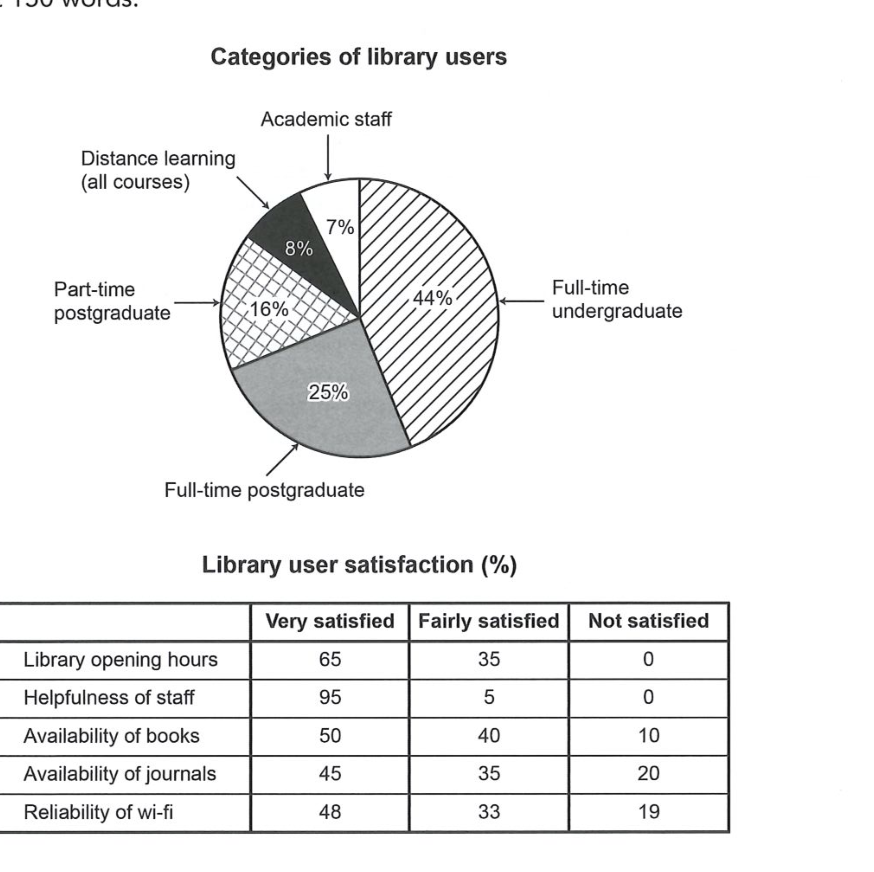
The chart and table below show the results of a survey of library users at a university.
Summarise the information by selecting and reporting the main features, and make comparisons where relevant.
Categories of library users
Student answer (Band 6.0)
The chart presents the division of 5 categories of library students and table compares the three user satisfaction criteria with 5 functions of library . The data is given in percentage.
Overall, library has mostly full-time undergraduate users while academic staff users are the least. Moreover, most people are satisfied with library functions and only a minimum people are not satisfied.
Most users are full-time undergraduate who cover almost half of the chart ,44%, while academic staff users are the least ,7% only. Full-time postgraduate users also covers a considerable area in chart that is 25% whereas part-time postgraduate makes up only 16% of users.
In the table, most functionalities of library comes up in very satisfied category with helpfulness of staff ranking as 95% while availability of journals got only 45% ranking in this very satisfies category. Meanwhile , in fairly satisfied category people are more satisfied with availability of books ranking it 40% whereas helpfulness of staff is ranked lowest that is 5%. Very few people voted for not satisfied only covering 10 to 20 %.
AI examiner evaluation
| Criterion | Band |
|---|---|
| Task Achievement / Task Response | 6.5 |
| Coherence and Cohesion | 6.5 |
| Lexical Resource | 6.0 |
| Grammatical Range and Accuracy | 5.5 |
| Overall | 6.0 |
Task Achievement / Task Response: Band 6.5
You identify the main user group and the smallest group accurately, and your overview also captures the generally positive satisfaction results. The figures for the user categories are reported correctly, and you make useful comparisons between staff helpfulness and journal availability. However, the satisfaction table is not fully summarised: the statement that dissatisfaction is “only covering 10 to 20%” overlooks the two categories with 0% dissatisfied, and it does not identify journals as having the highest dissatisfaction (20%). The overview’s claim that “most people are satisfied” would be stronger if supported by the consistently high combined satisfied proportions. To move further, select the most notable contrasts across all five functions and report them precisely rather than relying on a broad final generalisation.
Coherence and Cohesion: Band 6.5
The response has a clear overall arrangement: an introduction, a brief overview, a paragraph on user categories and a final paragraph on satisfaction. This makes the two visuals easy to distinguish, and linking expressions such as “Overall,” “Moreover” and “Meanwhile” help signal relationships. The progression is generally logical, but the final paragraph moves between satisfaction categories without a fully systematic comparison, and “Very few people voted for not satisfied” is not clearly connected to the specific rows or figures. Some transitions also feel mechanical, particularly the repeated use of “while” to contrast figures. Grouping the satisfaction results by notable patterns—for example, staff helpfulness and opening hours versus books, journals and wi-fi—would make the comparisons more cohesive and the paragraph’s progression clearer.
Lexical Resource: Band 6.0
You use a reasonable range of task-related vocabulary, including “division,” “considerable,” “ranking” and “availability,” and the meaning is generally clear. There are, however, several imprecise or unnatural choices that limit flexibility. “Library students” is not an accurate label for all the groups, since academic staff and distance learners are included; “library users” is more suitable. “Functions” and “functionalities” are also awkward for the listed features, while “very satisfies category” is an inaccurate form. Phrases such as “cover almost half of the chart” and “got only 45% ranking” are understandable but not natural ways to describe proportions. Aim for precise reporting verbs and collocations, such as “accounted for,” “recorded” and “were satisfied with,” while keeping the language concise.
Grammatical Range and Accuracy: Band 5.5
You attempt a mix of simple and more complex sentence forms, and most sentences communicate the intended comparisons. Some grammatical errors remain, especially with articles, agreement and sentence construction. For example, “table compares” needs an article, and “Full-time postgraduate users also covers” has a subject–verb agreement error. In “most functionalities of library comes up,” both the plural subject and the article pattern need attention. The sentence “Very few people voted for not satisfied only covering 10 to 20%” is also awkwardly constructed, making the relationship between the figures and the satisfaction category less clear. Check singular and plural subjects carefully, use articles consistently, and build comparisons in complete clauses. Greater control of these patterns would make your otherwise understandable reporting more accurate.
See this exact question answered at other band scores. The same prompt compared across bands.
Browse more IELTS Writing model answers or get your own writing scored by the same AI examiner.