Band 6.0 IELTS Writing Task 1 Model Answer
Overall Band Score: 6.0 · Cambridge IELTS 21 · 2026-11-24
IELTS Writing Task 1 question
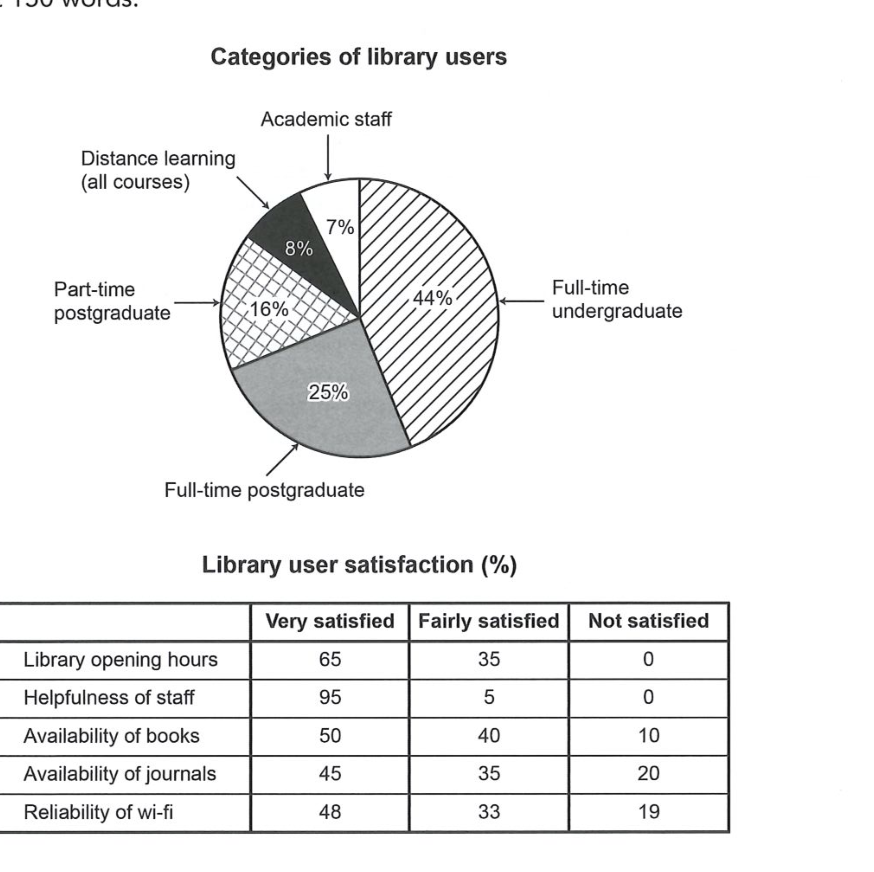
The chart and table below show the results of a survey of library users at a university.
Summarise the information by selecting and reporting the main features, and make comparisons where relevant.
Categories of library users
Student answer (Band 6.0)
the pie chart illustrates use of library by different categories students and the table gives information about survey which condocted for checking the satisfaction ratio of the people who use library.
Overall, it is clearly evident that full time undergraduate is the domineting category, while list users of library are academic staff. However, largest number of people are very setisfied with staff nature. Where as, availability of journals is the most unliked part by students.
Full-time undergraduates are the largest group who use library 44%. Moreover, the fourth portion is used by full-time postgraduate students. Following to that, 16% of part-time postgraduates use library. In contrast, two groups distance learners and academic staffs are smaller than the other, they covere 8% and 7% respectively.
In terms of survay, the largest number of people very satisfied with helpfulness of staff 95% rest of them are fairly setisfied. For library opning hours 65% people are very satisfied, while 35% are fairly satisfied. Among all availability of journals and reliability of wifi are categories from which fifth part people are not satisfied. half peopel are very satisfied with availability of books, other 40% are fairly satisfied and 10% are not satisfied.
AI examiner evaluation
| Criterion | Band |
|---|---|
| Task Achievement / Task Response | 6.5 |
| Coherence and Cohesion | 6.5 |
| Lexical Resource | 5.5 |
| Grammatical Range and Accuracy | 5.0 |
| Overall | 6.0 |
Task Achievement / Task Response: Band 6.5
You cover both visuals and identify the main user group correctly: full-time undergraduates account for 44%, while academic staff are the smallest group at 7%. The overview also highlights the high satisfaction with staff helpfulness and the comparatively poor ratings for journals. Most figures you report are accurate, including the user-category shares and the opening-hours and book-satisfaction results. However, the overview’s claim that journals are the “most unliked” aspect is too broad: journals have the highest dissatisfaction at 20%, but wi-fi is close at 19%, and the response does not report the 48% very satisfied with wi-fi. The satisfaction discussion also omits the journal figures and gives limited comparison across all five aspects. More precise coverage of these less-developed details would strengthen the summary.
Coherence and Cohesion: Band 6.5
The response has a clear overall arrangement: an introduction, an overview, a paragraph on user categories and a paragraph on satisfaction. This makes the two visuals easy to distinguish, and sequencing phrases such as “In contrast” and “In terms of” help signal shifts. The main progression is generally logical, but some links are mechanical or unclear. For example, “Moreover, the fourth portion” does not clearly explain the ranking, and “Among all” does not smoothly introduce the comparison of journals and wi-fi. The final paragraph also moves from staff and opening hours to journals and wi-fi, then back to books, which weakens the comparison. Grouping the satisfaction results by high and lower dissatisfaction, with clearer linking, would make the progression more controlled.
Lexical Resource: Band 5.5
You use some relevant task vocabulary, including “categories,” “satisfaction,” “availability,” and “reliability,” and you attempt more descriptive terms such as “domineting” and “unliked.” However, spelling errors are noticeable throughout, including “condocted,” “setisfied,” “survay,” and “peopel,” which detract from accuracy. Several expressions are also unnatural or imprecise: “the fourth portion is used by” does not clearly describe the postgraduate share, while “staff nature” is not an appropriate way to refer to staff helpfulness. Repetition of “people” and “satisfied” limits flexibility. Aim for accurate collocations and precise chart language, such as “accounted for,” “respondents,” and “rated the service positively.”
Grammatical Range and Accuracy: Band 5.0
You attempt a mixture of simple and more complex sentences, including a contrast with “while” and a relative clause in “the largest group who use library.” However, control is uneven, and several sentence patterns contain errors or missing grammatical elements. For example, “the pie chart illustrates use of library” needs articles, and “the largest number of people very satisfied” is missing a verb. In “the largest group who use library 44%,” the percentage is not connected to the clause with a suitable verb or preposition. Some sentence boundaries and punctuation also need attention, particularly in the final paragraph, where several figures are joined in a run-on sequence. Practise complete clauses and accurate article, verb and agreement patterns while retaining your attempts at complex sentences.
See this exact question answered at other band scores. The same prompt compared across bands.
Browse more IELTS Writing model answers or get your own writing scored by the same AI examiner.