Band 5.0 IELTS Writing Task 1 Model Answer
Overall Band Score: 5.0 · Cambridge IELTS 21 · 2026-11-24
IELTS Writing Task 1 question
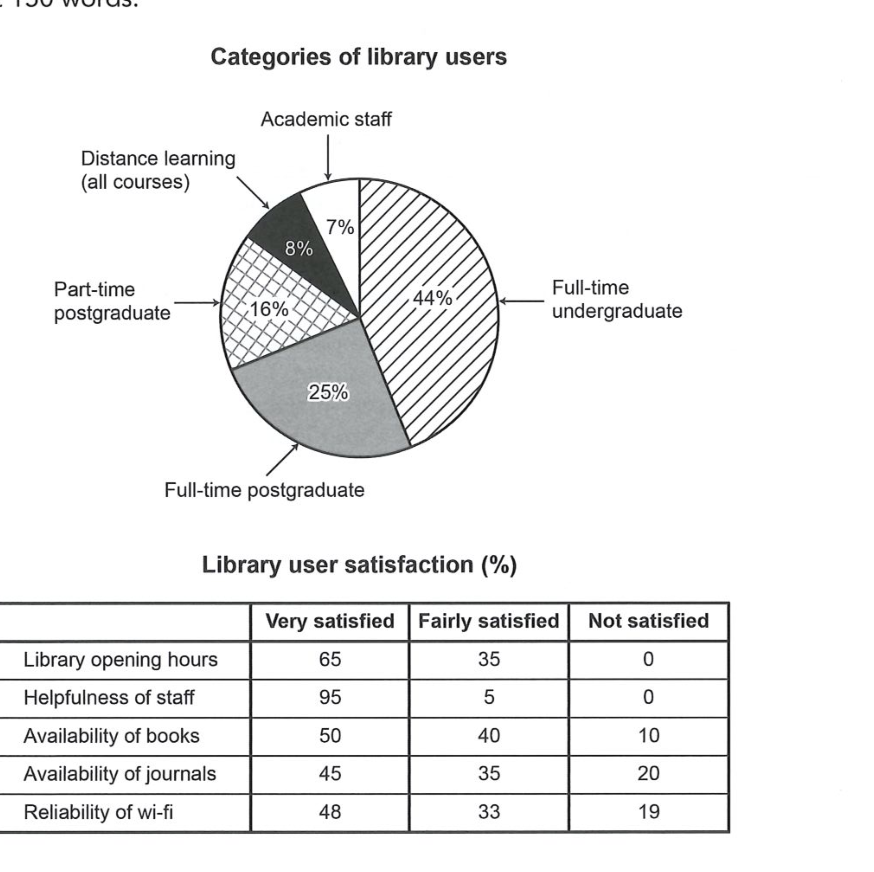
The chart and table below show the results of a survey of library users at a university.
Summarise the information by selecting and reporting the main features, and make comparisons where relevant.
Categories of library users
Student answer (Band 5.0)
The provided table and charts illustrate the percentages of different types of library users, while the table compares their satisfaction levels with five different library services.
Overall, full-time undergraduate students made up the largest proportion of library users, whereas the smallest group consisted of part-time undergraduate students. In terms of satisfaction, the helpfullness of stuff received the highest level of satisfaction, while the availability of journals and reliability of Wi-Fi received comparatively lower ratings.
Firstly, looking at the pie chart, full-time undergraduate 44%. However, full-time postgraduate accounted for 25%. followed by part-time postgraduate around 16% and distance learnind for all courses 6% and lasting academic staff 7% students users library.
Secondly, looking at the table and students user satisfaction proporation and they shows the p
AI examiner evaluation
| Criterion | Band |
|---|---|
| Task Achievement / Task Response | 4.5 |
| Coherence and Cohesion | 4.5 |
| Lexical Resource | 5.5 |
| Grammatical Range and Accuracy | 5.0 |
| Overall | 5.0 |
Task Achievement / Task Response: Band 4.5
You identify the largest user group correctly (full-time undergraduates, 44%) and note that staff satisfaction is highest. However, the overview incorrectly calls part-time undergraduates the smallest group; the chart shows academic staff at 7%, while distance learners are 8%. You also report distance learners as 6%, rather than 8%. Most importantly, the response stops before describing the satisfaction figures, so several key comparisons are missing, including the 95% very satisfied with staff and the lower ratings for journals and Wi-Fi. The response is also 25 words below the required minimum. To improve, complete the summary with accurate figures and a clear overview of both visuals, then support the main comparisons with selected data.
Coherence and Cohesion: Band 4.5
There is an attempt to organise the response with an introduction, an overview, and sequencing phrases such as “Firstly” and “Secondly.” This gives the reader some indication of the intended structure. However, the progression breaks down: the first body paragraph contains incomplete and disconnected statements, and the second ends abruptly at “they shows the p,” leaving the table discussion unfinished. The link between the overview and the details is therefore weak, and the final section provides no usable comparison. Use one paragraph for user categories and another for satisfaction, with complete sentences in each. Ensure that each paragraph develops a clear point and that the response has a finished ending.
Lexical Resource: Band 5.5
You use some relevant task vocabulary, including “percentages,” “proportion,” “satisfaction levels,” and “availability,” which helps establish the topic. There are also attempts at more specific terms such as “full-time postgraduate” and “distance learning.” However, spelling and word-choice errors are noticeable: “helpfullness,” “stuff,” “learnind,” and “proporation” reduce accuracy, while “students users library” is difficult to interpret. “Part-time undergraduate” is also an inaccurate label for the chart category, which is part-time postgraduate. Aim for accurate, consistent labels and natural collocations, such as “library users” and “staff helpfulness.” Proofreading spelling and checking category names against the visual would make your vocabulary clearer and more precise.
Grammatical Range and Accuracy: Band 5.0
The response includes a few basic sentence patterns, including a clear introductory sentence and the comparison “whereas the smallest group consisted of…”. However, grammatical control is uneven, and several statements are fragments rather than complete sentences: “full-time undergraduate 44%” and “followed by part-time postgraduate around 16%.” The sentence beginning “Secondly” also lacks a complete grammatical structure and ends mid-clause. There are problems with sentence boundaries and punctuation, for example the full stop after “25%” separates it from “followed by” without creating a complete sentence. Practise writing complete subject–verb sentences for each comparison, and check that every sentence has a clear main clause and appropriate punctuation.
See this exact question answered at other band scores. The same prompt compared across bands.
Browse more IELTS Writing model answers or get your own writing scored by the same AI examiner.