Band 6.0 IELTS Writing Task 1 Model Answer
Overall Band Score: 6.0 · Cambridge IELTS 21 · 2026-11-26
IELTS Writing Task 1 question
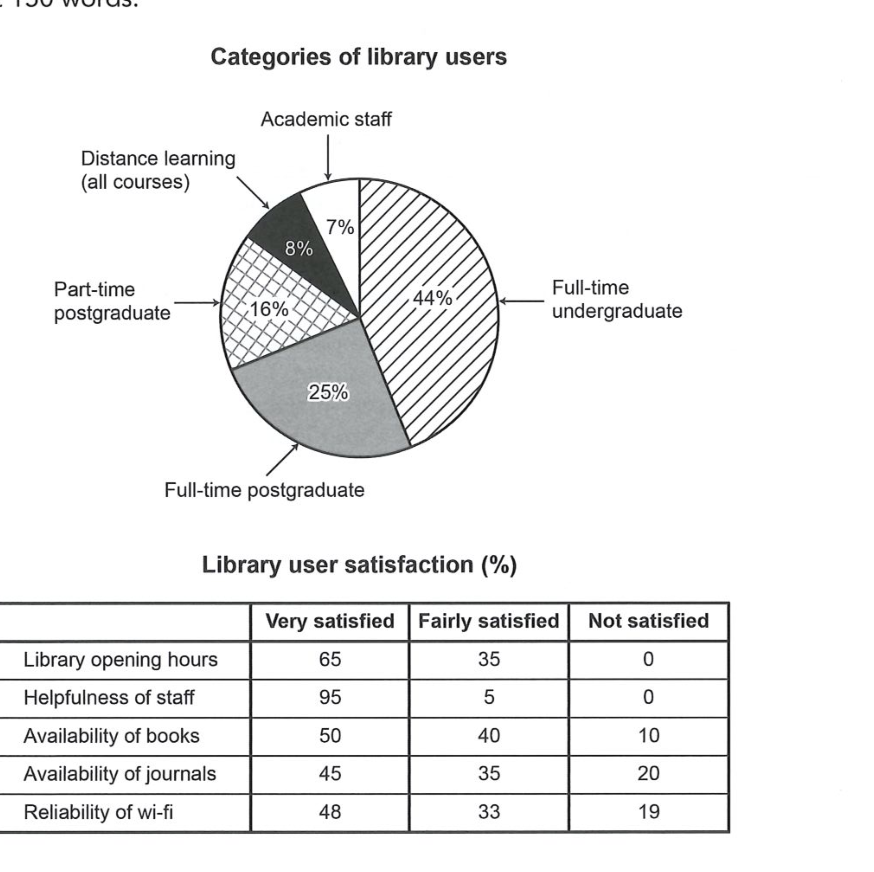
The chart and table below show the results of a survey of library users at a university.
Summarise the information by selecting and reporting the main features, and make comparisons where relevant.
Categories of library users
Student answer (Band 6.0)
The pie chart and table illustrate the data regarding the library users of a university. Information is divided into five categories in piechart and the table shows the level of satisfaction among the users related to the services of the library.
Overall, the majority of the people who attended library were consisted of full-time undergraduate (44 %) while the proportions of distance learning users and academic staff were alomost same with lowest numbers (8% and 7%).
The table shows that mostly users showed highest satisfaction about the staff but they were not satisfied about the journals available in the library.
The part and full time postgraduates showed moderate range of library usage 16% and 25% respectively. Regarding the facilities available, people were more satisfied with library opening hours.On the other hand, greater proportion of dissatisfaction was shown in availability of books, journals and wi-fi. In addition, less number of people were fairly satisfied regarding the staff helpfulness.
AI examiner evaluation
| Criterion | Band |
|---|---|
| Task Achievement / Task Response | 6.0 |
| Coherence and Cohesion | 6.0 |
| Lexical Resource | 6.0 |
| Grammatical Range and Accuracy | 6.0 |
| Overall | 6.0 |
Task Achievement / Task Response: Band 6.0
You identify the main user group accurately: full-time undergraduates account for 44%, while distance learners and academic staff are the smallest groups at 8% and 7%. You also capture the broad satisfaction pattern, noting strong approval of staff and greater dissatisfaction with journals. However, some comparisons are imprecise: the highest dissatisfaction is for journals (20%), not books, and wi-fi dissatisfaction is 19%; books are lower at 10%. The overview could also report that staff helpfulness has 95% very satisfied and no dissatisfied users, while opening hours have 65% very satisfied and no dissatisfaction. The response addresses both visuals, but several key figures and contrasts are underdeveloped or unclear.
Coherence and Cohesion: Band 6.0
The response has a recognisable structure: an introduction, an overview, and further details about user categories and satisfaction. This gives the reader a coherent overall route through the two visuals. Linking phrases such as “Overall,” “Regarding the facilities,” and “On the other hand” help signal shifts in focus. However, the information is not always grouped in the clearest order: the final paragraph moves from postgraduate proportions to facilities, then to dissatisfaction and staff satisfaction. The contrast introduced by “On the other hand” is also not fully precise, since the preceding point concerns opening hours rather than a directly opposing trend. Grouping the user categories together and then comparing satisfaction results would make progression clearer.
Lexical Resource: Band 6.0
You use an adequate range of task-related vocabulary, including “proportions,” “satisfaction,” “availability,” and “dissatisfaction,” and the meaning is generally clear. There are also attempts at more formal reporting language, such as “illustrate” and “regarding.” Some word choices and collocations are inaccurate or unnatural, however: “people who attended library were consisted of” and “moderate range of library usage” do not express the intended comparisons naturally. “The part and full time postgraduates” is also imprecise, and “less number” is not idiomatic. Spelling slips such as “alomost” and the joined form “piechart” reduce accuracy. More precise chart language, such as “accounted for” and “the proportion of users,” would improve control.
Grammatical Range and Accuracy: Band 6.0
You use a mix of simple and more complex sentence forms, including clauses introduced by “while” and “but,” and most of the message remains understandable. Some grammatical errors persist in sentence construction and agreement. For example, “the majority … were consisted of” uses an incorrect passive form, while “the proportions … were almost same” needs an article and a more suitable construction. In “people were more satisfied with library opening hours,” the article is missing, and “availability of books, journals and wi-fi” would be clearer with consistent article use. Punctuation is also uneven, particularly the missing space after “hours.” On the positive side, these issues rarely prevent the reader from understanding the comparisons.
See this exact question answered at other band scores. The same prompt compared across bands.
Browse more IELTS Writing model answers or get your own writing scored by the same AI examiner.