Band 5.5 IELTS Writing Task 1 Model Answer
Overall Band Score: 5.5 · Cambridge IELTS 21 · 2026-11-26
IELTS Writing Task 1 question
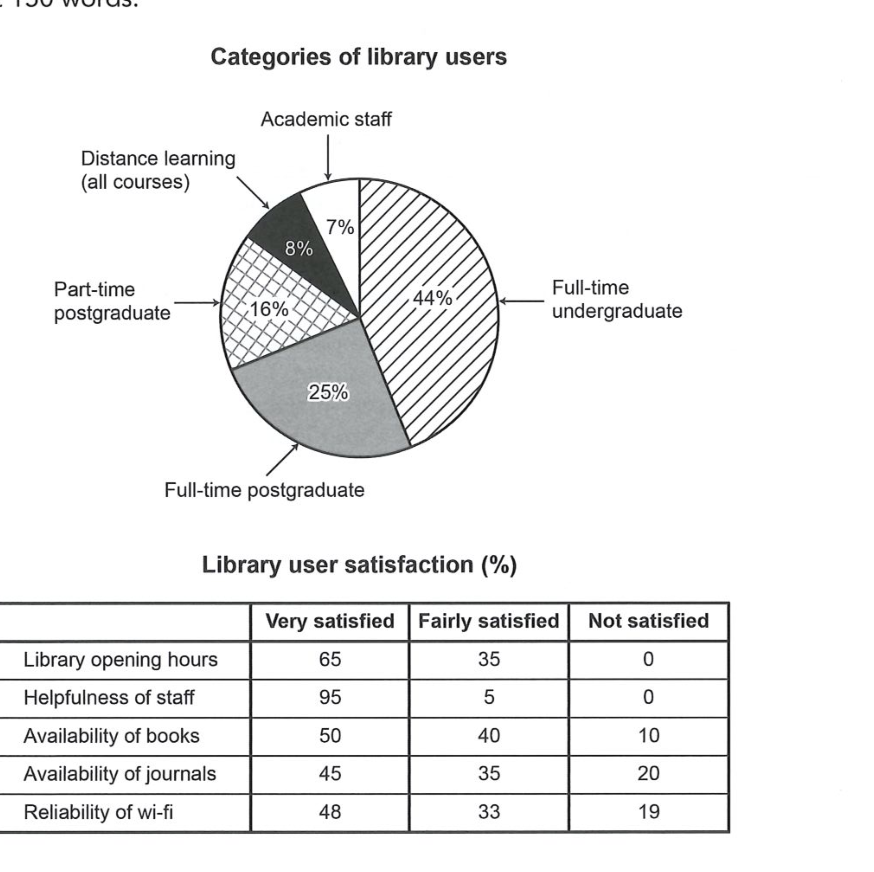
The chart and table below show the results of a survey of library users at a university.
Summarise the information by selecting and reporting the main features, and make comparisons where relevant.
Categories of library users
Student answer (Band 5.5)
First we talk about the chart. It shows different categories of library users. According to this, 44% of total library users are full time undergraduate, 25% users are full time post graduate, 16% are part-time postgraduate, 8% of users are distance learning and 7% are academic staff.
Now we disscus about how satisfied students are with library. There are 65% students who are completely satisfied with library opening hours, 35% users are fairly satisfied. But there is no user who is not satisfied. when we talk about helping nature of staff, almost 95% of users are very happy about it , only 5% of users are fairly satisfief and 0% is unsatisfied. About 50% of students are very satisfied with availability of books,40% are fairly satisfied and only 10% are unsatisfied. To availability of journals, 45% users are satisfied ,35% are fairly satisfied and 20% are not satisfied. 48% of students are very satisfied with reliability of wifi, 33% are faily satisfied and 19% are not satisfied .
AI examiner evaluation
| Criterion | Band |
|---|---|
| Task Achievement / Task Response | 5.0 |
| Coherence and Cohesion | 6.0 |
| Lexical Resource | 5.5 |
| Grammatical Range and Accuracy | 5.5 |
| Overall | 5.5 |
Task Achievement / Task Response: Band 5.0
You report the main user categories accurately, including the largest group, full-time undergraduates (44%), and the smallest, academic staff (7%). You also include figures for all five satisfaction areas, so the response is relevant and covers much of the data. However, the task is only partly fulfilled because there is no clear overview identifying the main patterns across the table. Some comparisons are also imprecise: for journals, “45% users are satisfied” does not distinguish very satisfied from fairly satisfied, although the chart gives 45% and 35% respectively. The response mainly lists figures rather than selecting and summarising the most significant contrasts. Add an overview noting, for example, that staff helpfulness received the strongest satisfaction and that journals had the highest dissatisfaction.
Coherence and Cohesion: Band 6.0
The response has a generally understandable sequence: it first describes the user categories and then moves to satisfaction, with the transition “Now we discuss” signalling the change in focus. The figures are presented in a mostly logical order, and readers can follow the information. However, the organisation is somewhat mechanical, relying on repeated openings such as “when we talk about” and “About,” rather than grouping related comparisons or highlighting an overall pattern. The opening “First we talk about the chart” is also conversational rather than a clear report introduction. Use distinct paragraphs for the chart and table, add a concise overview before the details, and connect comparisons more purposefully—for instance, contrast the high ratings for staff and opening hours with the lower ratings for journals and wi-fi.
Lexical Resource: Band 5.5
You use enough topic vocabulary to communicate the main information, including “library users,” “availability of books,” “fairly satisfied,” and “reliability of wifi.” However, the range is limited and several choices are informal, repetitive, or imprecise for an academic summary. “First we talk about” and “Now we discuss” sound like spoken instructions, while “helping nature of staff” is an unnatural phrase for staff helpfulness. “Completely satisfied” and “very happy” also vary the chart’s category label, which is better reported consistently as “very satisfied.” Spelling errors such as “disscus,” “satisfief,” and “faily” are noticeable. Aim for precise reporting verbs and standard collocations, and check spelling carefully so that the vocabulary is more controlled and appropriate to the task.
Grammatical Range and Accuracy: Band 5.5
Your meaning is generally clear, and you attempt some longer sentence patterns, including “There are 65% students who are completely satisfied…” and clauses introduced by “when we talk about.” However, sentence structures are mostly simple or repetitive, and some grammatical errors remain. For example, “44% of total library users are full time undergraduate” needs an article and plural form (“full-time undergraduates”), while “0% is unsatisfied” has a subject–verb agreement problem and an awkward construction. The sentence beginning “when we talk about helping nature…” also starts with a lowercase letter after a full stop, and punctuation around figures is inconsistent. Build a wider mix of accurate comparative sentences and check articles, plurals, agreement, and sentence boundaries.
See this exact question answered at other band scores. The same prompt compared across bands.
Browse more IELTS Writing model answers or get your own writing scored by the same AI examiner.