Band 6.0 IELTS Writing Task 1 Model Answer
Overall Band Score: 6.0 · Cambridge IELTS 21 · 2026-11-28
IELTS Writing Task 1 question
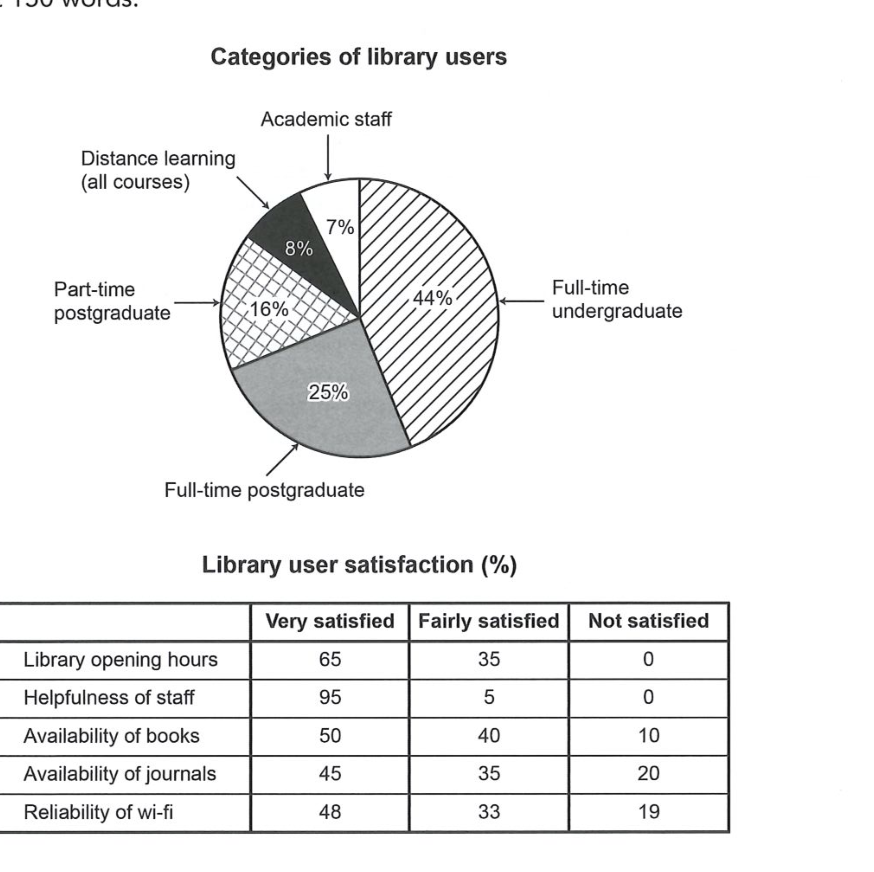
The chart and table below show the results of a survey of library users at a university.
Summarise the information by selecting and reporting the main features, and make comparisons where relevant.
Categories of library users
Student answer (Band 6.0)
The pie chart illustrates the proportion of categories of library user and the table provide data on library user satisfaction.
Overall, Full time undergraduate are mostly using library and least usage of library is by distance learners. People were very satisfied by helpfulness of staff. Availability of Journals was issue in the library as it has most non satisfied people.
Firstly, Highest percentage of library users are the full time undergraduate about 44% while 25% full time postgraduate are library users. Part time postgraduate accounted for 16%. Distance learning student cover 8% of the proportion. Academic staff has least contribution about 7% of them are library users.
95% of people are satisfied by helpfulness of staff and 5% of them are fairly satisfied and 65% of very satisfied by library opening hours but it has more fairly satisfied people about 5%.Both have no not satisfied user. 50% of users are very satisfied by availability of books while percentage decline in availability of journals where only 45% were very satisfied. Availability of journals has most not satisfied users about 20% while reliability of wi-fi has 19% them.
AI examiner evaluation
| Criterion | Band |
|---|---|
| Task Achievement / Task Response | 6.5 |
| Coherence and Cohesion | 6.5 |
| Lexical Resource | 5.5 |
| Grammatical Range and Accuracy | 5.5 |
| Overall | 6.0 |
Task Achievement / Task Response: Band 6.5
You cover both visuals and identify several important features: undergraduates form the largest user group (44%), academic staff the smallest (7%), and staff helpfulness receives the strongest satisfaction rating. You also correctly note that journals have the highest dissatisfaction (20%). This gives the report a relevant overview and generally accurate supporting figures. However, one comparison is misreported: after saying 65% were very satisfied with opening hours, you describe “more fairly satisfied people about 5%”; the figure is 35%. The overview could also compare satisfaction across the table more fully, for example noting that opening hours and staff helpfulness have no dissatisfied users. Some details are therefore less fully or accurately presented, while the main features are addressed.
Coherence and Cohesion: Band 6.5
The response has a clear overall structure: an introduction, an overview, a paragraph on user categories, and a final paragraph on satisfaction. Sequencing within the categories paragraph is easy to follow, and transitions such as “Firstly” and “while” help connect comparisons. The satisfaction paragraph, however, moves quickly between several measures, and the opening-hours figures are difficult to follow because the 35% fairly satisfied figure is incorrectly given as 5%. Some linking is also mechanical, and the overview’s points are not developed into a clear comparison of the satisfaction results. Grouping the satisfaction data more deliberately—for example, staff and opening hours first, then books, journals and wi-fi—would make progression smoother and references clearer.
Lexical Resource: Band 5.5
You use a relevant range of task vocabulary, including “proportion,” “accounted for,” “availability,” and “reliability,” and the meaning is generally understandable. However, several word choices and collocations are awkward or imprecise: “categories of library user,” “least usage of library,” “issue in the library,” and “non satisfied people” do not sound natural in this context. Repetition of “library users” and “satisfied” also limits flexibility. Aim for precise reporting phrases such as “the smallest user group,” “the least-used category,” and “the highest level of dissatisfaction.” Check word forms and spelling as well, including “non-satisfied” or, more naturally, “dissatisfied,” and consistent use of “full-time.”
Grammatical Range and Accuracy: Band 5.5
You attempt both simple and more complex sentences, and the overall meaning is usually clear. Some errors in agreement, articles, plurals and sentence construction remain. For example, “the table provide data” needs a singular verb, while “Full time undergraduate are mostly using library” has problems with number and article use. “65% of very satisfied by library opening hours” is missing a grammatical subject and verb, and “reliability of wi-fi has 19% them” is not a complete, well-formed construction. Punctuation is also inconsistent, particularly the missing space after the full stop before “Both.” To improve, build complete comparison sentences with a clear subject and verb, and check agreement and articles when describing groups and percentages.
See this exact question answered at other band scores. The same prompt compared across bands.
Browse more IELTS Writing model answers or get your own writing scored by the same AI examiner.