Band 5.0 IELTS Writing Task 1 Model Answer
Overall Band Score: 5.0 · Cambridge IELTS 17 · 2026-11-08
IELTS Writing Task 1 question
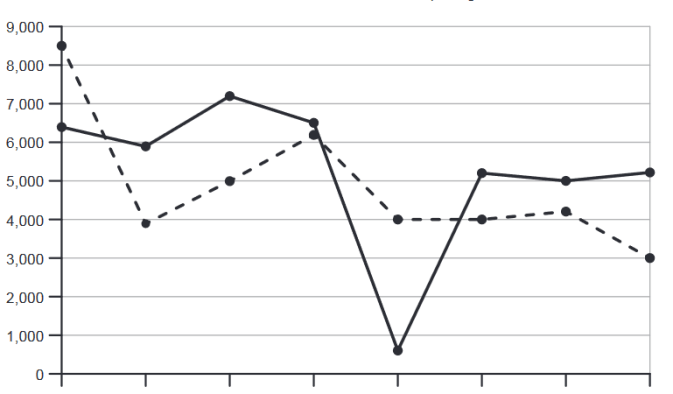
The graph below shows the number of shops that closed and the number of new shops that opened in one country between 2011 and 2018.
Summarise the information by selecting and reporting the main features, and make comparisons where relevant.
Number of shop closures and openings 2011– 2018
Student answer (Band 5.0)
The line graph illustrate the number of shops open and closed in one country between 2011 and 2018.
Overall, both figures experience a singnificant fluctuation overall the period. While the number of shops open are high at the starting period and decline overall, the number of shops close are stable at first three periods and a dramatic drop in 2015.
At the begning of the first period in 2011, the number o shops opening are higer about 8500 which relitively higher than 6200 number of shops closed. Meanwhile, the number of shop opning are dropped sharply to 4000 in 2012. And the number of shop closed are fluctuate between the 6000 to 7000 from 2012 to 2014. In 2015 the number of shops closed are dramatically went down below 1000 shows the lowest figures.
The number of shops opening are rose from 4000 to 6000 from 2012 to 2014. Then it down again to 4000 in 2015 and from this year it remain stable to 4000 next two years and then it down to 3000 in 2018. In contrast the number of shops open rose from 1000 to
AI examiner evaluation
| Criterion | Band |
|---|---|
| Task Achievement / Task Response | 5.0 |
| Coherence and Cohesion | 5.0 |
| Lexical Resource | 5.5 |
| Grammatical Range and Accuracy | 5.0 |
| Overall | 5.0 |
Task Achievement / Task Response: Band 5.0
You identify the two series and include several relevant figures, such as openings at about 8,500 in 2011 and closures falling below 1,000 in 2015. The overview also notes the overall decline in openings and the sharp closure drop. However, the account is only partial: the final sentence is unfinished, and the later closure figures are not reported. Some details are inaccurate or unclear: closures were about 6,400 in 2011, not 6,200, and they fluctuated from 2012 to 2014 rather than being stable. The overview should compare the series more precisely and highlight their contrasting movements. Select the main turning points and give a complete account of both lines through 2018.
Coherence and Cohesion: Band 5.0
The response has a basic structure, with an opening, an overview and paragraphs describing the data. Time markers such as “At the beginning,” “In 2015” and “Then” help readers follow the chronology. However, progression is weakened by repetition: the opening figures and the movements in openings from 2012 to 2015 are described more than once. The final paragraph also ends mid-sentence (“rose from 1000 to”), leaving the comparison incomplete and disrupting the overall flow. Some linking is mechanical, particularly repeated use of “And” and “Then.” Organise the details into a clear sequence, avoid repeating the same trend, and ensure the final comparison forms a complete sentence.
Lexical Resource: Band 5.5
You use some relevant vocabulary for describing a line graph, including “fluctuation,” “decline overall,” “dropped sharply” and “dramatic drop.” These choices show an attempt to describe trends rather than simply list figures. However, the range is limited and several word-form, spelling or collocation errors reduce precision, including “singnificant,” “begning,” “higer,” and “shops open” where “shop openings” is intended. Phrases such as “stable at first three periods” and “went down” are also imprecise or informal for this task. Build a more accurate set of trend expressions and check spelling and collocations; for example, use “remained relatively stable” or “fell sharply” where appropriate.
Grammatical Range and Accuracy: Band 5.0
You attempt both simple and longer sentences, and the response is generally understandable. However, errors occur frequently in basic sentence patterns and in attempts to combine ideas. For example, “the number of shops open are high” has subject–verb disagreement, while “the number of shops closed are dramatically went down” combines incompatible verb forms. Articles and prepositions are also often missing or inaccurate, as in “at the starting period” and “between the 6000 to 7000.” The unfinished final sentence further prevents the reader from understanding the intended comparison. Practise accurate subject–verb agreement with “the number,” and use consistent past-tense forms such as “fell,” “rose” and “remained.”
See this exact question answered at other band scores. The same prompt compared across bands.
Browse more IELTS Writing model answers or get your own writing scored by the same AI examiner.