Band 5.0 IELTS Writing Task 1 Model Answer
Overall Band Score: 5.0 · Cambridge IELTS 17 · 2026-11-14
IELTS Writing Task 1 question
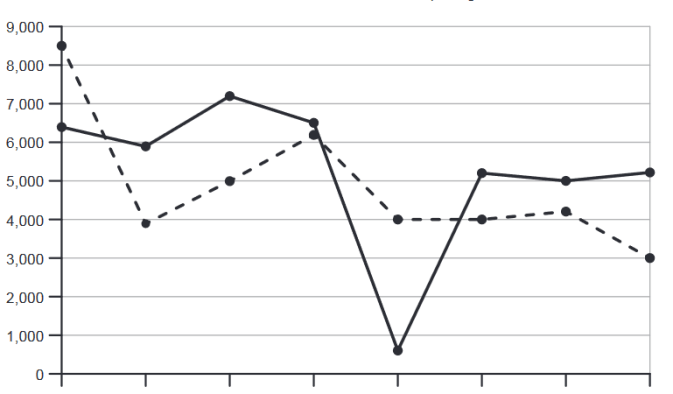
The graph below shows the number of shops that closed and the number of new shops that opened in one country between 2011 and 2018.
Summarise the information by selecting and reporting the main features, and make comparisons where relevant.
Number of shop closures and openings 2011– 2018
Student answer (Band 5.0)
The line graph illutrates the number of new shops open and close in one country over the time period.
IT is clearly seen that, number of new shops open in 2011 was amlost 8500 and the closing was above 6500 but till the 2018 the number of opening shops decrase to 3000 and the closing was above 5000.
Looking into the picture, the number of new shops open in 2011 was around 8500 but this numbers droped to 4000 till 2012 and again in 2013 its increased by 1000 same increase in 2014 and reach above 6000. But after that fall sharply to 4000 in 2015 and almost remains same to 1017 and show slight fall of 1000 in 2018.
On the other hands, at first year the closing number of shop was around 6300 but is shows rise to 2103 and reach 7000 and fall by half of number in 2014. Similarly, in 2015 to fall significently reach around 800 after that it rose again and was above 5000 in 2016 and in 2017 it face small fall and reach 5000 and agin rise and end by around 5200 in 2018.
AI examiner evaluation
| Criterion | Band |
|---|---|
| Task Achievement / Task Response | 5.0 |
| Coherence and Cohesion | 5.5 |
| Lexical Resource | 5.0 |
| Grammatical Range and Accuracy | 5.0 |
| Overall | 5.0 |
Task Achievement / Task Response: Band 5.0
You identify the two series and report several important movements, including the high opening figure in 2011 and the low point in closures in 2015. However, the overview is not consistently accurate: closures did not simply remain above 5,000 throughout, since they fell to about 600 in 2015. Some details are also misreported or unclear. For example, closures rose to about 7,200 in 2013, not 2,103, and the opening figure in 2017 was about 4,200 rather than showing the stated fall of 1,000. The response therefore covers the task only partially, with limited and sometimes inaccurate reporting. Give a concise, accurate overview first, then select the main comparisons and check each figure against the graph.
Coherence and Cohesion: Band 5.5
The response has a basic structure: an introduction, a general comparison, and separate descriptions of openings and closures. This helps the reader recognise which series is being discussed. However, progression is weakened by repetition, particularly the repeated reference to openings in 2011, and by unclear links between some events. Phrases such as “But after that fall sharply” do not clearly identify the subject, while “On the other hands” introduces the second series awkwardly. The chronology is also difficult to follow where years are mistyped or compressed into phrases such as “till 2012.” Use one overview paragraph followed by two clearly organised detail paragraphs, and connect each change explicitly to its year and series.
Lexical Resource: Band 5.0
You use some relevant chart vocabulary, including “rise,” “drop,” “fall sharply,” and “remains same,” so the reader can understand the general topic and direction of change. However, the range is limited and several word choices or forms are inaccurate, making parts of the account difficult to interpret. Examples include “shops open and close,” “the closing number of shop,” and “it face small fall.” Spelling errors such as “illutrates,” “decrase,” and “significently” also reduce clarity. Aim for precise, consistent terms such as “shop openings” and “shop closures,” and use a wider set of accurate trend expressions. Proofreading spelling and choosing natural collocations will make the data description clearer.
Grammatical Range and Accuracy: Band 5.0
You attempt both simple statements and longer sentences with time clauses, for example, “after that it rose again” and the sequence describing openings from 2011 to 2015. However, the longer structures are often faulty, and frequent errors in articles, agreement, tense, and sentence construction can make the meaning hard to follow. In “the number of new shops open in 2011 was,” the noun phrase and verb pattern are not controlled; “this numbers droped” also has incorrect agreement and tense. Several clauses lack a clear subject or complete structure, as in “But after that fall sharply.” Practise forming complete sentences with a clear subject and past-tense verb, and check singular/plural agreement and articles before combining clauses.
See this exact question answered at other band scores. The same prompt compared across bands.
Browse more IELTS Writing model answers or get your own writing scored by the same AI examiner.