Band 5.5 IELTS Writing Task 1 Model Answer
Overall Band Score: 5.5 · Cambridge IELTS 17 · 2026-11-17
IELTS Writing Task 1 question
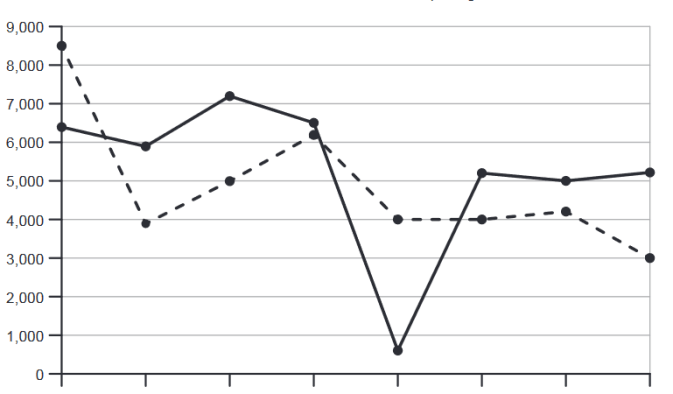
The graph below shows the number of shops that closed and the number of new shops that opened in one country between 2011 and 2018.
Summarise the information by selecting and reporting the main features, and make comparisons where relevant.
Number of shop closures and openings 2011– 2018
Student answer (Band 5.5)
The graph demostrates the development of a country, between 2011- 2018, many old shops are closed in their place new shops are opened.
Overall,the both closures and openings fluctuates between [redacted phone]. The clousres shows high change of trend, in contrast, opening of shops are low.The dark line represent the closure of shops and dotted line show the opening of shops.
In begning the opening of shops are at it's peak 8500 shops are opened in 2011, on the other hand, 6400 shops are closed. The both figure show relative decrease in 2012. In [redacted phone] the number of clousre and opening represent minimum change, while, in 2015, the number of shops closed are low 900 shops are closed, followed by opening of shops are 4000, then remain stable during [redacted phone].
In the end opening of shop are least in numbers 3000 and the rate of shop closed are more than opening about 5100 in 2018
AI examiner evaluation
| Criterion | Band |
|---|---|
| Task Achievement / Task Response | 5.5 |
| Coherence and Cohesion | 6.0 |
| Lexical Resource | 5.0 |
| Grammatical Range and Accuracy | 5.0 |
| Overall | 5.5 |
Task Achievement / Task Response: Band 5.5
You identify the two series and include several relevant figures, including the opening peak of about 8,500 in 2011 and the low point for closures in 2015. However, some key information is inaccurate or unclear: closures in 2015 were about 600, not 900, and openings did not remain stable from 2016 to 2017, rising slightly from about 4,000 to 4,200. The overview that both series “fluctuates” is too general and does not clearly summarise their contrasting patterns or the overall decline in openings. The claim that 2013–2014 showed “minimum change” also overlooks the substantial movement in closures. Select the main trends accurately and compare the series more explicitly.
Coherence and Cohesion: Band 6.0
The response has a recognisable structure: an introduction, an overview, and paragraphs describing the earlier and later years. This gives the reader a basic route through the information. However, progression within the paragraphs is sometimes difficult to follow, particularly in “In 2013-2014 the number of clousre and opening represent minimum change, while, in 2015…” The links “on the other hand,” “while,” and “followed by” are used, but some do not express the relationship clearly, and the final sentence introduces the 2018 comparison abruptly. Referencing is also occasionally unclear, as in “The both figure.” Grouping the data into clearer phases and using simpler, more precise comparisons would make the organisation more coherent.
Lexical Resource: Band 5.0
You use some task-relevant vocabulary, including “peak,” “relative decrease,” “stable,” and “rate,” and the reader can generally identify whether you mean openings or closures. However, the range is limited and several word choices or collocations are inaccurate, such as “development of a country,” “high change of trend,” and “minimum change.” Repetition of “shops,” “number,” and “opening” also makes the description less precise. Spelling errors—including “demostrates,” “clousres,” “begning,” and “clousre”—are noticeable and reduce the clarity and control of the vocabulary. Use standard chart language such as “rose,” “fell,” “fluctuated,” and “reached a low,” and check spelling carefully.
Grammatical Range and Accuracy: Band 5.0
You attempt both simple and more complex sentences, for example, “The both figure show relative decrease in 2012” and the sentence beginning “In 2013-2014… while…”. However, errors in sentence structure, agreement, articles, and punctuation are frequent enough to make some statements awkward or unclear. Examples include “Overall,the both closures and openings fluctuates,” where the subject–verb agreement and article use are faulty, and “the dark line represent,” where the verb does not agree with its subject. The opening sentence is also a run-on, joining several ideas without clear grammatical boundaries. Build accuracy first with complete sentences, consistent past-tense reporting, and correct subject–verb agreement; then add complex clauses where you can control them.
See this exact question answered at other band scores. The same prompt compared across bands.
Browse more IELTS Writing model answers or get your own writing scored by the same AI examiner.