Band 5.0 IELTS Writing Task 1 Model Answer
Overall Band Score: 5.0 · Cambridge IELTS 17 · 2026-11-18
IELTS Writing Task 1 question
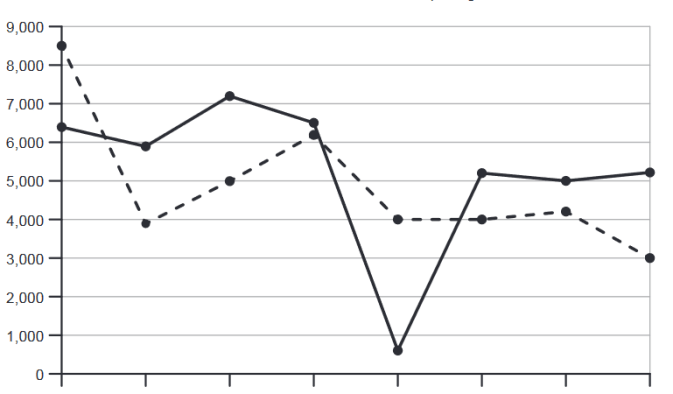
The graph below shows the number of shops that closed and the number of new shops that opened in one country between 2011 and 2018.
Summarise the information by selecting and reporting the main features, and make comparisons where relevant.
Number of shop closures and openings 2011– 2018
Student answer (Band 5.0)
The graph illustrates that in 2011 and 2018 the number of shop closed and the opening of new shops in one country.
Both opening and closing shop shows flautuation. Opening of shops at start has highest ratio while the closing shop has minimum ratio. In 2011 to 2014 the closing shops outnumbered the new opening.
In 2011 the number of closed shop is around 7,000 then there is little stabilty occure in 2012 the numbered reach to 6,000. Then in 2013 ration reach above the 7,000 and then 2014 the closing shop ratio is slightly above the 6,000. Huge flautuation occure and the ratio reach below the 1,000 in 2015. In 2016 and 2017 the ratio remain almost same there is slightly difference one is slightly above 5,000 amd other is 5,000 and in 2018 the ratio is above then 5,000. The opening of new shops in 2011 is on peak it reaches almost 9,000 and then the downfall accur in 2012 and ratio reach to 4,000. In 2013 and 2014 the ratio is 5,000 and other is almost 6,000. Then in 2015 and 2016 the ratio remain same which is 4,000. In 2017 ratio is slightly above 4,000 and at last in 2018 the ratio reach to 3,000
AI examiner evaluation
| Criterion | Band |
|---|---|
| Task Achievement / Task Response | 5.0 |
| Coherence and Cohesion | 5.0 |
| Lexical Resource | 5.0 |
| Grammatical Range and Accuracy | 5.0 |
| Overall | 5.0 |
Task Achievement / Task Response: Band 5.0
You identify both series and report several key movements, including the sharp fall in closures in 2015 and the decline in openings from their 2011 peak. However, the overview is limited and partly inaccurate: openings were highest in 2011, but closures were not at their minimum then; their lowest point was 2015. The claim that closures outnumbered openings from 2011 to 2014 is also incorrect for 2011, when openings were higher. Some figures are broadly accurate, but the response does not clearly summarise the overall patterns or make the most important comparisons. Add a concise overview that accurately contrasts the two trends, then select a few representative figures to support it.
Coherence and Cohesion: Band 5.0
The response has a basic structure, beginning with an introduction and then describing closures before openings. This gives the reader some sense of organisation, and the years are generally presented in chronological order. However, there is no clear, effective overview, and the long final paragraph combines many details without a clear progression or separation between the two series. Linking is repetitive, especially the frequent use of “then,” and some references such as “the ratio” are unclear because the graph shows numbers of shops, not ratios. Use distinct paragraphs for the overview and detailed comparisons, and vary linking expressions while making each comparison explicit.
Lexical Resource: Band 5.0
You use some relevant vocabulary for describing trends, including “downfall,” “reach,” “slightly above,” and “remain almost same.” However, the range is limited and several choices are inaccurate or unnatural, which sometimes makes the meaning less clear. For example, “ratio” is repeatedly used for the number of shops, while “shop closed” and “new opening” are awkward forms. There are also noticeable spelling errors, such as “flautuation,” “stabilty,” and “occure.” Build a more accurate set of trend terms and check spelling and collocations; for example, use “figure,” “number,” “fell sharply,” and “remained stable” where appropriate.
Grammatical Range and Accuracy: Band 5.0
You attempt to describe changes across several years and use some longer sentences, but grammatical control is inconsistent. Errors in agreement and verb forms occur in phrases such as “Both opening and closing shop shows” and “the ratio remain almost same.” Articles, plurals, and sentence construction are also frequently inaccurate, as in “the number of closed shop” and “then 2014 the closing shop ratio.” These errors can make relationships between figures difficult to follow. Practise forming clear comparison sentences with accurate subjects and verbs—for example, “The number of closures fell to about 600 in 2015, before rising to around 5,200 in 2016”—and use full stops to control long sequences of information.
See this exact question answered at other band scores. The same prompt compared across bands.
Browse more IELTS Writing model answers or get your own writing scored by the same AI examiner.