Band 4.0 IELTS Writing Task 1 Model Answer
Overall Band Score: 4.0 · Cambridge IELTS 17 · 2026-11-19
IELTS Writing Task 1 question
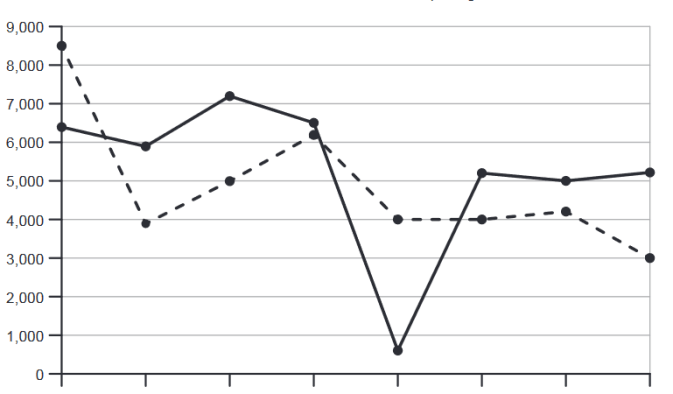
The graph below shows the number of shops that closed and the number of new shops that opened in one country between 2011 and 2018.
Summarise the information by selecting and reporting the main features, and make comparisons where relevant.
Number of shop closures and openings 2011– 2018
Student answer (Band 4.0)
The line graph given below demonstrates the number of shops closed and new shops in one country between 2011 and 2018.
Overall, approximately 6500 shops were closed in 2011 ,7000 shops were closed in 2013 and in 2015 less than 1000 shops were closed.
AI examiner evaluation
| Criterion | Band |
|---|---|
| Task Achievement / Task Response | 3.0 |
| Coherence and Cohesion | 4.5 |
| Lexical Resource | 4.5 |
| Grammatical Range and Accuracy | 4.5 |
| Overall | 4.0 |
Task Achievement / Task Response: Band 3.0
The response identifies the chart’s subject and reports a few closure figures, including the sharp low point in 2015, so some relevant information is selected. However, it gives no account of shop openings and does not summarise the main pattern across the period. The 2013 figure is also reported as approximately 7,000, whereas the graph shows about 7,200; the 2011 and 2015 figures are broadly accurate. The overview is limited to closures and does not compare the two series or describe their overall changes. The response is 44 words, well below the required 150, leaving most of the task unanswered. To improve, include an overview of both series and compare key highs, lows and changes, supported by selected figures.
Coherence and Cohesion: Band 4.5
The response has a basic sequence: it introduces the graph and then gives a brief overall statement about closures. The opening sentence makes the topic clear, and “Overall” signals an attempt to organise the information. However, there is no developed progression from an overview to comparisons or supporting details, and the response ends before the chart’s main features are organised into a complete account. The comma spacing in “2011 ,7000” also makes the figures harder to read. Use separate paragraphs for the overview and key details, and connect comparisons explicitly—for example, contrast the trends in closures and openings before describing their notable changes.
Lexical Resource: Band 4.5
The vocabulary is understandable and relevant to the chart: “line graph,” “number of shops,” and “closed” communicate the basic subject. However, the range is very narrow, with no varied language for describing movement, comparison or extremes. “New shops” is less precise than the chart’s category of shop openings, and “shops closed” could be expressed more naturally as “shop closures” or “shops that closed.” Because the response contains so little description, it does not demonstrate flexible use of task-specific vocabulary. Build a small range of accurate terms such as “openings,” “rose,” “fell,” “fluctuated,” “peaked,” and “reached a low,” and use them to report the graph’s changes without repeating the same wording.
Grammatical Range and Accuracy: Band 4.5
The response uses simple sentence forms that are generally understandable. The introductory sentence, “The line graph given below demonstrates…,” is grammatically complete, and the second sentence attempts to report several figures. However, the range is very limited, with no developed complex structures or varied comparisons. Punctuation is also faulty in “2011 ,7000 shops,” where the comma is misplaced and the figures run together; the sentence would be clearer if the data were separated into properly punctuated clauses. Practise combining accurate simple sentences with structures such as “while” and “whereas” to compare the two series. Careful punctuation and consistent sentence boundaries will make the numerical information easier to follow.
See this exact question answered at other band scores. The same prompt compared across bands.
Browse more IELTS Writing model answers or get your own writing scored by the same AI examiner.