Band 4.5 IELTS Writing Task 1 Model Answer
Overall Band Score: 4.5 · Cambridge IELTS 17 · 2026-11-20
IELTS Writing Task 1 question
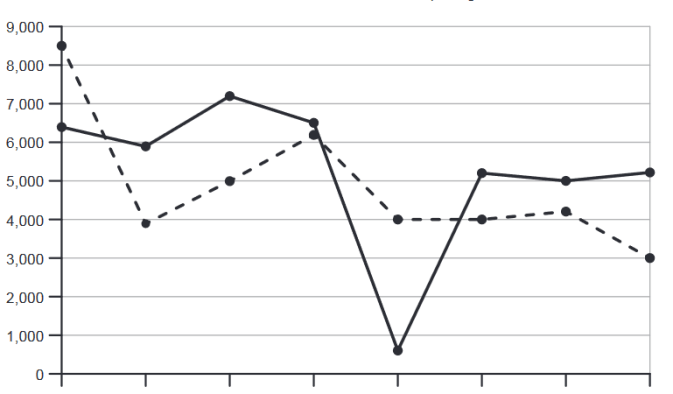
The graph below shows the number of shops that closed and the number of new shops that opened in one country between 2011 and 2018.
Summarise the information by selecting and reporting the main features, and make comparisons where relevant.
Number of shop closures and openings 2011– 2018
Student answer (Band 4.5)
the line graph illustrate the number of shop closure and openings [redacted phone] overall,the number of shop opening declined over the period.while the closure fluactuated considrabily.the most noticable change was a sharp fall clouser in 2015.followed by a significant change.the 8500 shops opened and 6400 shops closed.the number of opening shops sharply to 4000 in 2012.and than increase to 5000 in 2013.and about 6200 in 2014.after that fell 4100 in 2015.
AI examiner evaluation
| Criterion | Band |
|---|---|
| Task Achievement / Task Response | 4.0 |
| Coherence and Cohesion | 4.5 |
| Lexical Resource | 5.5 |
| Grammatical Range and Accuracy | 4.5 |
| Overall | 4.5 |
Task Achievement / Task Response: Band 4.0
The response identifies the graph’s subject and gives a brief overview that openings declined overall while closures fluctuated, which are relevant main features. It also reports several opening figures, including about 8,500 in 2011, 3,900 in 2012, 5,000 in 2013 and 6,200 in 2014. However, the account is very incomplete: it stops partway through the period, gives little information about closures beyond 2011, and does not describe the important 2015 collapse in closures (to roughly 600) or the later figures. The statement that openings fell to about 4,100 in 2015 is also inaccurate; the chart shows approximately 4,000. At 70 words, the response is substantially below the required 150, so it cannot adequately summarise the data. Include a complete overview and compare both series across the full period.
Coherence and Cohesion: Band 4.5
There is a basic attempt to organise the response: an opening sentence is followed by an overview and then a sequence of figures for shop openings. The time markers “in 2012,” “in 2013,” and “in 2014” help the reader follow that part of the account. However, the ideas are compressed into one continuous block, and the overview is not clearly separated from the detailed reporting. The phrase “followed by a significant change” does not explain what changed, while “after that” has an unclear reference. The response also ends abruptly after the 2015 figure, leaving the later years unconnected. Use distinct paragraphs for the overview and details, and group comparisons by trend so the progression is clearer.
Lexical Resource: Band 5.5
The response uses some relevant graph vocabulary, including “declined,” “fluctuated,” “sharp fall,” and “increase,” and these choices show an attempt to describe trends rather than merely list figures. However, the range is narrow and several spelling errors make the wording less clear, such as “fluactuated,” “considrabily,” and “clouser.” Some phrases are also imprecise or awkward: “the number of opening shops sharply to 4000” does not express the movement accurately, and “significant change” is too vague to identify a trend. Build a more accurate set of trend expressions and use the correct noun forms, such as “shop openings” and “shop closures.” Proofreading spelling and choosing precise collocations will make the data easier to understand.
Grammatical Range and Accuracy: Band 4.5
The response attempts to use both simple statements and linked clauses, for example, “overall, the number of shop opening declined over the period” and “while the closure fluctuated considerably.” However, grammatical control is weak and errors occur throughout. The opening needs subject–verb agreement and an article (“The line graph illustrates…”); “shop opening declined” also needs a plural noun form. The sentence “the number of opening shops sharply to 4000 in 2012” is missing a verb, and “and than increase” has an incorrect verb form and tense. Punctuation is also inconsistent, with missing spaces after full stops and commas. Practise complete past-tense sentences and check agreement, articles, and sentence boundaries before submitting.
See this exact question answered at other band scores. The same prompt compared across bands.
Browse more IELTS Writing model answers or get your own writing scored by the same AI examiner.