Band 4.5 IELTS Writing Task 1 Model Answer
Overall Band Score: 4.5 · Cambridge IELTS 17 · 2026-11-21
IELTS Writing Task 1 question
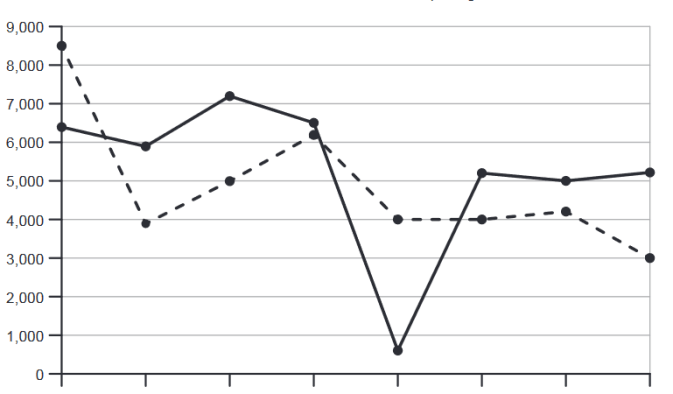
The graph below shows the number of shops that closed and the number of new shops that opened in one country between 2011 and 2018.
Summarise the information by selecting and reporting the main features, and make comparisons where relevant.
Number of shop closures and openings 2011– 2018
Student answer (Band 4.5)
The line graph illustrate,the number of closed shop and the number of new ahops that has been introduce in one country between 2011 and 2018.
this line shows us that number of closed shop has been droped and nupber of ne shop has also droped then previous month on fort line time opeaning of new shop was at lowest of
all time.
At start theie was more then 8000 shopes which has been closed and in next point it drop to 4000 nore then half but in next point it rose up more then 6000 and it flucute near 4000 and near 3000.
The numner of open shop start from betwen 6000 and 7000 and it start flucute betwen same range for next four point suddenly it drop rapedly bellow 1000 and surprisely it rise to 5000 and it stay in range between 500 and 5500 it also coundnt crose previous 6000 mark.
AI examiner evaluation
| Criterion | Band |
|---|---|
| Task Achievement / Task Response | 4.5 |
| Coherence and Cohesion | 5.0 |
| Lexical Resource | 4.5 |
| Grammatical Range and Accuracy | 4.5 |
| Overall | 4.5 |
Task Achievement / Task Response: Band 4.5
You identify both series and the period, and you attempt to describe changes over time. However, the account does not accurately report several key features: the opening figure in 2011 was about 8,500, not more than 8,000 closures, while closures began at about 6,400. The dramatic fall to below 1,000 in 2015 belongs to closures, but your response assigns it to openings; openings were around 4,000 that year. The overview is also unclear and says both series dropped without identifying the main contrast or endpoints. To improve, give a clear overview, distinguish the two lines consistently, and select a few accurate peaks, troughs and overall trends.
Coherence and Cohesion: Band 5.0
There is a basic attempt to organise the response, moving from an opening statement to descriptions of the two lines. Phrases such as “At start” and “in next point” show an effort to sequence information. However, the progression is difficult to follow because the series are not clearly identified in the body paragraphs, and the opening overview is fragmented and repetitive. The long final description combines several changes without clear links, making it hard to tell which figures refer to openings or closures. Use separate, logically ordered paragraphs and refer consistently to “closures” and “openings”; connect comparisons with clear terms such as “whereas,” “by contrast” and “in the final year.”
Lexical Resource: Band 4.5
You use some relevant chart vocabulary, including “drop,” “rose,” “fluctuate” and “range,” so the reader can recognise that you are describing trends. However, the vocabulary is basic and often inaccurate or repetitive, and frequent spelling errors make the account harder to understand. Examples include “ahops,” “nupber,” “flucute” and “surprisely.” Some phrases are also unsuitable for describing a graph, such as “previous month” and “first line time,” which obscure the intended comparison. Build a small set of accurate trend expressions and use them precisely, for example “fell sharply,” “reached a peak” and “remained relatively stable.”
Grammatical Range and Accuracy: Band 4.5
The response attempts both simple statements and longer sentences linked with “and,” “but” and “which,” but control is weak and errors occur throughout. For example, “The line graph illustrate” has subject–verb disagreement, while “the number of closed shop has been droped” has problems with number, tense and sentence construction. Articles and plurals are also frequently missing or incorrect, as in “At start” and “more then 8000 shopes.” Punctuation is inconsistent, including the comma after “illustrate” and several run-on sentences. Use short, complete sentences first, checking subject–verb agreement, articles and plural nouns; then add a few accurately formed comparisons using “while” or “whereas.”
See this exact question answered at other band scores. The same prompt compared across bands.
Browse more IELTS Writing model answers or get your own writing scored by the same AI examiner.