Band 5.0 IELTS Writing Task 1 Model Answer
Overall Band Score: 5.0 · Cambridge IELTS 17 · 2026-11-25
IELTS Writing Task 1 question
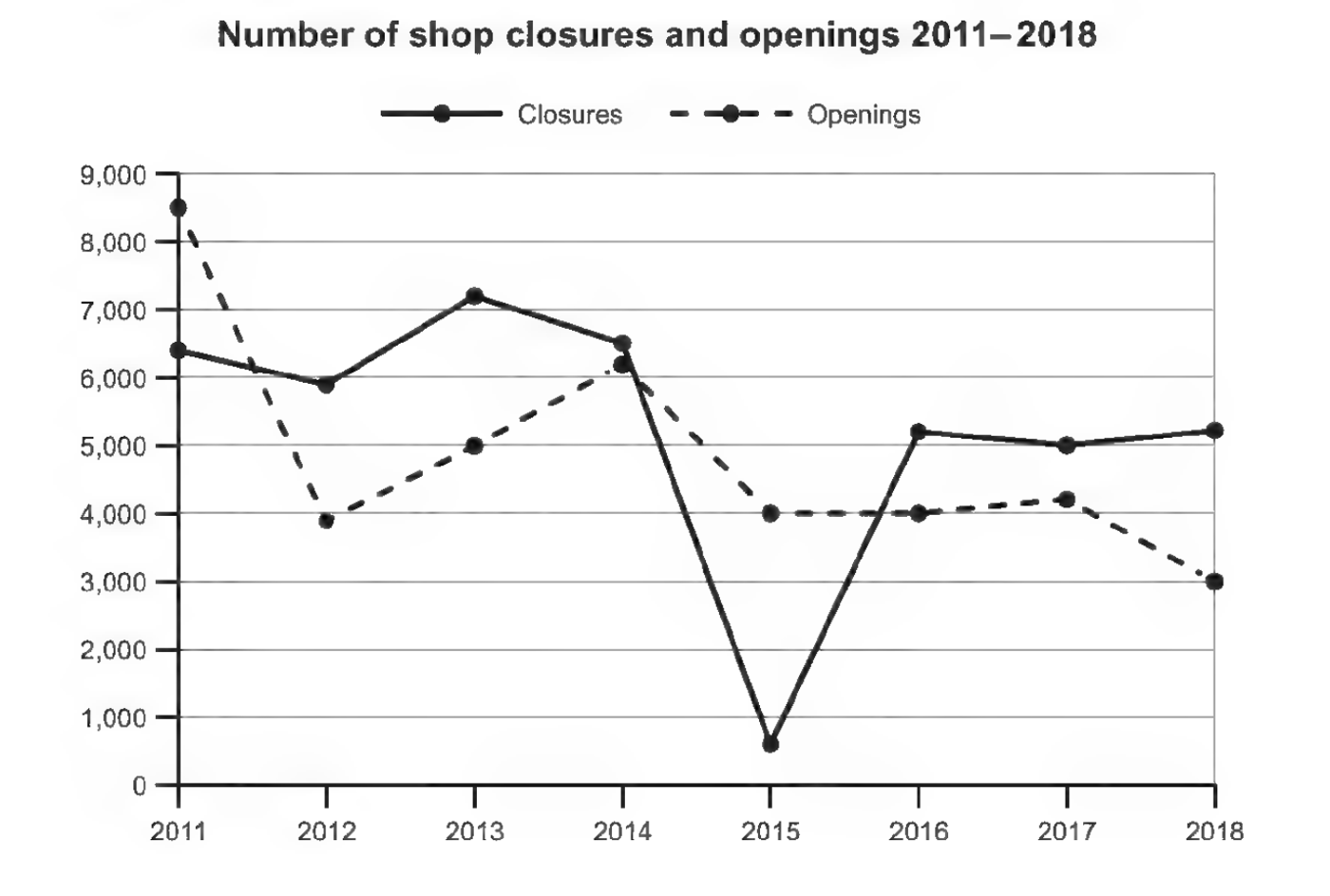
The graph below shows the number of shops that closed and the number of new shops that opened in one country between 2011 and 2018.
Summarise the information by selecting and reporting the main features, and make comparisons where relevant.
Student answer (Band 5.0)
This graph illustrates the comparsion between number of shops opened and closed from 2011 to 2018.there were 8500 shops opened in 2011 which falls to 4000 in 2012 , similarly , number of shops closed in 2011 were 6500 which falls down to a level of 6000 in 2012.Number of shops opened increased from 4000 to 5000 in 2013 and continue increasing to 6000 until 2014.Number of shops closed rises from 6000 to 7000 in 2013 and then falls down to 6500 in 2014.There was a sharp decrease in proportion of shops opened in 2015 to a level of 4000 and then remains constant in 2016 and likely littlerise in 2017 and then former pull back to 3000 in 2018 , on the other hand , number of shops closed also falls down below 1000 in 2015 showing massive drawback and then pull back to nearly 5000 in 2016 and then stablised almost until 2018.If we comapare both views , we can consider that number of closures showed the maximum fall , even under the 1000.
AI examiner evaluation
| Criterion | Band |
|---|---|
| Task Achievement / Task Response | 5.0 |
| Coherence and Cohesion | 5.0 |
| Lexical Resource | 5.5 |
| Grammatical Range and Accuracy | 5.0 |
| Overall | 5.0 |
Task Achievement / Task Response: Band 5.0
You report several key movements, including the sharp fall in closures to about 600 in 2015 and the recovery to around 5,000 in 2016, as well as the decline in openings to 3,000 by 2018. However, the response is only partially developed: it has no clear overview of the main pattern across the period, such as closures fluctuating markedly while openings generally ended lower. Some figures are inaccurate: closures were about 5,900, not 6,000, in 2012, and openings rose to about 6,200 in 2014 rather than 6,000. The final comparison focuses only on the lowest closure figure. Add a concise overview and select the most important comparisons more accurately.
Coherence and Cohesion: Band 5.0
The response follows the years in sequence and uses some linking expressions, such as “similarly,” “on the other hand,” and “then,” so the reader can follow much of the chronology. However, it is presented as one long paragraph, with no distinct overview or clear grouping of the two series. Several transitions are repetitive, and the final sentence introduces a comparison without developing it. Punctuation around connectors is also inconsistent, making some stretches difficult to read. Organise the report into an introduction, an overview, and one or two body paragraphs, and use links to show meaningful contrasts rather than simply joining successive events.
Lexical Resource: Band 5.5
You use some relevant trend vocabulary, including “sharp decrease,” “massive drawback,” “increased,” and “stabilised,” which helps communicate changes in the figures. There is also some attempt to vary wording rather than repeat “rise” throughout. However, several choices are inaccurate or unnatural for describing a graph: “proportion” is not appropriate for the number of shops, “pull back” is unclear, and “maximum fall” is an imprecise description. Spelling errors such as “comparsion,” “comapare,” and “stablised” are noticeable. Choose precise reporting verbs and check spelling; for example, use “number,” “recovered,” and “largest decline” where appropriate.
Grammatical Range and Accuracy: Band 5.0
The response attempts to combine ideas using clauses and time expressions, for example, “which falls to 4000 in 2012” and “and then falls down to 6500 in 2014.” However, the range of sentence structures is limited, and long sentences joined by commas often become difficult to follow. Verb forms and agreement are frequently inconsistent: “which falls” should be “which fell,” while “number of shops closed … were” needs a singular construction such as “the number … was.” Missing spaces after full stops and inconsistent comma use also affect accuracy. Use past tense consistently for this completed period, and divide the account into shorter, correctly punctuated sentences.
See this exact question answered at other band scores. The same prompt compared across bands.
Browse more IELTS Writing model answers or get your own writing scored by the same AI examiner.