Band 5.5 IELTS Writing Task 1 Model Answer
Overall Band Score: 5.5 · Cambridge IELTS 17 · 2026-11-25
IELTS Writing Task 1 question
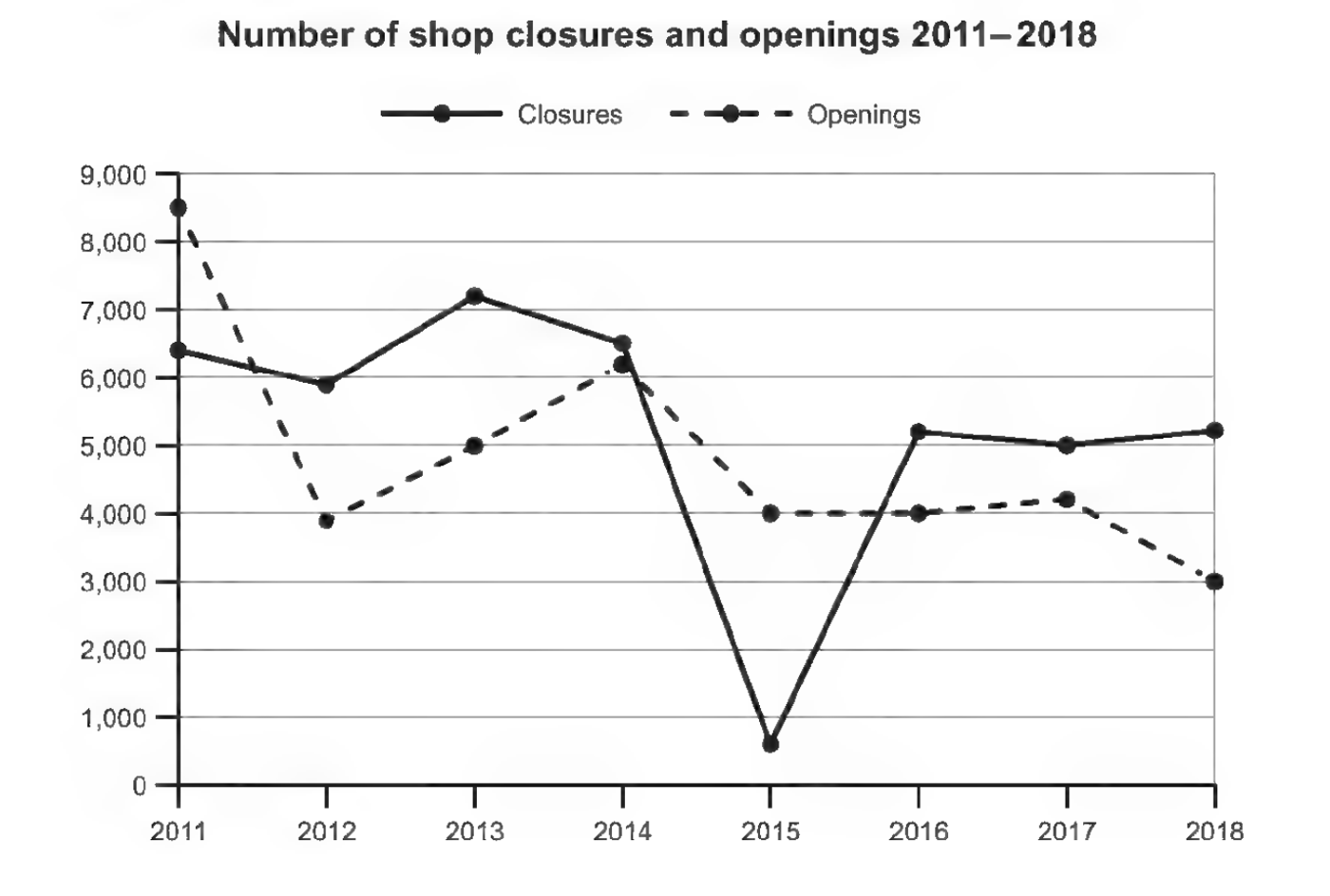
The graph below shows the number of shops that closed and the number of new shops that opened in one country between 2011 and 2018.
Summarise the information by selecting and reporting the main features, and make comparisons where relevant.
Student answer (Band 5.5)
The line graph illustrates the number of shops that closed and the number of new shops that opened in one country between 2011 and 2018.
Overall, the number of shops 6200 were closed in 2011 which were less than the number of shops newly opened in 2011. In the 2015 there was small number of shops which were closed in 2015.
To begin with number of newly opened shops are much more than number of closed shops in 2011. while in 2012 the number of shop which were closed are more than number of shops newly opened which was slightly below the 6000 and slightly below the 4000. While the number of shops were sharply declined between 2014 to 2015.
Furthermore the number of newly opened shops were seen go up between 2012 to 2014 while in after 2014 it get decreased to the 4000 in 2015 almost the same numbers of shops before in 2012. It stayed stable from 2015 to 2016 but there was minimum increased in 2017 has been seen. While the number of closures shops had increased rapidly to the 2016 which is little bit more than 5000 and it stayed almost stable until 2018
AI examiner evaluation
| Criterion | Band |
|---|---|
| Task Achievement / Task Response | 5.5 |
| Coherence and Cohesion | 5.5 |
| Lexical Resource | 5.5 |
| Grammatical Range and Accuracy | 5.0 |
| Overall | 5.5 |
Task Achievement / Task Response: Band 5.5
You identify the subject and period accurately, and you notice several relevant movements, including the sharp fall in closures in 2015 and the rise in openings from 2012 to 2014. However, the overview is not sufficiently clear or comprehensive: it focuses on 2011 and the low closure figure in 2015 rather than summarising the main pattern across the whole period. Some comparisons are inaccurate or unclear. For example, closures in 2012 were about 5,900, not “slightly below the 6000” in a way that clearly contrasts with openings at about 3,900; and closures rose to about 7,200 in 2013, a major feature that is omitted. Include the key highs, lows and overall contrast more systematically.
Coherence and Cohesion: Band 5.5
The response has an introduction, a brief overview and two body paragraphs, so there is some organisation and the reader can follow the general topic. However, progression is uneven: the overview repeats details that are then revisited, while the body paragraphs do not consistently group the data into clear comparisons. Linking words such as “while,” “Furthermore” and “To begin with” are used, but several are repetitive or do not create a clear relationship between the ideas. The sentence beginning “Furthermore the number of newly opened shops…” also combines several time periods without a clear progression. Organise the report around the main trends—for example, early fluctuations, the 2015 closure drop, and later figures—and use references that make each comparison explicit.
Lexical Resource: Band 5.5
You use relevant chart vocabulary, including “sharply declined,” “stable,” “increased rapidly” and “newly opened,” which helps communicate the main movements. However, the range is limited and some word combinations are unnatural or imprecise, such as “minimum increased,” “closures shops” and “number of shops 6200 were closed.” Repetition of “number of shops” and “while” also makes the description less flexible. Choose standard collocations such as “the number of closures,” “shop openings” and “a slight increase,” and vary the language used to describe rises, falls and stability. More precise vocabulary would also help distinguish a figure from a trend, particularly when reporting the 2015 low and the 2013 peak.
Grammatical Range and Accuracy: Band 5.0
The response attempts both simple and longer sentences, including comparisons introduced by “while,” but complex sentences are often faulty and errors occur frequently enough to make some passages difficult to interpret. Examples include “the number of shops 6200 were closed,” where the subject and verb do not agree, and “the number of shops were sharply declined,” which uses an incorrect verb construction. Tense and sentence formation are also inconsistent in “it get decreased” and “there was minimum increased in 2017 has been seen.” Articles, plurals and punctuation need closer control as well. Practise building clear comparison sentences with a singular subject such as “the number,” and use past-tense forms consistently when describing the completed period.
See this exact question answered at other band scores. The same prompt compared across bands.
Browse more IELTS Writing model answers or get your own writing scored by the same AI examiner.