Band 5.5 IELTS Writing Task 1 Model Answer
Overall Band Score: 5.5 · Cambridge IELTS 17 · 2026-11-25
IELTS Writing Task 1 question
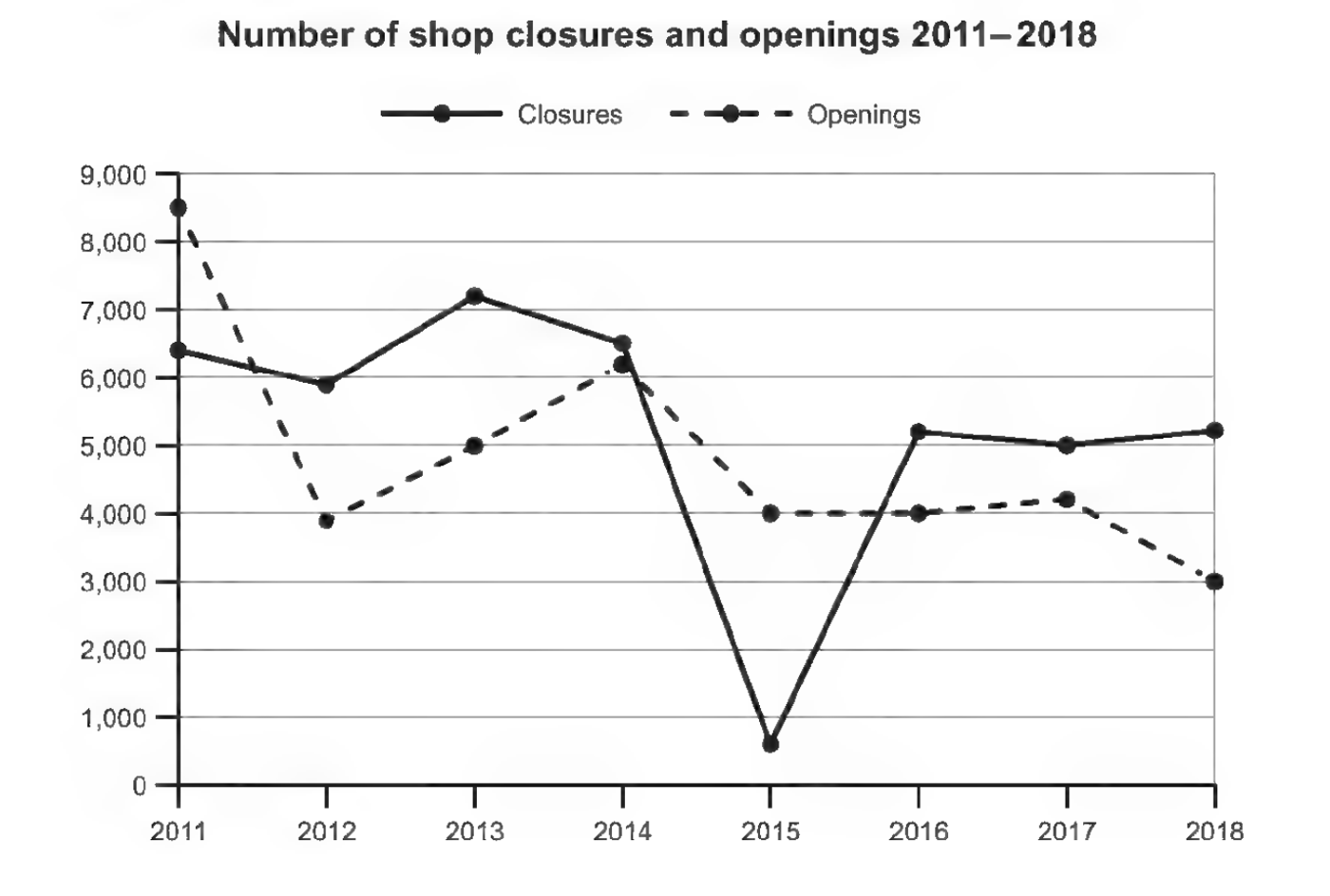
The graph below shows the number of shops that closed and the number of new shops that opened in one country between 2011 and 2018.
Summarise the information by selecting and reporting the main features, and make comparisons where relevant.
Student answer (Band 5.5)
The line graph illustrates the amount number of shops that closed and opened in one country in 2011 to 2018 .
Overall, it's clear that the numbers of shops who closed and opened are decreasing over the years , and the closures fall sharply in 2015 to a small number .
Firstly, the closures in 2011 stood at 6200 shops and the number fluctuaded throughout the period 2012 to2014 after that it fell significantly in 2015 to 5000 shops , In 2016 the figure has climbed to 5100 , and finally it remainded stable with a slight flactuation until 2018.
Secondly, In 2011 , the openings reached levelled off at 8000 shops and dropped sharply to 3900 in 2012, furthermore the number of shops increased gradually and met at 6100 with the number of closures , after that fell slightly to 4000 shops , finally it remained stable to 2017 and after that the rate decreased slowly and reach a number of 3000 in 2018 .
AI examiner evaluation
| Criterion | Band |
|---|---|
| Task Achievement / Task Response | 5.5 |
| Coherence and Cohesion | 6.0 |
| Lexical Resource | 5.5 |
| Grammatical Range and Accuracy | 5.0 |
| Overall | 5.5 |
Task Achievement / Task Response: Band 5.5
You identify both series and include an overview, noting the general decline and the sharp fall in closures in 2015. However, the overview is too broad: closures do not decrease steadily, and openings fluctuate before ending lower. Several figures are also inaccurate or unclear. Closures fell to about 600 in 2015, not 5,000, and the 2016 figure was around 5,200. Openings began at about 8,500, rather than 8,000, and the two series were closest in 2014, at roughly 6,500 and 6,200. The response covers the main subject, but these misreadings and the limited comparison of key trends leave some information unclear or under-developed.
Coherence and Cohesion: Band 6.0
The response has a recognisable structure: an introduction, an overview, and separate paragraphs for closures and openings. This makes the two series easy to identify, and time markers such as “in 2011,” “after that,” and “finally” help show sequence. However, the progression is sometimes mechanical, with “Firstly” and “Secondly” introducing descriptions rather than comparisons. Some links are awkward or unclear, particularly “increased gradually and met at 6100 with the number of closures,” which does not clearly explain the timing or relationship. Long sentences joined by commas also weaken the flow. Grouping the main turning points and directly comparing the lines would make the organisation more coherent and the connections more precise.
Lexical Resource: Band 5.5
You use a relevant range of trend vocabulary, including “dropped sharply,” “increased gradually,” “fell significantly,” and “remained stable.” These choices show an attempt to describe changes rather than simply list figures. However, several word choices or combinations are inaccurate or unnatural: “amount number,” “shops who closed,” and “reached levelled off” do not express the intended meaning clearly. There are also noticeable spelling errors, including “fluctuaded,” “remainded,” and “flactuation.” Use standard chart language consistently, such as “number of shops,” “stood at,” and “fluctuated,” and check spelling carefully. More precise vocabulary would help distinguish a sharp fall from a slight fluctuation.
Grammatical Range and Accuracy: Band 5.0
You attempt both simple and longer sentences, and the response is generally understandable. However, control is uneven: several sentences combine multiple clauses without appropriate punctuation, as in “the closures in 2011 stood at 6200 shops and the number fluctuaded throughout the period 2012 to2014 after that it fell significantly.” This creates run-on structures and makes the timeline harder to follow. There are also errors in verb forms and sentence construction, such as “the figure has climbed” in a past-time account and “reach a number of 3000,” where the verb form does not match the past tense. Capitalisation and spacing around punctuation are inconsistent. Use shorter, accurately punctuated sentences and maintain past tense throughout.
See this exact question answered at other band scores. The same prompt compared across bands.
Browse more IELTS Writing model answers or get your own writing scored by the same AI examiner.