Band 6.5 IELTS Writing Task 1 Model Answer
Overall Band Score: 6.5 · Cambridge IELTS 17 · 2026-11-26
IELTS Writing Task 1 question
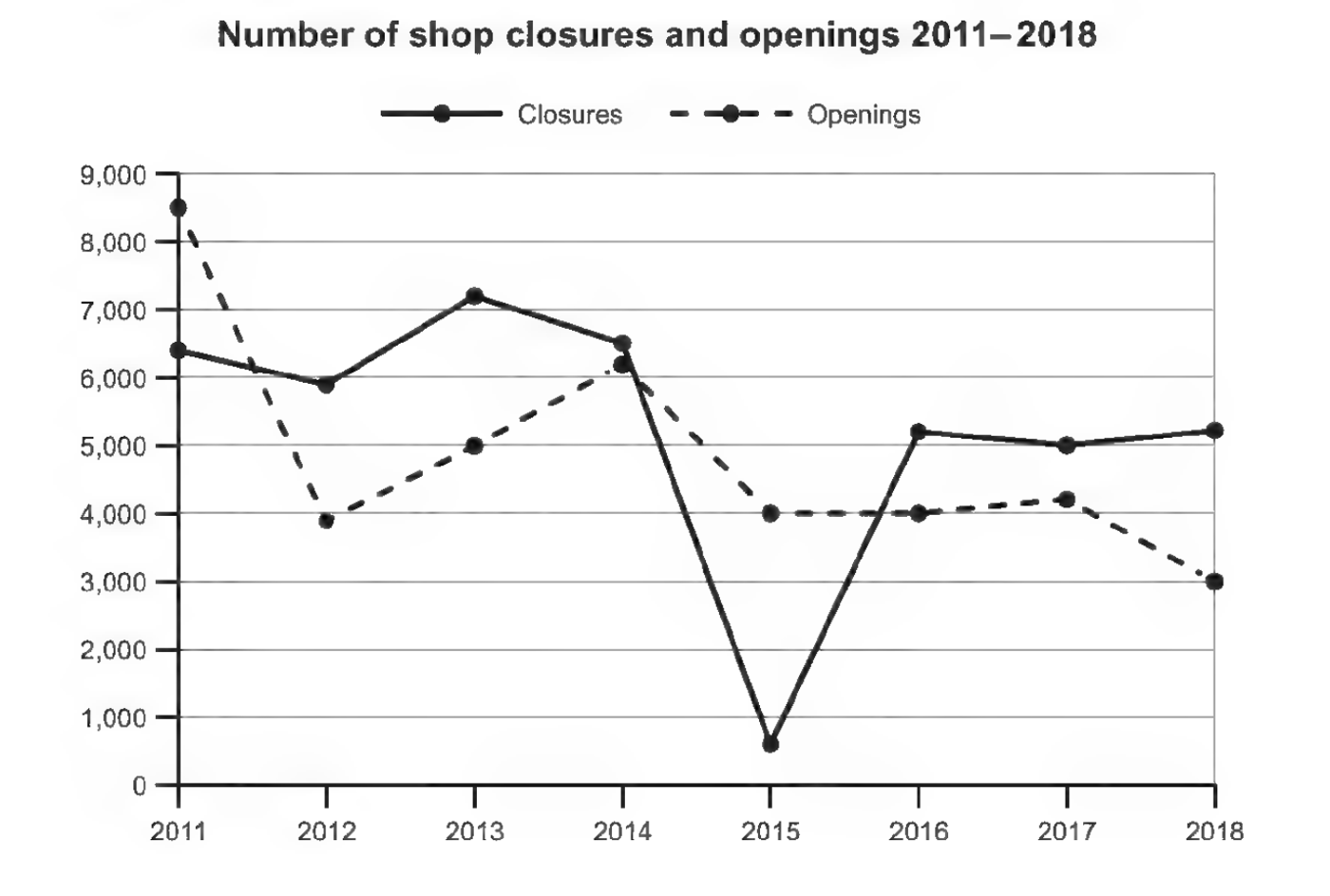
The graph below shows the number of shops that closed and the number of new shops that opened in one country between 2011 and 2018.
Summarise the information by selecting and reporting the main features, and make comparisons where relevant.
Student answer (Band 6.5)
The line graph illustrates the number of outlets in a certain country that were ceased operations and newly launced over the time period of 2011 and 2018.
Overall, the total number of newly opened shops were significantly higher than the number of closed stores in the begining. However, both numbers fluctuated rapidly over the time, especially number of closed shop saw a sharp decline in 2015, nevertheless, ended up higher in number than the opened one in the end.
In 2011, people satrted to open more stores than shutting down, where the numbers were approximately around 8600 for opened shops and around 6400 which were closed. Then the number of opned shop saw a massive fall to around 3900. There after the number recovered steadily, 5000 in 2013 and around 6100 in 2014. Then it fell again in 2015 to 4000 and remained same for the next year. After that it rose a little, around 4100 in 2017 before ending up to the minimum figure within the years, which was around 3000.
In contrast,the number of closed outlets saw fluctuations, around 3900 in 2012, around 7100 in 2013 and around 6500 in 2014. After that it saw the biggest decline in 2015 and downed to approximately 600. There after it followed a sharp increase to 5100 approximately in 2016. Then it decreased a little in 2017 to 5000 and finally ended up more than the number of total opened outlets, which was approximately 5100 in 2018.
AI examiner evaluation
| Criterion | Band |
|---|---|
| Task Achievement / Task Response | 7.0 |
| Coherence and Cohesion | 7.0 |
| Lexical Resource | 6.0 |
| Grammatical Range and Accuracy | 5.5 |
| Overall | 6.5 |
Task Achievement / Task Response: Band 7.0
You provide a clear overview of the main patterns: openings were higher at the start, both series fluctuated, closures plunged in 2015, and closures finished above openings. The body also supports this with relevant figures, including the opening decline from about 8,600 to 3,900 and the closure low of roughly 600. Most reported values and comparisons match the graph. To make the account more fully developed, state the overall endpoint comparison more precisely: closures were about 5,200 versus 3,000 openings in 2018. The overview’s phrase “both numbers fluctuated rapidly” is also broad; the sharp 2015 closure drop is the defining feature, while openings follow a different sequence. Overall, the key features are selected and supported, though some comparisons could be sharper.
Coherence and Cohesion: Band 7.0
The response is organised effectively into an introduction, an overview, and separate paragraphs for openings and closures. This gives the reader a clear route through the data, and the chronological sequencing within each series is easy to follow. Linking expressions such as “Then,” “After that,” and “In contrast” help signal movement and comparison. At times, however, the repeated use of “Then” and “After that” makes the progression somewhat mechanical, and the final comparison is embedded in the closures paragraph rather than highlighted as a concise concluding comparison. Use a wider range of linking structures and connect related movements across the two series where useful. The overall progression remains clear and logical.
Lexical Resource: Band 6.0
You use an adequate range of vocabulary for describing trends, including “massive fall,” “recovered steadily,” “sharp increase,” and “fluctuations.” These choices make the main movements understandable, and the response generally uses suitable terms for the graph. However, several word-choice, collocation, and spelling problems reduce precision: “were ceased operations” is awkward, “newly launced” is misspelled and unnatural, and “downed to” is not an appropriate way to describe a fall in figures. There are also inconsistent labels such as “outlets,” “stores,” and “shops,” where consistent terminology would be clearer. Aim for accurate trend collocations and check spelling carefully; this would make the vocabulary more controlled and natural.
Grammatical Range and Accuracy: Band 5.5
You attempt a mix of simple and more complex sentences, including clauses linked with “where,” “however,” and “before,” and the overall meaning is usually clear. Some grammatical errors remain, particularly with agreement and sentence construction. For example, “the total number … were” should use a singular verb, and “the number of closed shop saw” needs a plural noun and a more accurate grammatical structure. The sentence beginning “In 2011, people started to open more stores …” also has an unclear clause connection, while “which was approximately 5100 in 2018” does not attach cleanly to the comparison. Work on subject–verb agreement, clause boundaries, and clear relative clauses. More consistently accurate complex sentences would strengthen control.
See this exact question answered at other band scores. The same prompt compared across bands.
Browse more IELTS Writing model answers or get your own writing scored by the same AI examiner.