Band 4.5 IELTS Writing Task 1 Model Answer
Overall Band Score: 4.5 · Cambridge IELTS 17 · 2026-11-26
IELTS Writing Task 1 question
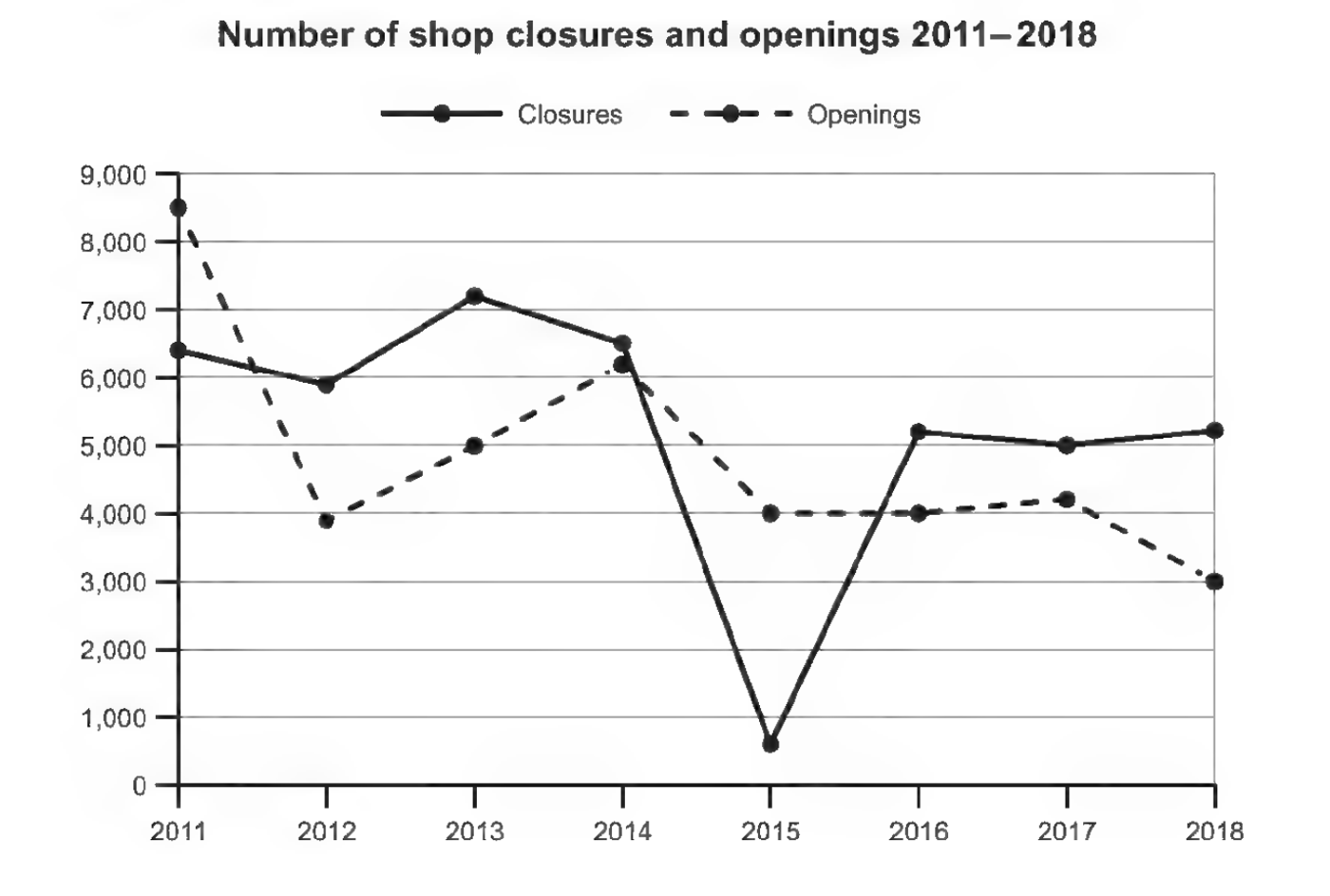
The graph below shows the number of shops that closed and the number of new shops that opened in one country between 2011 and 2018.
Summarise the information by selecting and reporting the main features, and make comparisons where relevant.
Student answer (Band 4.5)
The graph shows the number of shops that closed and number of new shops that opened in one nation between 2011 and 2018.
Overall, number of shop closures starting down compered the opening number and both are end almost near each other but opening ended down,
To being with, number of shop closures starting around 65000 in the 2011 and next on the next year they decresad alomost five thoused . In 2015 they descred gradully reached almost 700 only and after that they increase around 4000, In 2017 and 2018 in the end closures 5000 almost.
Futhermore,number of opening starting almost hightest point near about the 9000 they descred gradully and stay 4000 after the both year they increase gradully ariund 2000 and after that they stay and 2017 .Next one year in 2018 descred 1000 around.
AI examiner evaluation
| Criterion | Band |
|---|---|
| Task Achievement / Task Response | 4.5 |
| Coherence and Cohesion | 5.0 |
| Lexical Resource | 4.5 |
| Grammatical Range and Accuracy | 4.5 |
| Overall | 4.5 |
Task Achievement / Task Response: Band 4.5
You identify the subject and period, and you attempt to describe both series, including the sharp fall in closures in 2015 and the decline in openings by 2018. However, the overview is unclear and partly inaccurate: closures did not generally start downward, and the two series did not finish almost level; in 2018 closures were about 5,200 compared with 3,000 openings. Several figures and trends are also misreported, such as closures falling by “almost five thousand” in 2012 and openings rising by around 2,000 after 2016. The response contains 122 words, below the required 150, and this limits the detail available. Select the main turning points accurately and give a clear overview before supporting it with key comparisons.
Coherence and Cohesion: Band 5.0
There is a basic attempt to organise the response: an introduction, an overview, and separate discussion of closures and openings. Time references such as “In 2015” and “in 2018” help the reader follow the chronology. However, progression within the paragraphs is difficult to track because several trends are compressed into long, loosely connected sentences. The overview’s comparison is unclear, and transitions such as “Furthermore” and “Next one year” do not always show the relationship between the figures accurately. Punctuation and spacing also make some sections harder to read. Use one paragraph for the overview and one for each series, and connect each year to a precise change or comparison.
Lexical Resource: Band 4.5
The response uses some relevant task vocabulary, including “closures,” “opened,” “decreased,” and “increase,” so the reader can recognise the topic and intended trends. However, the range is basic and repetitive, and frequent spelling errors—such as “compared,” “decresad,” “alomost,” and “Futhermore”—make the account less clear. Some expressions are also imprecise or unnatural, including “starting down,” “stay and 2017,” and “highest point near about.” Choose standard trend language and check spelling carefully. More precise alternatives such as “fell sharply,” “remained stable,” and “recovered” would help describe the graph without relying repeatedly on “increase” and “decrease.”
Grammatical Range and Accuracy: Band 4.5
You attempt to form connected sentences and use past-tense verbs to describe the period, but grammatical control is weak and errors frequently affect clarity. For example, “number of shop closures starting down” lacks a clear subject and correctly formed verb, while “they increase around 4000” shifts tense and does not express the relationship clearly. Articles and sentence structure are also problematic in phrases such as “in the 2011” and “after the both year.” Several sentences run together without reliable punctuation, making it difficult to identify where one idea ends. Practise accurate simple past-tense sentences first, then combine them with clauses using “while” or “whereas”; check articles, verb forms, and sentence boundaries.
See this exact question answered at other band scores. The same prompt compared across bands.
Browse more IELTS Writing model answers or get your own writing scored by the same AI examiner.