Band 5.0 IELTS Writing Task 1 Model Answer
Overall Band Score: 5.0 · Cambridge IELTS 13 · 2026-11-09
IELTS Writing Task 1 question
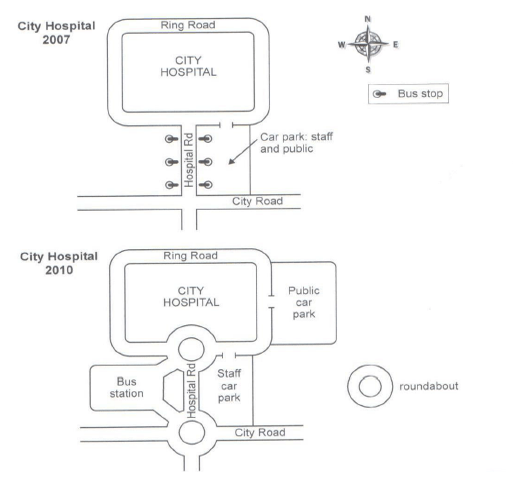
The two maps below show road access to a city hospital in 2007 and 2010.
Summarize the information by selecting and reporting the main features and make comparisons wherever relevant.
Student answer (Band 5.0)
Both diagram shows road access to city hospital in the year 2007 and 2010.
Overall, the maps shows the old features of the hospital and the new look in the year 2010.
To begin with, in 2007 the road access shows how to locate the city hispital . You must pass through the southeast in order to access the city road. Stop at the carpark by your right, which is together with the public park and it has a public transport. then walk through the hospital road, you will see city hospital in front of Ring road.
Secondly, the city map in 2010 has parks for public transport users, beside it is a round about and also a separate staff park for staffers. it is newly built.
The city hospital also has a bus station which were absent in 2007.
From the bus station,the city hospitalis easy to locate as well.
In conclusion, the newly innovated city hospital has new dev
AI examiner evaluation
| Criterion | Band |
|---|---|
| Task Achievement / Task Response | 4.5 |
| Coherence and Cohesion | 5.0 |
| Lexical Resource | 5.0 |
| Grammatical Range and Accuracy | 5.0 |
| Overall | 5.0 |
Task Achievement / Task Response: Band 4.5
You identify the two years and mention several relevant changes, including the separate staff parking area and the addition of a bus station. However, the response only minimally reports the map information: it does not clearly compare the layouts or explain the main changes in road access. Some details are inaccurate or unclear—for example, the 2007 car park served both staff and the public, while the 2010 public car park was newly located east of the Ring Road; the bus station was not a facility for “public transport users” in the way described. The overview, “old features” and “new look,” is too general to summarise the key changes. Focus on precise locations and transformations, including the roundabouts and removal of the individual bus stops.
Coherence and Cohesion: Band 5.0
The response has basic paragraphing and a recognisable sequence: an introduction, a description of 2007, a description of 2010, and a conclusion. “To begin with” and “Secondly” help signal the shift between years. However, the progression is not consistently clear because the description sometimes becomes directions to a visitor (“Stop at the carpark by your right”) rather than a comparison of map features. The conclusion is unfinished, and links between details are weak; for example, the relationship between the bus station, Hospital Road and the roundabouts is not explained. Use paragraphs to group the main changes and connect them with clear comparisons such as “whereas” and “by 2010.”
Lexical Resource: Band 5.0
You use some relevant map vocabulary, including “road access,” “carpark,” “bus station” and “round about,” so the reader can recognise the general subject. However, the range is limited and several choices are imprecise or unsuitable for an objective map report. “Public parks” appears to confuse parking areas with parks, while “staffers” and “newly innovated” are not natural descriptions of these changes. There are also spelling and spacing problems, such as “hispital” and “hospitalis,” which make parts of the response harder to read. Build a more precise set of terms for locations and changes, such as “situated east of,” “was converted into,” and “was added.”
Grammatical Range and Accuracy: Band 5.0
You attempt both simple statements and longer sentences, and the basic meaning is often recoverable. However, the range is limited, and errors occur frequently in agreement, verb forms, articles and sentence boundaries. For example, “Both diagram shows” should use a plural subject with a matching verb, and “the maps shows” has the same agreement problem. In “the city hospital … has a bus station which were absent,” the relative clause has incorrect agreement and tense. Capitalisation and punctuation are also inconsistent, as in the lower-case “then” after a full stop and the run-together “From the bus station,the.” Practise accurate simple comparisons before adding more complex clauses.
See this exact question answered at other band scores. The same prompt compared across bands.
Browse more IELTS Writing model answers or get your own writing scored by the same AI examiner.