Band 6.0 IELTS Writing Task 1 Model Answer
Overall Band Score: 6.0 · Cambridge IELTS 13 · 2026-11-07
IELTS Writing Task 1 question
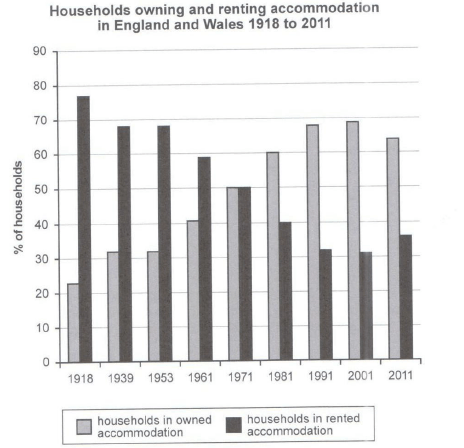
The chart below shows the percentage of households in owned and rented accommodation in England and Wales between 1918 and 2011.
Summarize the information by selecting and reporting the main features and make comparisons where relevant.
Student answer (Band 6.0)
The diagram illustrates the proportion of households between owned and rented residences in England and Wales from 1918 to 2011.
Overall, the percentage of own household accomodations gradually increased and at the end slightly fell.In contrast,rented households possesed a highest percentage at first but it started to decrease gradually ended up with a slight rise .However,househole in own accomodation overtook the percentage of rent accomodation after a few deceades.
Starting with percentage of residences owned by the civilian ,it was about 22% in 1918 which later on gradually increased untill the year 1971 came and it was nearly 50% .After that, it slighlty raise up to approximately 68% in 2001 followed by the year 2011 containing householdes roughly 63%.
For rented accommodation ,the percentage was higher initially (about 76%) in 1918 which gradually decreased a lot around 32% in 2001.Later on it followed a small raise up to nearly 33% in 2011.though the graphs met at 50% for both accomodation in 1971.
AI examiner evaluation
| Criterion | Band |
|---|---|
| Task Achievement / Task Response | 6.5 |
| Coherence and Cohesion | 6.5 |
| Lexical Resource | 5.5 |
| Grammatical Range and Accuracy | 5.5 |
| Overall | 6.0 |
Task Achievement / Task Response: Band 6.5
You identify the main overall movement: ownership rises for most of the period, while renting falls, and the two shares meet at 50% in 1971. You also include useful start and end figures, which makes the account relevant and generally accurate. The overview is present, but some details are unclear or imprecise: ownership is described as increasing “gradually” without noting its plateau between 1939 and 1953 or 2001, and the rented share is said to rise to about 33% in 2011, whereas the chart shows roughly 36%. The crossover is also described vaguely as occurring “after a few decades”; the chart shows the equal point in 1971, followed by ownership becoming higher. More precise comparisons would strengthen the report.
Coherence and Cohesion: Band 6.5
The response has a recognisable structure: an introduction, an overview, and separate paragraphs for ownership and renting. This gives the reader a clear general route through the information, and phrases such as “In contrast” and “After that” help signal relationships between trends. However, progression within sentences is sometimes awkward, and punctuation makes some links harder to follow—for example, “fell.In contrast,rented households” and the final “2011.though”. The overview and detail paragraphs also repeat some information, particularly the 1971 equality point. Grouping the two series by shared stages—early years, the 1971 crossover, and the later period—would create smoother comparisons and reduce repetition.
Lexical Resource: Band 5.5
You use relevant task vocabulary, including “proportion,” “percentage,” “increased,” “decreased,” and “overtook,” so the main trends are understandable. There is also some attempt to vary wording by referring to “owned” and “rented” accommodation. However, several choices are inaccurate or unnatural, such as “the percentage of own household accomodations,” “possessed a highest percentage,” and “a small raise.” Spelling errors in “accomodation,” “untill,” and “deceades” are noticeable, and repeated use of “gradually” limits precision. Aim for standard chart-report collocations such as “the proportion of households in owner-occupied homes” and “rose slightly”; check spelling carefully and use a wider range of accurate trend verbs.
Grammatical Range and Accuracy: Band 5.5
You attempt both simple and more extended sentence forms, including a contrast in “In contrast” and a time clause beginning “which later on…”. The overall meaning is usually recoverable, but some sentence structures are faulty or incomplete. For example, “it started to decrease gradually ended up with a slight rise” needs a clearer connection between the two actions, while “though the graphs met at 50%” is an incomplete sentence in this position. There are also errors in articles and agreement, as in “a highest percentage,” and punctuation spacing and sentence boundaries are inconsistent. Practise building complete sentences with clear subjects and finite verbs, and use accurate linking clauses to express changes over time.
See this exact question answered at other band scores. The same prompt compared across bands.
Browse more IELTS Writing model answers or get your own writing scored by the same AI examiner.