Band 5.5 IELTS Writing Task 1 Model Answer
Overall Band Score: 5.5 · Cambridge IELTS 13 · 2026-11-07
IELTS Writing Task 1 question
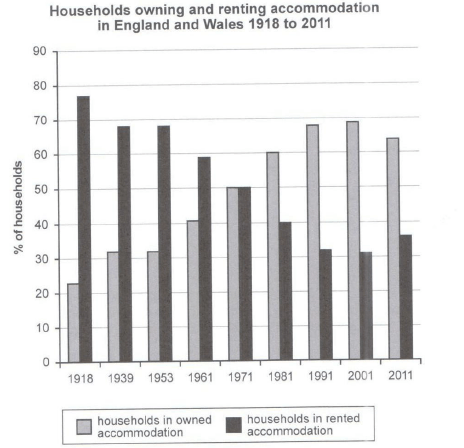
The chart below shows the percentage of households in owned and rented accommodation in England and Wales between 1918 and 2011.
Summarize the information by selecting and reporting the main features and make comparisons where relevant.
Student answer (Band 5.5)
The chart illustrates the proportion of owned households and rented accommodation in Egland and wales During 1918 and 2011.
Overall, The percentage of households in rented accommodation declined over the period, However, the owned ones rose till 2001 and then fall in 2011.
In the first two decades, from 1918 to 1939, rented ones decreased by approximately 10%. In addition the percentage still the same till 1953.
In 1961, it roughly declined to less than 60% and reached 50% in 1971. Furthermore, it continued to decline between 1981 and 1991 to reach the lowest point at above 30% in 2001, nevertheless, it turned to rise again and make up 35% or above in 2011.
On the other hand, Owned househelds continued to side through the period. Ot started at over 20% in 1918 and rose by 10% on 1939 and it also stayed at the same percentage in 1953.
After that, It rose anf reached 50% of households in 1971 so rented and owned ones were equal.
After that It Climbed up to 60% in 1981 and in 1991 and 2001 it reached a peak by approximately 68%. But it declined in 2011 at less than 65%.
AI examiner evaluation
| Criterion | Band |
|---|---|
| Task Achievement / Task Response | 6.5 |
| Coherence and Cohesion | 5.5 |
| Lexical Resource | 5.0 |
| Grammatical Range and Accuracy | 5.0 |
| Overall | 5.5 |
Task Achievement / Task Response: Band 6.5
You cover both accommodation types and provide a clear overview of the main opposing trends: renting generally falls, while ownership rises before dipping at the end. Several key comparisons are also accurate, including the equal 50% shares in 1971 and the ownership peak around 68% in 1991 and 2001. This meets the task well, with some of the detail and overview already showing the precision expected at a higher level. However, a few figures or descriptions are imprecise: renting reaches its lowest point at about 31% in 2001, not “above 30%” as a general low point without identifying the exact year clearly, and it rises to about 36% in 2011. The ownership figure in 1939 rises by about nine percentage points, rather than exactly 10%. More precise reporting of these stages would strengthen the response.
Coherence and Cohesion: Band 5.5
The response has a recognisable structure: an introduction and overview are followed by details about renting and then ownership. This makes the two series easy to identify, and phrases such as “On the other hand” signal the shift between them. However, progression within the paragraphs is not always smooth. Repeated transitions such as “After that” make the account sound mechanical, while “Furthermore” and “nevertheless” do not always express the relationship between the figures clearly. The renting paragraph also moves through several years in a long sequence, and the reference in “the lowest point at above 30% in 2001” is unclear. Grouping the figures into clearer phases and using more precise links would improve the flow and cohesion.
Lexical Resource: Band 5.0
You use relevant vocabulary for describing trends, including “declined,” “rose,” “reached a peak” and “continued to decline,” so the main changes are generally understandable. However, the range is limited and some choices or collocations are noticeably inaccurate, which can make the reader pause. For example, “continued to side” does not describe a trend, and “make up 35% or above” is awkward for reporting a chart value. There are also spelling and word-form errors, including “Egland,” “househelds” and “anf.” Aim for accurate, conventional chart language such as “remained stable,” “accounted for” and “increased to,” and check spelling carefully. This would make your descriptions clearer and more natural.
Grammatical Range and Accuracy: Band 5.0
You attempt both simple and more complex sentences, including clauses linked with “however,” “after that” and “so,” and the overall meaning is usually recoverable. However, errors occur frequently enough to affect fluency. Tense and verb-form problems include “the owned ones rose … and then fall” and “it turned to rise again and make up”; these should use consistent past forms, such as “rose … then fell” and “turned upwards, reaching.” There are also sentence-boundary and punctuation problems, particularly the comma splice in “declined over the period, However,” and inconsistent capitalisation after commas. Some phrasing also lacks grammatical completeness, as in “the percentage still the same till 1953.” Practise accurate past-tense reporting and punctuating linked clauses.
See this exact question answered at other band scores. The same prompt compared across bands.
Browse more IELTS Writing model answers or get your own writing scored by the same AI examiner.