Band 6.5 IELTS Writing Task 1 Model Answer
Overall Band Score: 6.5 · Cambridge IELTS 13 · 2026-11-08
IELTS Writing Task 1 question
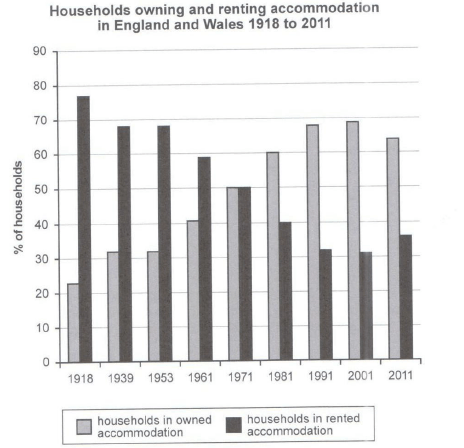
The chart below shows the percentage of households in owned and rented accommodation in England and Wales between 1918 and 2011.
Summarize the information by selecting and reporting the main features and make comparisons where relevant.
Student answer (Band 6.5)
The bar chart illustrates the proportion of families in owned and rented houses in England and Wales between the period of 1918 and 2011.
Overall, it is clear that families in owned accomodation increased within the time period while families in rented accomodation decreased steadily and both became same in 1971.
In 1918, families in owned houses was 23% while in rented accomodation comprised of 77%, whereas In 1939, households in owned accomodation increased to 32% and households in rented accomodation declined to 68%. It remained constant at 32% and 68% in 1953 respectively. In 1961, families in owned houses made up 40% while families in rented houses made up 59%. However, in 1971, households in both rented and owned accomodation became equal at 50%.
Moreover, In 1981, families in owned accomodation increased to 60% while in rented accomodation decreased to 40%. In 1991, residents in owned apartments increased to 68% and residents in rented apartments dropped to 32%, whereas in 2001, residents in owned apartments slightly increased to 69% and in rented accomodation slightly fell to 31%. While in 2011, families in owned apartments fell to 64% and households in rented accomodation rose to 36%.
AI examiner evaluation
| Criterion | Band |
|---|---|
| Task Achievement / Task Response | 6.5 |
| Coherence and Cohesion | 7.0 |
| Lexical Resource | 6.5 |
| Grammatical Range and Accuracy | 6.0 |
| Overall | 6.5 |
Task Achievement / Task Response: Band 6.5
You identify the main pattern accurately: ownership rises overall, renting falls, and the two shares meet at 50% in 1971. The overview is relevant, and the response reports the key stages across the period, including the slight reversal in 2011. Most figures match the chart; the 1961 ownership figure is given as 40% rather than approximately 41%, a small difference, while the other reported values are accurate. This covers the task well, though the overview could be more precise by noting that ownership peaks at about 69% in 2001 before declining, rather than describing renting as decreasing steadily throughout. A clearer emphasis on this turning point would make the main features more fully developed.
Coherence and Cohesion: Band 7.0
The response is organised into an introduction, a clear overview, and two chronological detail paragraphs. The sequence from 1918 to 2011 is easy to follow, and linking expressions such as “whereas,” “Moreover,” and “However” help signal comparisons and changes. The paired figures for ownership and renting are generally presented together, which supports the reader’s understanding. Some transitions are slightly mechanical, and repeated openings such as “In 1991” and “in 2001” make the later paragraph read like a list. The capitalisation after commas in “whereas In 1939” and “Moreover, In 1981” also interrupts the flow. Varying sentence openings and grouping the early and later trends more deliberately would make cohesion more flexible.
Lexical Resource: Band 6.5
You use an adequate range of task-related vocabulary, including “proportion,” “declined,” “remained constant,” “increased,” and “fell,” and the meaning is consistently clear. There is some variation in how the groups are described, but terms such as “families,” “households,” and “residents” are not always precise or consistent for chart data; “households” would be the clearest choice throughout. “Owned houses” and “owned apartments” also shift the meaning from accommodation ownership to particular property types, which the chart does not specify. The spelling of “accomodation” is repeated incorrectly. More accurate, consistent collocations and careful spelling would strengthen the vocabulary control while preserving the clear reporting style.
Grammatical Range and Accuracy: Band 6.0
You use a mix of simple and complex sentence forms, including comparisons with “while” and “whereas,” and most sentences communicate the figures clearly. However, some errors in agreement and sentence construction remain. For example, “families in owned houses was 23%” should use a plural verb (“were”), while “rented accomodation comprised of 77%” has an awkward grammatical pattern; write “rented accommodation accounted for 77%.” The sentence beginning “Overall” also needs a clearer structure: “the proportion of households in owned accommodation increased, while the proportion renting decreased.” Capitalisation after commas is inconsistent, as in “whereas In 1939.” Improving agreement, clause structure, and punctuation would make the range more controlled and accurate.
See this exact question answered at other band scores. The same prompt compared across bands.
Browse more IELTS Writing model answers or get your own writing scored by the same AI examiner.