Band 6.5 IELTS Writing Task 1 Model Answer
Overall Band Score: 6.5 · Cambridge IELTS 13 · 2026-11-09
IELTS Writing Task 1 question
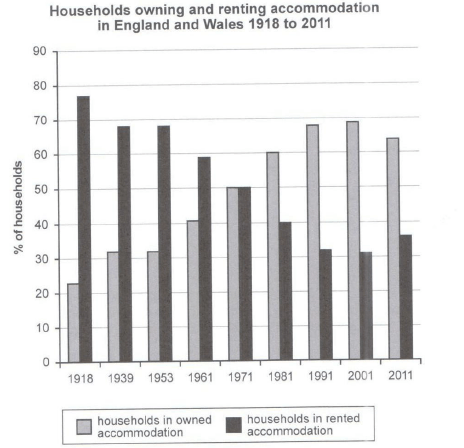
The chart below shows the percentage of households in owned and rented accommodation in England and Wales between 1918 and 2011.
Summarize the information by selecting and reporting the main features and make comparisons where relevant.
Student answer (Band 6.5)
The graph illustrates difference in proportion of households in owned and rented accomodation in England and Wales in 1918 and 2011.
Overall, significant differences can be observed among the given categories. The percentage of owned home experienced an upward trend, whereas rental units showed downward trend over a period of time.
Firstly, The most noticable feature is that living in rented houses recorded the highest figures, while proportion of people who owned the houses remained lowest in 1918. Moreover, the numbers for both rental and personal residences remained unchanged in 1939 and 1953 with 68% and 32% respectively. However, the figures for rental housing decreased to 59% and for owner-occupied housing increased to 41% in 1961.
Additionally, in 1971 both categoried represented 50% of households. In contrast, percentage of owned accodomation steadily inclined and reach a peak of 69%, while number for rental housing declined to the lowest of 31% in 2001. In 2011 rented accomodation again started increasing with 36% and owned houses stood at 64%.
AI examiner evaluation
| Criterion | Band |
|---|---|
| Task Achievement / Task Response | 6.5 |
| Coherence and Cohesion | 6.5 |
| Lexical Resource | 6.0 |
| Grammatical Range and Accuracy | 6.0 |
| Overall | 6.5 |
Task Achievement / Task Response: Band 6.5
The response identifies the main contrast and overall direction: ownership generally rose while renting declined, and it reports the later reversal in 2011. It also selects several useful comparisons, including the equal 50% shares in 1971 and the 2001 peak in ownership. These details are largely consistent with the chart. However, the opening refers to the period as “1918 and 2011,” which can suggest only two years rather than the full sequence, and the overview could more clearly state that renting was the larger category at the start before the two shares converged and ownership became dominant. The claim that ownership “steadily” increased also overlooks its fall from 69% to 64% in 2011. More precise coverage of the full trend would strengthen the summary.
Coherence and Cohesion: Band 6.5
The response has a clear overall arrangement: an introduction and overview are followed by chronological details, with the 1971 crossover and 2011 change presented in sequence. Connectors such as “Moreover,” “However,” and “In contrast” help signal relationships between figures. This gives the report a coherent progression. At times, though, the linking language feels mechanical, and “Firstly” and “Additionally” do not add much to the chronological organisation. The overview and detail paragraphs could also be more distinctly developed, with the overview summarising the crossover and late reversal rather than repeating general trend language. Clearer referencing—for example, naming the two categories consistently—would make some comparisons easier to follow.
Lexical Resource: Band 6.0
The response uses a reasonable range of task-related vocabulary, including “proportion,” “upward trend,” “declined,” and “peak,” and the intended meaning is generally clear. It also attempts more specific expressions such as “owner-occupied housing.” However, several word choices and collocations are inaccurate or awkward: “percentage of owned home,” “rental units,” and “numbers for both rental and personal residences” do not describe the chart’s household shares naturally. There are also spelling errors in “accomodation,” “noticable,” “categoried,” and “accodomation.” Use consistent terms such as “households in owned accommodation” and “the proportion renting,” and check spelling carefully. This would make the vocabulary more precise and controlled.
Grammatical Range and Accuracy: Band 6.0
There is a mix of simple and more complex sentence forms, and most of the information remains understandable. For example, the contrast in “The percentage of owned home experienced an upward trend, whereas rental units showed downward trend” shows an attempt to combine ideas. Some grammatical errors remain, however. Articles are missing in “in owned and rented accommodation” and “showed downward trend”; “percentage of owned home” also needs a more accurate noun structure. In “percentage of owned accommodation steadily inclined and reach a peak,” the verb form and tense are not controlled consistently. Capitalisation after “Firstly,” is also incorrect. Review articles, subject–verb agreement, and past-tense consistency, while retaining the range of sentence structures already attempted.
See this exact question answered at other band scores. The same prompt compared across bands.
Browse more IELTS Writing model answers or get your own writing scored by the same AI examiner.