Band 5.5 IELTS Writing Task 1 Model Answer
Overall Band Score: 5.5 · Cambridge IELTS 13 · 2026-11-10
IELTS Writing Task 1 question
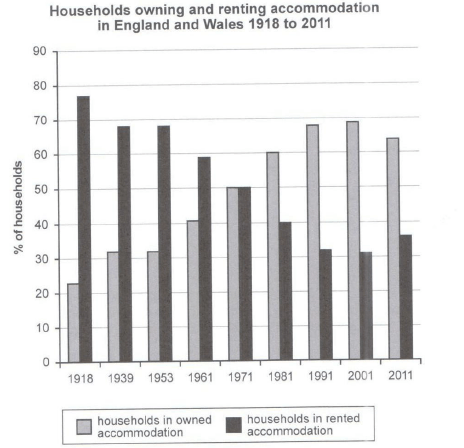
The chart below shows the percentage of households in owned and rented accommodation in England and Wales between 1918 and 2011.
Summarize the information by selecting and reporting the main features and make comparisons where relevant.
Student answer (Band 5.5)
Graph shows comparison of owning and renting husehold accomodations in England and Wales over the years from 1918 to 2011.If we talk about the household owned accomodation it is gradually increasing over the years ,compare to rented ones which are decreasing in percentage with time. According to graph, from 1918 to 1950 mostly people live in rented houses but as the time passes people of england and wales started to owned the houses in which they live and this trend immensly increasing from 1981 to 2011. According to this graph 60 to 70 percent people owned their houses till 2000. Household rented accomodation majorly decrease in between 1981 to 2001 and get a slight uplift in 2011. As the graph shows in 1971 the percentage of owned and rented household are equal, but with the time going most of the people prefer to own their houses and this percentage has been increasing with time .
AI examiner evaluation
| Criterion | Band |
|---|---|
| Task Achievement / Task Response | 6.0 |
| Coherence and Cohesion | 5.0 |
| Lexical Resource | 5.5 |
| Grammatical Range and Accuracy | 5.5 |
| Overall | 5.5 |
Task Achievement / Task Response: Band 6.0
You identify the chart’s central contrast: ownership generally rises while renting falls, and you note that the two shares are equal in 1971 and that renting edges up by 2011. These are relevant features and the broad trends are accurate. However, some details are imprecise: ownership does not keep increasing through 2011, but falls from about 69% in 2001 to 64%; renting correspondingly rises from about 31% to 36%. The claim that ownership increased “immensely” from 1981 to 2011 also overstates the pattern, which includes a plateau and a final decline. The overview is present, but key stages and figures need clearer, more precise reporting and comparison.
Coherence and Cohesion: Band 5.0
The response has a generally understandable order: it introduces the two trends, describes the earlier preference for renting, and then mentions the crossover and later changes. However, it is presented as one continuous paragraph, so the overview and supporting details are not clearly separated. Several linking phrases, including “According to graph” and “As the graph shows,” are repeated and do not always help the progression. The time references also move between broad periods and individual years without a clear structure. Organise the response into an introduction, a concise overview, and paragraphs comparing the earlier and later periods; use links such as “By contrast” or “After reaching a peak” only where they clarify relationships.
Lexical Resource: Band 5.5
You use relevant topic vocabulary, including “percentage,” “owned,” “rented,” “decrease,” and “uplift,” and the main meaning is usually clear. There is some attempt to describe change, but several choices are imprecise or unnatural for chart reporting: “immensly increasing” exaggerates the trend, “slight uplift” is informal, and “people ... started to owned the houses” is not an appropriate collocation. Spelling errors such as “husehold,” “accomodations,” and “england” also reduce accuracy. Aim for precise terms such as “the proportion of households,” “rose steadily,” and “increased slightly,” and check spelling and word forms before finishing.
Grammatical Range and Accuracy: Band 5.5
You attempt both simple statements and longer clauses, for example, “As the graph shows in 1971...” and the sentence contrasting ownership with renting. The overall message remains understandable, but some grammatical errors recur. Examples include “people ... started to owned” (use “started to own”), “the percentage ... are equal” (use “was equal”), and “compare to rented ones” (use “compared with rented accommodation”). Articles and sentence boundaries also need attention: the opening runs directly into “If we talk...” without a space or clear punctuation, and several clauses are joined with commas. Practise accurate verb forms, agreement, and punctuation while retaining a mix of sentence structures.
See this exact question answered at other band scores. The same prompt compared across bands.
Browse more IELTS Writing model answers or get your own writing scored by the same AI examiner.