Band 5.5 IELTS Writing Task 1 Model Answer
Overall Band Score: 5.5 · Cambridge IELTS 13 · 2026-11-10
IELTS Writing Task 1 question
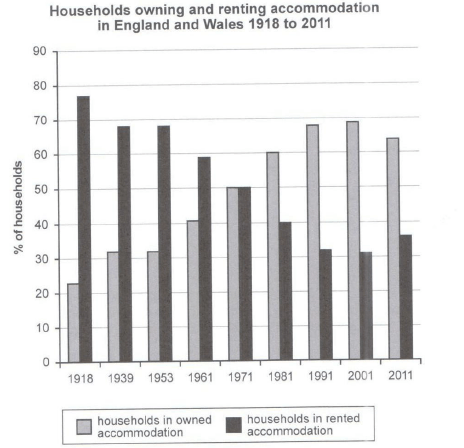
The chart below shows the percentage of households in owned and rented accommodation in England and Wales between 1918 and 2011.
Summarize the information by selecting and reporting the main features and make comparisons where relevant.
Student answer (Band 5.5)
The chart illustrates the percentage of households in owned and rented accommodation in England and Wales between 1918 and 2011.
From the graph we can see that the percentage of households in rented accommodation in 1918 is the highest but gradually fell after some year. On the other hand , the percentage of households in owned accommodation was lower but gradually increased after some years. The percentage of households in rented accommodation in 1939 and 1953 was approximately same aslo the percentage of households in owned accommodation in these years.
After 1953, the percentage of households in rented accommodation started to fall but the percentage of households in owned accommodation started to rise. Thus we can say that people felt comfortable of having their owned house in modern years. At some point in 1971, the percentage was same for both which was 50%.
But in 2011, the percetage of households in owned accommodation started to fell a little bit than previous year and the percentage of households in rented accommodation started to rose a little bit in 2011 than previous years.
From the graph we can actually can understands how people of modern years chose to be in their owned house rather than rented house.
AI examiner evaluation
| Criterion | Band |
|---|---|
| Task Achievement / Task Response | 5.5 |
| Coherence and Cohesion | 5.5 |
| Lexical Resource | 5.0 |
| Grammatical Range and Accuracy | 5.0 |
| Overall | 5.5 |
Task Achievement / Task Response: Band 5.5
You identify the two series and describe their broad opposing movement, including the equal 50% figures in 1971 and the reversal in 2011. These are relevant features, and the reported values are broadly consistent with the chart. However, the overview is not sufficiently precise: renting was highest at the start and ownership rose to a peak of about 69% in 2001 before falling, but that peak is not reported. The claim that people felt more comfortable owning homes is speculation rather than information shown by the chart. Also, the statement that the 1939 and 1953 figures were approximately the same is unclear about which series is being compared. Focus on the main trends and key turning points, without explaining causes the chart cannot establish.
Coherence and Cohesion: Band 5.5
The response has a basic structure: an introduction, paragraphs describing trends, and a concluding statement. Time markers such as “After 1953” and “in 2011” help the reader follow the chronology. However, the progression is repetitive, with the same rise-and-fall pattern restated in several places, and the final paragraph repeats the general preference for ownership rather than adding a useful summary. Some linking is awkward or mechanical, particularly “On the other hand” and “Thus we can say,” while the long middle paragraph combines several stages without clear separation. Organise the response around an overview followed by selected comparisons across periods, and use references such as “the ownership figure” to make comparisons clearer.
Lexical Resource: Band 5.0
You use relevant basic terms, including “percentage,” “owned accommodation,” “rented accommodation,” “gradually fell,” and “gradually increased,” so the topic remains understandable. However, the vocabulary is limited and repetitive, especially the repeated use of “percentage” and “started to.” Several word-choice and spelling problems reduce precision: “comfortable of having their owned house” is an unnatural expression, and “percetage” is misspelled. “Modern years” is also vague, while “same” needs a more suitable expression in this context. Use a wider range of accurate trend language and collocations, such as “the proportion of households,” “reached a peak,” and “declined slightly,” while avoiding unsupported interpretations about people’s preferences.
Grammatical Range and Accuracy: Band 5.0
You attempt both simple and complex sentences, for example, “After 1953, the percentage … started to fall but … started to rise,” and most of the intended meaning can be understood. However, errors occur frequently, particularly in verb forms and sentence construction. Examples include “started to fell” and “started to rose,” where the verb after “started to” should be in its base form, and “can actually can understands,” which has duplicated modal structure and incorrect agreement. The sentence about 1939 and 1953 also lacks a clear grammatical comparison. There are punctuation and spacing issues, such as the space before the comma in “On the other hand ,”. Practise accurate verb patterns and build shorter, controlled comparisons before adding more complex clauses.
See this exact question answered at other band scores. The same prompt compared across bands.
Browse more IELTS Writing model answers or get your own writing scored by the same AI examiner.