Band 5.5 IELTS Writing Task 1 Model Answer
Overall Band Score: 5.5 · Cambridge IELTS 13 · 2026-11-11
IELTS Writing Task 1 question
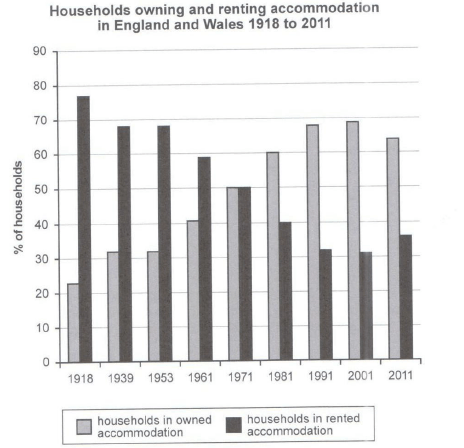
The chart below shows the percentage of households in owned and rented accommodation in England and Wales between 1918 and 2011.
Summarize the information by selecting and reporting the main features and make comparisons where relevant.
Student answer (Band 5.5)
The chart shows the households owning and renting accommodation in england and wales from 1918 to 2011.On the x-axis we can see the percentage of the households listed and the y-axis shows the years.From 1918 we can see a huge rise upto 75 percent in rented accommodation while owned stayed at 25 percent,but that changed in the year 1939 the rented accomodation witnessed a slight decrease and owned went upto 32 percent which stayed almost the same till the year 1953.In 1961, owned accommodation rised upto 40 percent gradually decreasing the rented accommodation and owned properties and rented met the same percentage in 1971.After this the owned accommodation kept rising and went upto around 70 percent in 2001 while the rented properties saw a major decrease over these years and was at the lowest 30 percent in in 2001.In the end the owned accommodation was at 65 percent and rented was at 35 percent in the year 2011.
AI examiner evaluation
| Criterion | Band |
|---|---|
| Task Achievement / Task Response | 5.0 |
| Coherence and Cohesion | 5.5 |
| Lexical Resource | 5.5 |
| Grammatical Range and Accuracy | 5.5 |
| Overall | 5.5 |
Task Achievement / Task Response: Band 5.0
You identify the two categories and describe the broad shift from renting to ownership, including the crossover in 1971 and the reversal in 2011. However, the response does not give a clear overview that summarises the main pattern, and some figures or trends are inaccurate: ownership was about 23% in 1918, not 25%, and it rose to about 69% in 2001 rather than “around 70%” (a reasonable approximation), while renting was about 31%, not exactly 30%. More importantly, “a huge rise” in renting from 1918 is the opposite of the chart, where renting falls from about 77%. Add a concise overview and report the main stages accurately to make the account more complete and clear.
Coherence and Cohesion: Band 5.5
The response follows the years in chronological order, so the reader can trace the changes, and phrases such as “After this” and “In the end” provide basic links. However, the information is presented as one continuous paragraph, with no distinct overview or grouping of the main trends. Several transitions are also unclear: “From 1918 we can see a huge rise” does not specify the period of change and conflicts with the later description of a decrease. The sentence beginning “In 1961” combines several trends without clearly separating them. Organise the response into an introduction, an overview, and one or two detail paragraphs, and use links that make the direction and timing of each change explicit.
Lexical Resource: Band 5.5
You use relevant vocabulary for describing charts, including “decrease,” “rising,” “lowest,” and “percentage,” and the meaning is generally understandable. However, the range is limited and some choices are imprecise or repetitive: “went upto” is used for several different movements, while “huge rise” inaccurately describes the rental trend. There are also spelling and form errors, such as “accomodation” and “rised,” and “owned properties” is less precise than the chart’s category of households in owned accommodation. Choose verbs that match the data, such as “declined,” “increased,” or “remained stable,” and use the category labels consistently. Check spelling and avoid repeating the same general phrase.
Grammatical Range and Accuracy: Band 5.5
You attempt to connect several clauses and use past-tense reporting, which helps convey the sequence of changes. However, many sentences are long and joined mainly with commas, as in “In 1961, owned accommodation rised…,” making relationships between ideas difficult to follow. There are also errors in verb forms and sentence construction, including “owned accommodation rised” and “rented met the same percentage”; the latter would be clearer as “the two figures were equal.” Missing spaces after full stops and inconsistent punctuation also affect readability. Use a mix of shorter, complete sentences and carefully controlled complex sentences, and check past-tense forms, articles, and punctuation before submitting.
See this exact question answered at other band scores. The same prompt compared across bands.
Browse more IELTS Writing model answers or get your own writing scored by the same AI examiner.