Band 5.0 IELTS Writing Task 1 Model Answer
Overall Band Score: 5.0 · Cambridge IELTS 13 · 2026-11-11
IELTS Writing Task 1 question
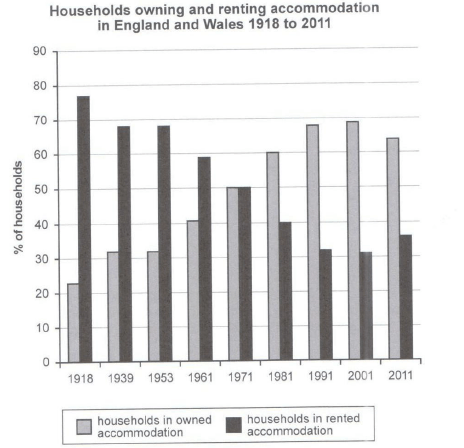
The chart below shows the percentage of households in owned and rented accommodation in England and Wales between 1918 and 2011.
Summarize the information by selecting and reporting the main features and make comparisons where relevant.
Student answer (Band 5.0)
The bar chart illustrates the average of households in private and rented residence in twin cities england and Walles between 1918 and 2011.
Overall, the percentage of private accommodation was increaesd significantly then decline in the end of period, while the proportion of rented residence decreased relatively and in the last year it increased slightly.In addition,both category was at same rate in 1971.
The households in owned accommodation experienced rose dramatically from approximately 23% in 1918 to 69% in 2001 after that it showed some declined by 5% in last few years. furthermore , the both category was at same percentage in 1971 around 50%.
moreover, the
AI examiner evaluation
| Criterion | Band |
|---|---|
| Task Achievement / Task Response | 5.0 |
| Coherence and Cohesion | 4.5 |
| Lexical Resource | 5.5 |
| Grammatical Range and Accuracy | 5.0 |
| Overall | 5.0 |
Task Achievement / Task Response: Band 5.0
You identify the main contrast and a key turning point: ownership rises overall, renting falls, and the two figures meet at about 50% in 1971. You also report the ownership peak of 69% in 2001 and its subsequent fall to 64% in 2011. However, the response is incomplete: the final paragraph trails off at “moreover, the”, and the rented figures are not supported with specific data beyond the overview. The opening also misdescribes the chart as showing “twin cities” and “private” accommodation, rather than households in England and Wales and owned accommodation. The response is 107 words, below the required 150, which limits how fully you can summarise and compare the data. Develop both series across the period and complete the report.
Coherence and Cohesion: Band 4.5
There is a basic overall structure: an introduction, an overview, and a paragraph giving figures for ownership. The overview also groups the main trends and notes the 1971 equality, giving the reader a useful starting point. However, progression is limited because the rented series is not developed in a separate comparison, and the response ends abruptly with “moreover, the”. Connect the ownership and renting figures in a complete sequence, for example by comparing their shared 1971 value with the opposite trends before and after it. Linking expressions such as “Overall”, “In addition” and “Furthermore” are attempted, but some are awkwardly placed or punctuated, and the repeated “moreover/furthermore” does not create clear progression.
Lexical Resource: Band 5.5
You use some relevant chart vocabulary, including “percentage”, “proportion”, “accommodation” and “declined”, and the reader can generally understand the intended trends. There is also an attempt to vary wording between “owned” and “rented” categories. However, several choices are inaccurate or unnatural: “average of households” does not describe percentages, “private accommodation” is not the chart’s category, and “twin cities” misrepresents the locations. Spelling errors such as “increaesd” and “Walles” are noticeable, while “some declined” is an awkward word form. Use precise terms from the chart and familiar collocations such as “the proportion of households” and “home ownership”; check spelling and word forms before submitting.
Grammatical Range and Accuracy: Band 5.0
The response attempts both simple statements and longer sentences, including a contrast in the overview and a time sequence in “from approximately 23% in 1918 to 69% in 2001 after that…”. However, control is inconsistent, and several sentences contain errors that make the relationships between ideas less clear. For example, “the percentage … was increaesd” uses an incorrect passive form, while “both category was” has a number-agreement error. The sentence about the ownership rise also needs clearer punctuation or a connector before “after that”. Articles and sentence boundaries are not consistently controlled, as seen in “the both category” and the run-on transition after “slightly”. Practise accurate past-tense trend descriptions and build complete, correctly punctuated comparisons.
See this exact question answered at other band scores. The same prompt compared across bands.
Browse more IELTS Writing model answers or get your own writing scored by the same AI examiner.