Band 5.5 IELTS Writing Task 1 Model Answer
Overall Band Score: 5.5 · Cambridge IELTS 13 · 2026-11-11
IELTS Writing Task 1 question
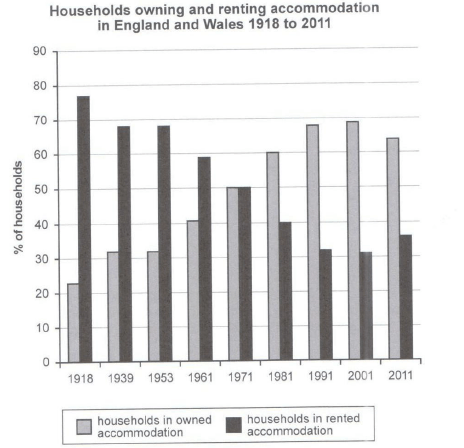
The chart below shows the percentage of households in owned and rented accommodation in England and Wales between 1918 and 2011.
Summarize the information by selecting and reporting the main features and make comparisons where relevant.
Student answer (Band 5.5)
The bar chart compares the data of households from England and Wales about how much are owned and how much of accommodations are rented from the years 1918 to 2011.
The rented accommodation declined throughout the years from 1918 to 2011. It surged up a little again after 2001 when it was at its lowest of about 30% households and in 2011 about 35% households renting accommodation. The highest numbers were in 1918 at about 78% households and it being equal from 1939 to 1959 at about 68%.
The owning accommodation kept surging up throughout the years and then hit a little plummet in 2011 to about 65%. The highest households owning accommodation were in 2001 at about 68%. The lowest figures were in years 1939 to 1959 at about 32%.
Both owning and renting accommodations were same in year 1971 at about 50% each.
AI examiner evaluation
| Criterion | Band |
|---|---|
| Task Achievement / Task Response | 5.5 |
| Coherence and Cohesion | 6.0 |
| Lexical Resource | 5.5 |
| Grammatical Range and Accuracy | 5.5 |
| Overall | 5.5 |
Task Achievement / Task Response: Band 5.5
You identify the main contrast and several key stages: renting starts highest, ownership rises, the two meet at about 50% in 1971, and ownership peaks around 2001 before falling. Most figures are close to the chart. However, the overview is not clearly separated from the details, and the description is incomplete: for example, ownership is broadly stable from 1939 to 1953, while renting falls overall, rather than declining at every point. The reference to “1939 to 1959” also misstates the chart’s 1953 date. The response is five words below the 150-word minimum, which limits how fully the trends can be reported. Add a concise overview and cover the main turning points more precisely.
Coherence and Cohesion: Band 6.0
The response has a clear basic structure, with an opening sentence followed by separate paragraphs about renting, ownership, and the point where the figures are equal. This makes the main comparisons easy to locate. However, the progression is somewhat list-like: the two trend paragraphs repeat similar information about highs and lows, and there is no distinct overview to guide the reader through the chart’s main pattern. Some links between ideas are also awkward, such as “It surged up a little again,” where the reference of “It” is not immediately clear. Grouping the shared trends and turning points more deliberately, and using clearer references and transitions, would make the organisation more cohesive.
Lexical Resource: Band 5.5
You use relevant chart vocabulary, including “declined,” “lowest,” “highest,” and “about,” so the main trends are generally understandable. However, several choices are inaccurate or unnatural for describing data. “Surged up” suggests a sharp rise, although the changes are gradual, and “plummet” overstates the small fall in ownership in 2011. Phrases such as “the data of households” and “how much are owned” are also imprecise, while “accommodations” is less natural here than “accommodation” or “homes.” Aim for precise trend language and standard collocations for proportions. This would improve clarity and give you a more suitable range for an academic chart summary.
Grammatical Range and Accuracy: Band 5.5
Your meaning is usually clear, and you attempt both simple statements and more developed sentences, such as “It surged up a little again after 2001 when it was at its lowest.” However, some sentence patterns are awkward or incomplete. The opening phrase “compares the data of households … about how much are owned” has an unclear structure, and “The highest numbers were in 1918 … and it being equal” does not form a well-controlled parallel construction. There are also issues with articles and number agreement in phrases such as “the owning accommodation” and “Both owning and renting accommodations were same.” Use direct structures—for example, “The proportion of rented households fell”—and check articles, agreement, and sentence completeness.
See this exact question answered at other band scores. The same prompt compared across bands.
Browse more IELTS Writing model answers or get your own writing scored by the same AI examiner.