Band 5.5 IELTS Writing Task 1 Model Answer
Overall Band Score: 5.5 · Cambridge IELTS 13 · 2026-11-11
IELTS Writing Task 1 question
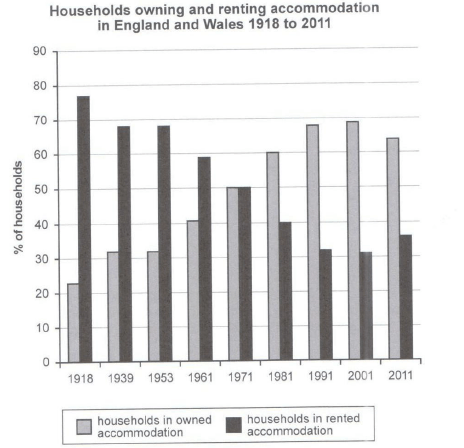
The chart below shows the percentage of households in owned and rented accommodation in England and Wales between 1918 and 2011.
Summarize the information by selecting and reporting the main features and make comparisons where relevant.
Student answer (Band 5.5)
The percentage of households in owned and rented accomodation shows a dramatic shift in last century. In 1918, nearly 80% of population was living in rented accomodations. With the passage of time it shifted drastically low to 30%.
One of the enormous reason of this shift is purchasing power of individual person increased repidly in the recent years especially after 1980. People preffered to own a house rather than renting one.
On the other hand if we take a look on broader perspective, England developed and improved their infrastructure. They worked on their living standards. England and Wales reshaped its way of living by developing civilization and cities to attract tourists.
For a moment if we focus on the specific time in the history, In 1970's the ratio of owned accomodation and rented accomodation was balanced 50/50. This was the perfect time when none of them had issues to own or rent an apartment
In conclusion, people learned a lesson from the past for not owning a house, then they gained their purchasing power by developing their financial conditions.
AI examiner evaluation
| Criterion | Band |
|---|---|
| Task Achievement / Task Response | 5.5 |
| Coherence and Cohesion | 5.5 |
| Lexical Resource | 5.5 |
| Grammatical Range and Accuracy | 5.5 |
| Overall | 5.5 |
Task Achievement / Task Response: Band 5.5
You identify the chart’s broad direction correctly: renting falls while ownership rises, and you note the equal split around 1971. However, the response only partially reports the visual data. The opening gives rented accommodation as nearly 80% in 1918 and says it fell to 30%, but does not report the corresponding ownership figures or explain that ownership rose from about 23% to a peak of 69% in 2001 before declining slightly. Much of the response instead speculates about purchasing power, infrastructure, tourism and people learning a lesson; these explanations are not shown by the chart. Focus on an overview of the trends and support it with accurate comparisons across the period, without adding causes the data cannot establish.
Coherence and Cohesion: Band 5.5
The response has separate paragraphs and uses signposting such as “On the other hand,” “For a moment” and “In conclusion,” so the reader can see an attempt to organise the discussion. However, the progression is not consistently logical: the second and third paragraphs introduce unsupported explanations rather than developing comparisons from the chart, and the conclusion repeats a speculative claim instead of summarising the main trends. Some linking phrases also do not express a clear contrast or relationship. A clearer sequence would be an overview followed by a paragraph comparing the early years with the midpoint, then one describing the later rise in ownership and slight reversal by 2011. Use references and connectors only where they clarify those comparisons.
Lexical Resource: Band 5.5
You use some topic-related vocabulary, including “owned and rented accommodation,” “ratio” and “purchasing power,” and attempt more descriptive language such as “dramatic shift.” However, the range is limited for describing chart data, and several choices are inaccurate or awkward: “shifted drastically low” and “one of the enormous reason” do not express the intended meaning naturally. There are also noticeable spelling errors, including “accomodation,” “repidly” and “preffered.” These do not prevent the general message from being understood, but they reduce precision and fluency. Build a small set of accurate trend expressions—such as “declined,” “rose steadily,” “reached a peak” and “fell slightly”—and check spelling and collocations before submitting.
Grammatical Range and Accuracy: Band 5.5
You attempt a mixture of simple and more complex sentences, for example, “In 1918, nearly 80% of population was living…” and “One of the enormous reason… increased…”. However, control is uneven, particularly in longer constructions. Examples include “One of the … reason … increased,” where the subject and verb do not agree, and “England and Wales reshaped its way of living,” where the pronoun does not match the compound subject. Articles and sentence boundaries also need attention, as in “80% of population” and the comma splice in “the ratio … was balanced 50/50. This was…” (the latter is better separated or joined with a suitable connector). Practise accurate subject–verb agreement, articles and sentence construction while keeping the useful variety of sentence forms.
See this exact question answered at other band scores. The same prompt compared across bands.
Browse more IELTS Writing model answers or get your own writing scored by the same AI examiner.