Band 6.0 IELTS Writing Task 1 Model Answer
Overall Band Score: 6.0 · Cambridge IELTS 13 · 2026-11-11
IELTS Writing Task 1 question
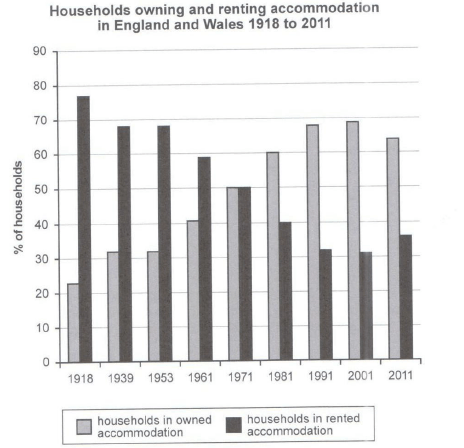
The chart below shows the percentage of households in owned and rented accommodation in England and Wales between 1918 and 2011.
Summarize the information by selecting and reporting the main features and make comparisons where relevant.
Student answer (Band 6.0)
The bar chart illustrates the proportion of personal and rented accomodations in England and wales between 1918 and 2011.Overall, the trend of living in rental properties remained dominant till the mid of the given time but then it declined by the end of the period.
In the year 1918,the highest proportion of people about 75% lived in rented accomodations which remained stable for the next two years nearly at 68%.Following the next year 1961 it dropped to 58% and then equalled to home ownership at 50% in next decade.For the last four decades, this trend to live in rented housed dropped steadily,starting from 40% and ending at approximately 38% in 2011.
As concerned for the house ownership which grew consistently from 20% in 1918 to 40% in 1961.After becoming equal to rental accomodations in 1971,home ownership increased significantly to 67% in 1991.For the second last decade of the given period it increased slightly by 68% and then declined to 63% by the end of the period.
AI examiner evaluation
| Criterion | Band |
|---|---|
| Task Achievement / Task Response | 6.5 |
| Coherence and Cohesion | 6.5 |
| Lexical Resource | 6.0 |
| Grammatical Range and Accuracy | 5.5 |
| Overall | 6.0 |
Task Achievement / Task Response: Band 6.5
You identify the two categories and give a clear overall pattern: renting was higher at the start, the figures met in 1971, and ownership then became more common. Most reported values are close to the chart, including the 50% crossover and the ownership peak around 69% in 2001. However, the overview says renting remained dominant until the middle of the period, which is imprecise because the lines meet in 1971; the later decline is also described as steady even though renting levels off around 1991–2001 before rising in 2011. The phrase “next two years” misrepresents the interval between 1918 and 1939. More precise coverage of these stages and the final reversal would make the summary more complete.
Coherence and Cohesion: Band 6.5
The response has a coherent overall arrangement: an introduction and overview are followed by a paragraph on renting and one on ownership. This makes the two series easy to compare, and phrases such as “After becoming equal” help connect the trends. The progression is not always precise, however. “Following the next year 1961” is confusing because 1961 is not the next year after 1953, and “For the last four decades” groups several distinct changes, including the plateau and final rise in renting. Some transitions feel mechanical, while missing spaces after full stops make the paragraph boundaries less polished. Use clear time markers such as “By 1961” and “From 1991 to 2001” to guide the reader through the data.
Lexical Resource: Band 6.0
You use an adequate range of trend vocabulary, including “remained stable,” “dropped,” “grew consistently,” “increased significantly,” and “declined.” These choices generally communicate the main movements, and the repeated topic vocabulary keeps the report focused. Some word choices and collocations are inaccurate or imprecise: “personal … accommodations” does not describe the ownership category, “the trend of living in rental properties” is awkward, and “rented housed” is not a natural phrase. “Stable for the next two years” also gives the wrong sense of the interval. Spelling errors in “accomodations” and the lower-case “wales” reduce accuracy. Prefer standard chart language such as “owner-occupied homes,” “rented accommodation,” and “remained unchanged between 1939 and 1953.”
Grammatical Range and Accuracy: Band 5.5
You attempt both simple and more complex sentence forms, including the overview sentence with “but” and the ownership sentence beginning “After becoming equal…”. Meaning is generally recoverable, but some grammatical errors and punctuation problems remain. For example, “In the year 1918,the highest proportion of people about 75% lived” has faulty punctuation and an awkwardly placed figure; “Following the next year 1961 it dropped” lacks a clear grammatical connection; and “As concerned for the house ownership” is not a well-formed introductory phrase. There are also missing spaces after full stops and commas. Build cleaner clauses—for example, “In 1918, about 77% of households rented their homes”—and check sentence boundaries and punctuation to improve control.
See this exact question answered at other band scores. The same prompt compared across bands.
Browse more IELTS Writing model answers or get your own writing scored by the same AI examiner.