Band 5.5 IELTS Writing Task 1 Model Answer
Overall Band Score: 5.5 · Cambridge IELTS 13 · 2026-11-11
IELTS Writing Task 1 question
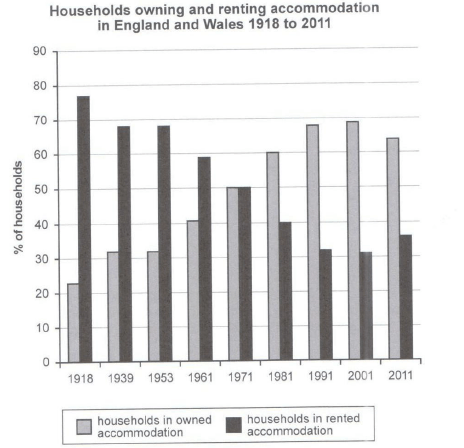
The chart below shows the percentage of households in owned and rented accommodation in England and Wales between 1918 and 2011.
Summarize the information by selecting and reporting the main features and make comparisons where relevant.
Student answer (Band 5.5)
The charts illustrates the proportion of households in owned and rented accommodation in England and Wales between 1918 and 2011.
Overall it can be seen that, households in owned accommodation increased, whereas households in rented decreased. Furthure, rented households in 1918 was the highest figure on entire chart.
Looking at the owned households data in more details it is clear that, about 23% of owned households stood in 1918 which was the lowest proportion on the chart then it increased to 32% in 1939 and remained unchange untill 1953, respectively. Owned accommodation gradually increased from 32% in 1953 to 69% in 2001, while it decreased 64% in 2011.
Turning to the rented data in more details it is evident that, about 77% of rented house in 1918. In 1939 and 1953 the proportion of rented accommodation was same about 68%, then it steadly decreased untill 2001 at 31%. Finally it increased about 36% at 2011.
AI examiner evaluation
| Criterion | Band |
|---|---|
| Task Achievement / Task Response | 5.5 |
| Coherence and Cohesion | 6.0 |
| Lexical Resource | 5.5 |
| Grammatical Range and Accuracy | 5.5 |
| Overall | 5.5 |
Task Achievement / Task Response: Band 5.5
You identify the main opposing trends and include relevant figures, such as ownership rising from 23% to a peak of 69% in 2001 before falling, while renting follows the reverse pattern. The overview also correctly notes that renting was highest at the start. However, the response is 140 words, below the required 150, and this limits how fully the data are reported. Some details are unclear or incomplete: for example, the rise in ownership from 1953 to 1991 is compressed into one broad statement, and the key crossover at 50% in 1971 is not highlighted. Develop the main stages and comparisons more fully, while keeping the overview focused on the overall pattern and turning point.
Coherence and Cohesion: Band 6.0
The response has a clear overall arrangement: an introduction, an overview, and separate paragraphs for ownership and renting. This makes the two series easy to follow, and transitions such as “Looking at” and “Turning to” signal the change of focus. However, some linking is mechanical, and the repeated phrase “in more details” makes the paragraph openings feel formulaic. The sentence beginning “Overall it can be seen that” also contains an unnecessary pause after “that,” interrupting the flow. Improve progression by grouping related years into stages and using comparisons between the two series, rather than treating them only in separate lists. This would make the relationships between the figures clearer.
Lexical Resource: Band 5.5
You use relevant task vocabulary, including “proportion,” “increased,” “decreased,” and “remained,” so the main trends are generally understandable. There is some repetition of “households,” “accommodation,” and “proportion,” and several inaccurate forms or collocations reduce precision: “owned households data,” “rented house,” and “stood in 1918” are not natural ways to describe the chart. Spelling errors such as “Furthure,” “unchange,” and “steadly” are also noticeable. Aim for accurate, varied trend language and standard spelling; for example, describe the percentage of households that owned or rented their homes, and use verbs such as “rose,” “fell,” or “levelled off” where appropriate.
Grammatical Range and Accuracy: Band 5.5
You attempt both simple and more complex sentences, including a contrast with “whereas” and a time clause describing the figures. The meaning is usually recoverable, but some errors in agreement, articles, and sentence construction remain. For example, “The charts illustrates” has a subject–verb agreement error, while “rented households in 1918 was” does not agree in number. “About 77% of rented house in 1918” is a sentence fragment, and “it decreased 64%” needs a clearer grammatical pattern, such as “it fell to 64%.” Commas after introductory phrases are also sometimes misplaced. Check each sentence for a complete subject and verb, and use “to” when stating a new percentage level.
See this exact question answered at other band scores. The same prompt compared across bands.
Browse more IELTS Writing model answers or get your own writing scored by the same AI examiner.