Band 6.0 IELTS Writing Task 1 Model Answer
Overall Band Score: 6.0 · Cambridge IELTS 13 · 2026-11-12
IELTS Writing Task 1 question
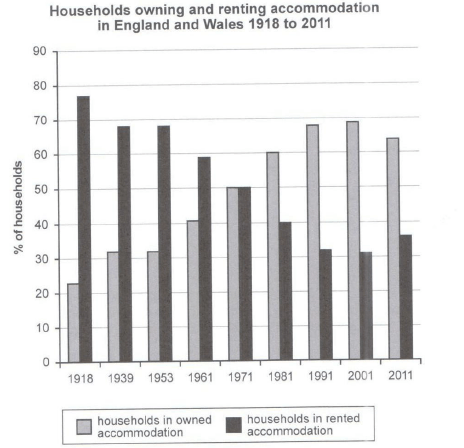
The chart below shows the percentage of households in owned and rented accommodation in England and Wales between 1918 and 2011.
Summarize the information by selecting and reporting the main features and make comparisons where relevant.
Student answer (Band 6.0)
The bar chart illustrates the percentage of households owned and rented accommodation in England and Wales between 1918 and 2011.
Overall, there is a significant change in house occupancy over the time frame. The percentage of rented accommodation was relatively high at the starting period but it gradually went down with time period. And house ownership increase at the end of period.
In 1918, the proportion of rented house was higher than house ownership accounting for 77% which is three times higher than house ownership. Meanwhile, rented accommodation slightly went down to 68% in the mid century in 1953. In 1971, both rented and owned accommodation reach equal proportion about 50%.
Conversely, the percentage of households owning surge gradually with time. After meeting equal point in 1971 thereafter it peaking just under 70% in 2001. In 2011 house ownership experienced a slight decreased to 65%, through it well above the percentage of rented households.
AI examiner evaluation
| Criterion | Band |
|---|---|
| Task Achievement / Task Response | 6.0 |
| Coherence and Cohesion | 6.0 |
| Lexical Resource | 5.5 |
| Grammatical Range and Accuracy | 5.5 |
| Overall | 6.0 |
Task Achievement / Task Response: Band 6.0
You identify the main contrast and broad trend: renting starts much higher, the two figures meet at about 50% in 1971, and ownership later becomes dominant. The figures you include are generally consistent with the chart, including the rented share of 77% in 1918 and the ownership peak just under 70% in 2001. However, the overview is imprecise: ownership rises for most of the period but falls by 2011, rather than simply increasing “at the end.” The account also omits several useful stages, such as the early ownership plateau and the 2011 rise in renting. The response is 142 words, below the 150-word minimum; develop the later comparison and report more key stages to meet the requirement.
Coherence and Cohesion: Band 6.0
The response has a clear overall shape, with an introduction, an overview, and paragraphs describing the early and later trends. The contrast between renting and ownership is easy to follow, and “Conversely” signals a shift in focus. However, some linking is mechanical or awkward: “And” begins a sentence in the overview, while “After meeting equal point in 1971 thereafter” combines time links unclearly. The progression would be stronger if each paragraph followed the timeline consistently and the overview stated the full pattern, including the reversal in 2011. Use clearer links such as “From 1971 onwards” and “By contrast,” and avoid repeating the same trend in separate sentences.
Lexical Resource: Band 5.5
You use relevant chart vocabulary, including “percentage,” “proportion,” “accounting for,” and “peaking,” so the topic is generally clear. There is some variety in how you describe change, but several word choices and collocations are inaccurate or unnatural: “house occupancy,” “rented house,” “went down with time period,” and “house ownership surge gradually.” These choices make parts of the report less precise, even though the intended meaning can usually be understood. Aim for standard data-reporting phrases such as “the proportion of households renting accommodation declined” and “home ownership rose.” Also check word forms and spelling, including “decreased” when used as a noun phrase.
Grammatical Range and Accuracy: Band 5.5
You attempt both simple and more complex sentence forms, and the main comparisons are usually understandable. Some grammatical errors remain, particularly with articles, verb forms, and sentence construction. For example, “the percentage of households owned and rented accommodation” needs a grammatical link such as “in” or “that owned or rented”; “house ownership increase” needs a correctly inflected verb; and “it peaking” should be recast as a finite clause, such as “it peaked.” The sentence beginning “After meeting equal point…” also lacks a clear grammatical structure. Review subject–verb agreement and use complete clauses when describing trends. More consistently accurate sentences would make the report easier to read.
See this exact question answered at other band scores. The same prompt compared across bands.
Browse more IELTS Writing model answers or get your own writing scored by the same AI examiner.