Band 6.0 IELTS Writing Task 1 Model Answer
Overall Band Score: 6.0 · Cambridge IELTS 13 · 2026-11-12
IELTS Writing Task 1 question
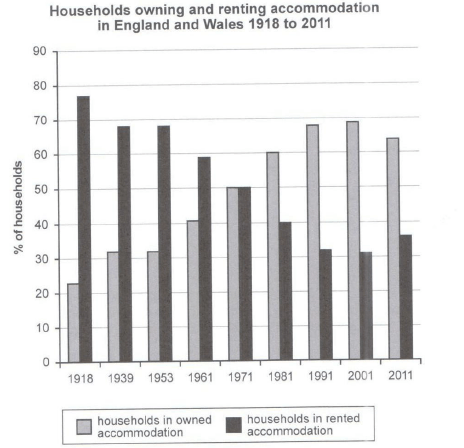
The chart below shows the percentage of households in owned and rented accommodation in England and Wales between 1918 and 2011.
Summarize the information by selecting and reporting the main features and make comparisons where relevant.
Student answer (Band 6.0)
The provided bar chart illustrates the proportion of households in owner and rented accommodation in England and wales from 1918 to 2011.
Overall, it can be seen that the ratio of households in rented accommodation had shown downward trend over the years, while the percentage households in owned accommodation had shown upward treand in the given years.
In detail, household in rented accommodation started
the period at highest rate, with almost 77% in 1918. In 1939 and 1953, it stood same at 68% then sudden dropped to 59%, 50%, 40%, 32% and 31% in 1961, 1971, 1981, 1991 and 2001 respectively. In 2011 it slightly rose 35%.
In contrast, the percentage of households in owned accomodation had recorded 22% in 1918, then escalated to 32% in 1939 and stay constant till 1953. This trend moved upward for onwards years. In 1971, its proportion seen exactl 50% then escalated to 60% in 1981, 68% and 69% in 1991 and 2001 respectively. The most dramatic change can be seen in 2011 where the ratio reduce to 65%.
AI examiner evaluation
| Criterion | Band |
|---|---|
| Task Achievement / Task Response | 6.5 |
| Coherence and Cohesion | 6.0 |
| Lexical Resource | 6.0 |
| Grammatical Range and Accuracy | 5.5 |
| Overall | 6.0 |
Task Achievement / Task Response: Band 6.5
You cover both accommodation types and give a clear overview of their opposing long-term trends, including the point at which ownership and renting are equal in 1971. Most figures are accurately reported: for example, renting falls from about 77% to 31% by 2001, while ownership rises from about 23% to 69%. The final values are slightly inaccurate (the chart shows about 36% renting and 64% owning in 2011), and “the most dramatic change” in 2011 is not well supported because this is a modest reversal rather than the largest change. This is a relevant, well-selected account, but more precise reporting and a clearer description of the late-period reversal would make it more fully developed.
Coherence and Cohesion: Band 6.0
The response has a clear overall arrangement: an introduction, an overview, and separate detail sections for renting and ownership. “In contrast” effectively signals the relationship between the two series, and the chronological sequence makes the figures easy to follow. However, some linking is mechanical, particularly the repeated use of “then” and the long list of rented-accommodation figures in one sentence. The phrase “This trend moved upward for onwards years” also makes the progression less clear. Improve cohesion by grouping the data into meaningful phases—for example, the early period, the rise to 2001, and the reversal in 2011—and use more precise references between sentences.
Lexical Resource: Band 6.0
You use an adequate range of task-related vocabulary, including “proportion,” “downward trend,” “constant,” and “in contrast,” so the main comparisons are understandable. There are also attempts at more descriptive language, such as “escalated” and “dramatic change,” but these are not always natural or precise for describing chart movements. Spelling errors such as “wales,” “treand,” “accomodation,” and “exactl” reduce accuracy, while phrases such as “stood same” and “for onwards years” show some difficulty with collocation. Aim for accurate, conventional chart language and check spelling carefully; this would make your descriptions more fluent and precise.
Grammatical Range and Accuracy: Band 5.5
You attempt both simple and more complex sentence forms, and the overall meaning is generally clear. However, some errors in verb forms, articles, and sentence construction remain. For example, “had shown downward trend” needs an article and a more suitable tense, while “then sudden dropped” has an incorrect adverb form. In “its proportion seen exactl 50%,” the verb is missing, and “the ratio reduce to 65%” has an incorrect verb form. The long sentence listing several years and percentages would also benefit from clearer punctuation or division into shorter sentences. Work on consistent past-tense reporting and complete sentence structures while retaining your attempts at varied forms.
See this exact question answered at other band scores. The same prompt compared across bands.
Browse more IELTS Writing model answers or get your own writing scored by the same AI examiner.