Band 6.0 IELTS Writing Task 1 Model Answer
Overall Band Score: 6.0 · Cambridge IELTS 13 · 2026-11-12
IELTS Writing Task 1 question
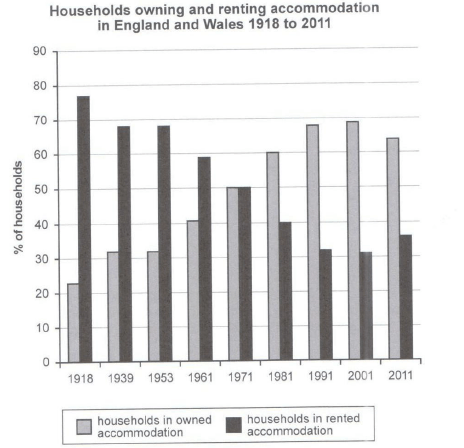
The chart below shows the percentage of households in owned and rented accommodation in England and Wales between 1918 and 2011.
Summarize the information by selecting and reporting the main features and make comparisons where relevant.
Student answer (Band 6.0)
The chart illustrates the proportion of households in private property and leased accommodation in England and Wales from 1918 to 2011.
Overall, the most noticeable feature is that the amount of rental housing was considerably higher than the private property in the earlier years. However, in the next years the proportion of proprietary housing was significantly increased, while the rental housing was fell between 1918 and 2011 in England and Wales.
We look first at the proportion of rental housing is increased to 78% in 1918 then in the next years the figure was continuously fell from 78% to 30% by 2001, while the proportion was slightly increased to 35% by 2011.
Turning to the remaining figures, the proportion of private property was 23% in 1918. However, the figure was continuously rising to 69% by 2001, In 1971 households in owned accommodation was approximately the same as rental housing, while the figure was marginally fell from 69% to 65% by 2011
AI examiner evaluation
| Criterion | Band |
|---|---|
| Task Achievement / Task Response | 6.5 |
| Coherence and Cohesion | 6.0 |
| Lexical Resource | 5.5 |
| Grammatical Range and Accuracy | 5.5 |
| Overall | 6.0 |
Task Achievement / Task Response: Band 6.5
You identify the main contrast and broad change: renting starts well above ownership, the two reach parity in 1971, and ownership becomes more common before a slight reversal at the end. Several figures are also close to the chart, including ownership at 23% in 1918 and around 69% in 2001. This gives the response a clear, relevant overview and covers both categories. To make the account more precise, correct the opening rental figure (about 77%, not 78%) and the 2001 rental figure (about 31%, not 30%). The overview also says ownership increased significantly, but should note that it peaked around 69% in 2001 before falling to 64% in 2011. Some intermediate stages are compressed, so the trends are not fully developed.
Coherence and Cohesion: Band 6.0
The response has a recognisable structure: an introduction, an overview, and separate paragraphs for renting and ownership. Phrases such as “Overall” and “Turning to the remaining figures” help signal the organisation, and the reader can follow the broad comparison. However, progression within the detail paragraphs is sometimes awkward. “We look first at the proportion of rental housing is increased” is not a clear transition into the data, and the ownership paragraph jumps from the 2001 peak back to 1971 without a smooth chronological link. The repeated “while” constructions also make relationships feel mechanical. Presenting each series in chronological order and using clearer links for the crossover and final reversal would make the progression more consistent.
Lexical Resource: Band 5.5
You use a reasonable range of task-related vocabulary, including “proportion,” “rental housing,” “continuously,” and “marginally,” and the meaning is generally understandable. There are, however, several imprecise or unnatural choices that limit control. “Private property” and “proprietary housing” are not suitable substitutes for households in owned accommodation; “home ownership” or “owner-occupied housing” would be clearer. “Leased accommodation” is also less natural here than “rented accommodation.” In addition, “the amount of rental housing” is less precise than “the proportion of households renting.” Aim for consistent, accurate terms for the two categories and use collocations that describe percentages and trends naturally.
Grammatical Range and Accuracy: Band 5.5
You attempt both simple and more complex sentences, including comparisons with “while” and a contrast introduced by “However.” The overall meaning can usually be understood, but some sentence structures and verb forms are faulty. For example, “the proportion of rental housing is increased” does not form a correct reporting clause, and “the rental housing was fell” combines incompatible verb forms. “The figure was marginally fell” has the same problem. There are also punctuation and sentence-boundary issues, such as the capital letter after the comma in “by 2001, In 1971.” Use past simple forms for the historical data (“rose,” “fell”) and check that each clause has a complete, correctly formed verb.
See this exact question answered at other band scores. The same prompt compared across bands.
Browse more IELTS Writing model answers or get your own writing scored by the same AI examiner.