Band 5.5 IELTS Writing Task 1 Model Answer
Overall Band Score: 5.5 · Cambridge IELTS 13 · 2026-11-13
IELTS Writing Task 1 question
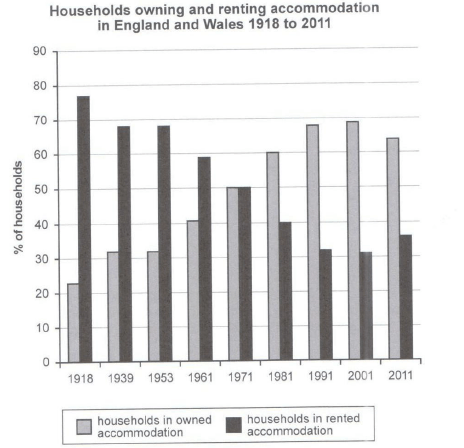
The chart below shows the percentage of households in owned and rented accommodation in England and Wales between 1918 and 2011.
Summarize the information by selecting and reporting the main features and make comparisons where relevant.
Student answer (Band 5.5)
The bar chart illustrate the ratio of accommodation for both owned and rented households in wales, England between 1918 and 2011.
Overall, from 1918 to 1961, rented accommodation made a big profit but after 1971 rented accommodation fall although owned accommodation rose while in 1971, both households accommodation remained same over the year.
On the one hand, households in rented accommodation made a good profit of 77% in 1918, but after that percentage started to drop about 68% in 1939 to 1953.Furthermore, it gradually started to decrease and stop to 31% in 2001 although it increased to 35% at the end of 2011.
On the other hand , households in owned accommodation started with 23% in 1918 and increased to 32% in 1939 to 1953. Furthermore, it rose to 50% in 1971 and 60% in 1981 but in 2001, it reached the highest percentage of 69% in owned accommodation although percentage is drop to 64% at the end of the year 2011 .the bar chart shows that the rented accommodation is decrease and owned accommodation increased over the period.
AI examiner evaluation
| Criterion | Band |
|---|---|
| Task Achievement / Task Response | 6.0 |
| Coherence and Cohesion | 6.0 |
| Lexical Resource | 5.0 |
| Grammatical Range and Accuracy | 5.0 |
| Overall | 5.5 |
Task Achievement / Task Response: Band 6.0
You identify the main contrast and give an overview of the broad movement: renting declines overall while ownership rises, with both at 50% in 1971. You also include several relevant figures, such as 23% ownership in 1918 and 69% in 2001. However, the overview is not fully accurate: rented accommodation did not “make a big profit” from 1918 to 1961; its share fell from 77% to 59%, with a pause at 68% in 1939 and 1953. The account also misses the important reversal after ownership peaked in 2001, when it fell to 64% by 2011. Report the main stages more precisely and distinguish the overall trend from these later changes.
Coherence and Cohesion: Band 6.0
The response has a recognisable structure, with an introduction, an overview, and separate paragraphs for rented and owned accommodation. This makes the two series easy to identify, and linking phrases such as “On the one hand” and “On the other hand” help signal the comparison. However, progression within the paragraphs is sometimes unclear: the overview’s “but after 1971” does not clearly explain the change, and the final sentence repeats the general trend rather than adding a useful comparison. Some connectors, including repeated “Furthermore” and “although,” feel mechanical or do not express the relationship accurately. Use clearer time-based sequencing and connect each figure directly to the trend it illustrates.
Lexical Resource: Band 5.0
You use relevant topic vocabulary, including “rented accommodation,” “households,” “percentage,” and “increased,” so the subject is generally clear. However, several word choices or collocations are inaccurate and make the description less precise. “Made a big profit” is unsuitable for a percentage share, and “stop to 31%” does not clearly describe the low point. The repeated use of “started,” “increased,” and “decrease” also limits the range of language for describing trends. Choose standard chart-reporting expressions such as “accounted for,” “fell to,” “remained stable,” and “peaked at,” and check that each verb accurately describes the data.
Grammatical Range and Accuracy: Band 5.0
You attempt both simple statements and longer sentences with clauses, for example, “although it increased to 35% at the end of 2011.” The main comparisons are usually understandable, but some grammatical errors recur. The opening needs subject–verb agreement (“The bar chart illustrates”), and several trend descriptions have incorrect verb forms, as in “rented accommodation fall” and “the rented accommodation is decrease.” Sentence boundaries and punctuation also need attention: there is no space after “1953.”, and the final sentence begins “the” after a full stop. Aim for consistent past-tense reporting and check agreement, articles, and punctuation when editing.
See this exact question answered at other band scores. The same prompt compared across bands.
Browse more IELTS Writing model answers or get your own writing scored by the same AI examiner.