Band 6.0 IELTS Writing Task 1 Model Answer
Overall Band Score: 6.0 · Cambridge IELTS 13 · 2026-11-14
IELTS Writing Task 1 question
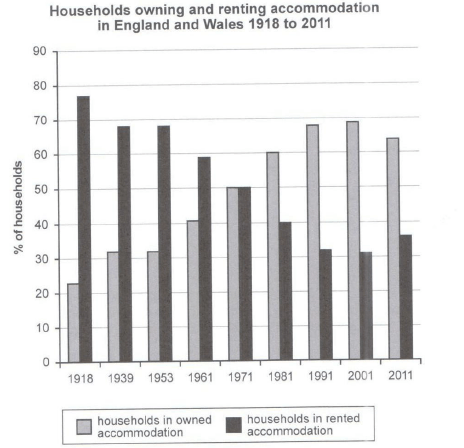
The chart below shows the percentage of households in owned and rented accommodation in England and Wales between 1918 and 2011.
Summarize the information by selecting and reporting the main features and make comparisons where relevant.
Student answer (Band 6.0)
The bar chart compares the proportion of household of England and Wales living in an owned or rented accomodation from 1918 to 2011.
Overall, the share of rented accomdation has declined in 2011 as compared to 1918. On the other hand, the proportion of households who live in their owned accomodation experienced a rise in the 2011. However, in 1971 there was an equal proportion of people living in their own house and those who were having a rented house.
In 1918, about 76% of household had a rented accomodation which declined gradually and reached the lowest point at approximately 31% in 2001. After that it rose slightly to about 36% in 2011.
Only about 23% of household were residing in their own house in 1918. It gradually rose and reached its peak of about 78% in 2001 and then fell to about 74% in the final year. Both the rented and owned accomodation had a 50-50% of people residing in
AI examiner evaluation
| Criterion | Band |
|---|---|
| Task Achievement / Task Response | 6.5 |
| Coherence and Cohesion | 6.0 |
| Lexical Resource | 5.5 |
| Grammatical Range and Accuracy | 5.5 |
| Overall | 6.0 |
Task Achievement / Task Response: Band 6.5
You identify the main contrast and give a clear overview: renting falls over the period, ownership rises, and the two are equal in 1971. Several figures are also reported accurately, including the starting ownership share and the rented share’s low point in 2001. This covers the task well, with some features more fully supported than others. However, the ownership figures for the later years are substantially inaccurate: ownership peaks at about 69% in 2001, not 78%, and falls to about 64% in 2011, not 74%. The overview also says ownership rose in 2011, although it declined from 2001. Correcting these key details and completing the final comparison would make the report more fully precise.
Coherence and Cohesion: Band 6.0
The response has a recognisable structure: an introduction, an overview, and separate paragraphs describing rented and owned accommodation. The sequence from the earliest year to the latest is generally easy to follow, and phrases such as “After that” help signal change. However, the final sentence is unfinished (“those who were residing in”), so the comparison begun there is not completed and the ending feels abrupt. Some linking is also repetitive, particularly the repeated use of “gradually,” and the overview’s “On the other hand” does not clearly express the relationship between the two opposing trends. Use a complete concluding comparison and vary transitions to make the progression smoother.
Lexical Resource: Band 5.5
You use relevant vocabulary for describing chart data, including “proportion,” “declined,” “reached the lowest point,” “rose slightly,” and “peak.” These choices make the general trends understandable. However, several spelling errors recur in a key topic word: “accomodation” and “accomdation” should be “accommodation.” Some expressions are also imprecise or unnatural, such as “household of England and Wales” and “people living in their own house,” when the chart measures households. “Had a rented accommodation” is not a natural collocation. Aim for accurate, consistent terms such as “the percentage of households” and “owner-occupied homes”; this would improve precision and reduce repetition.
Grammatical Range and Accuracy: Band 5.5
You attempt a mix of simple and more complex structures, including the contrastive overview sentence beginning “On the other hand” and the time sequence “After that it rose slightly.” Most of the intended meaning remains clear. Some grammatical errors nevertheless recur. For example, “the proportion of household” needs a plural noun, and “the proportion of households who live” uses an unsuitable relative pronoun for households. The phrase “experienced a rise in the 2011” has an unnecessary article, while “Both … had a 50-50% of people residing in” is structurally incomplete and does not form a grammatical comparison. Check agreement, articles, and sentence completion, and use a wider range of accurate sentence patterns.
See this exact question answered at other band scores. The same prompt compared across bands.
Browse more IELTS Writing model answers or get your own writing scored by the same AI examiner.