Band 6.0 IELTS Writing Task 1 Model Answer
Overall Band Score: 6.0 · Cambridge IELTS 13 · 2026-11-14
IELTS Writing Task 1 question
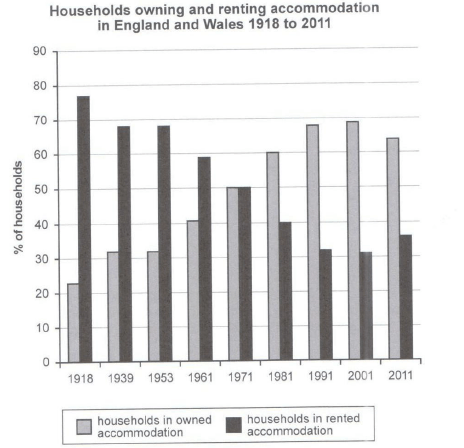
The chart below shows the percentage of households in owned and rented accommodation in England and Wales between 1918 and 2011.
Summarize the information by selecting and reporting the main features and make comparisons where relevant.
Student answer (Band 6.0)
The bar chart compares owned and rented accomodation households in percentage between 1918 and 2011 in England and Wales.
Overall, households in owned accomodation shows an incline and surpassed rented accomodation, while rented accomodation fluctuates. Initially rented accomodation accounts for highest figure in the chart.
Households in rented accomodation accounts for highest figure 78% in 1918, declined and plateaued at 69% in 1939 and 1953, dropped frequently from 59% in 1961 to 32% in 1991. Plateaued again at 32% in 1991 and 2001, then gradually increased and reached 38% in 2011.
Households in owned accomodation increased from 22% to 32% in 1938 remained at same level in 1953, then increased gradually and reached same level as rented accomodation in 1971 at 50%, eventually surpassed rented accomodation in 1981 and reached at 60% afterthat remained close to 70% in 1991 and 2001 and then declined to 63% in 2011 .
AI examiner evaluation
| Criterion | Band |
|---|---|
| Task Achievement / Task Response | 6.0 |
| Coherence and Cohesion | 6.0 |
| Lexical Resource | 5.5 |
| Grammatical Range and Accuracy | 5.5 |
| Overall | 6.0 |
Task Achievement / Task Response: Band 6.0
You identify the main contrast: ownership rises overall, overtakes renting, and renting falls before a late recovery. The report also includes several relevant figures, such as the equal 50% shares in 1971 and the near-70% ownership level around 1991–2001. However, some details are inaccurate: the chart shows 77% rented and 23% owned in 1918, and 64% owned and 36% rented in 2011, rather than 78/22 and 63/38. The year for the 32% ownership figure is 1939, not 1938. The overview’s claim that renting “fluctuates” is imprecise; it mostly declines, then rises at the end. The response is also one word below the required minimum. More precise reporting and a clearer overview would strengthen coverage.
Coherence and Cohesion: Band 6.0
The response has a clear overall arrangement: an introduction, an overview, and separate paragraphs describing each accommodation type. This makes the main trends easy to follow, and sequencing expressions such as “Initially,” “then,” and “eventually” help show change over time. However, cohesion is sometimes mechanical, with repeated openings such as “Households in rented accommodation” and “Households in owned accommodation.” Some links are also unclear: “Plateaued again at 32% in 1991 and 2001” repeats the previous 1991 figure rather than clearly presenting the 2001 value. The final paragraph contains several trends in one long sentence, and punctuation around “afterthat” and the final clause weakens readability. Use clearer sentence boundaries and vary references to the two categories.
Lexical Resource: Band 5.5
You use a suitable range of trend vocabulary, including “declined,” “plateaued,” “surpassed,” and “increased gradually,” so the main movements are generally communicated. Some choices are imprecise or awkward, however. “Fluctuates” suggests repeated rises and falls, whereas renting mainly declines before a final increase; “dropped frequently” is also not a natural description of a steady downward trend. The phrase “accounts for highest figure” is incomplete and unnatural, and “reached at 60%” uses an unsuitable collocation. Spelling errors such as “accomodation” and “afterthat” also reduce accuracy. Aim for precise trend terms and check spelling and common word combinations before finishing.
Grammatical Range and Accuracy: Band 5.5
The response includes both simple statements and longer sentences with sequencing clauses, and the overall meaning remains understandable. Some grammatical errors are present, particularly in subject–verb agreement and sentence construction. For example, “households … shows an incline” should use a plural verb, while “Households in rented accommodation accounts” has the same agreement problem. The phrase “32% in 1938 remained at same level” needs clearer clause structure and an article, and “reached at 60%” reflects an incorrect grammatical pattern. The final sentence also runs several clauses together, with punctuation missing before “afterthat.” Improve agreement, articles, and clause boundaries, while retaining the useful variety of sentence forms already attempted.
See this exact question answered at other band scores. The same prompt compared across bands.
Browse more IELTS Writing model answers or get your own writing scored by the same AI examiner.