Band 5.0 IELTS Writing Task 1 Model Answer
Overall Band Score: 5.0 · Cambridge IELTS 13 · 2026-11-15
IELTS Writing Task 1 question
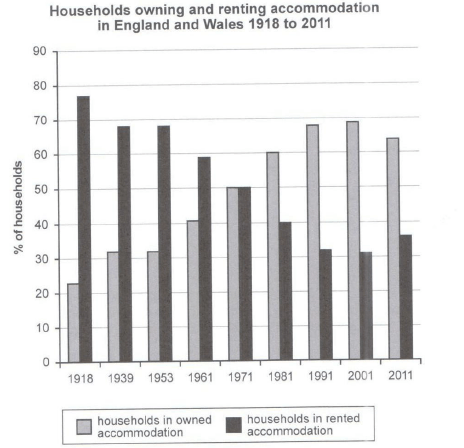
The chart below shows the percentage of households in owned and rented accommodation in England and Wales between 1918 and 2011.
Summarize the information by selecting and reporting the main features and make comparisons where relevant.
Student answer (Band 5.0)
The chart below illustrates the percentage of households is owned and rented accommodation in England and Wales between 1918 and 2011
In 1918, 78% people rented households accommodation, which was the highest in number. According to the chart rented accommodations have the highest percentage compared to people who have owned houses. In 1939, 1953 and 1961 again graph of rented houses were higher and rented accommodations were slowly growing. But in 1971, there were no difference between these accommodations. In 1981 owned accommodations got hike of 60%, as a result rented accommodation got the share of just 40%. Same thing happen again in 1991 owned houses got hike but this there was a huge jump as compared to other years. 2001 remain the same as compared to 1991. At the end 2011 household owned accommodation got the share of 65% and rented accommodation got the share of 35% of a whole market.
AI examiner evaluation
| Criterion | Band |
|---|---|
| Task Achievement / Task Response | 4.5 |
| Coherence and Cohesion | 5.0 |
| Lexical Resource | 5.0 |
| Grammatical Range and Accuracy | 5.0 |
| Overall | 5.0 |
Task Achievement / Task Response: Band 4.5
You identify the broad shift from renting to owning and note the crossover in 1971, which are relevant main features. However, several details are inaccurate: renting did not grow in the earlier years; it fell from 77% in 1918 to 68% in 1939, remained level in 1953, and then declined. Ownership rose to 68% in 1991 and 69% in 2001, rather than showing a “huge jump” in 1991 and remaining unchanged. The final figures are also reversed from the chart’s approximate values: ownership was about 64% and renting 36%. There is no clear, concise overview of the full trend. The response is 140 words, below the 150-word minimum; develop the overview and report the key stages more accurately.
Coherence and Cohesion: Band 5.0
The response follows a broadly chronological order, moving from 1918 to 2011, and uses time markers such as “In 1981” and “At the end 2011” to guide the reader. However, it is presented as one paragraph, so the main overview is not separated from supporting details, and there is little overall progression beyond listing years. Some links are repetitive or unclear: “Same thing happen again” does not specify the change, while “as a result” suggests a causal relationship between the two accommodation categories rather than simply describing their inverse proportions. Organise the response into an introduction, an overview, and detail paragraphs, and use precise comparisons to connect the figures.
Lexical Resource: Band 5.0
You use some relevant vocabulary for describing data, including “percentage,” “share,” “compared to,” and “difference,” so the topic is generally understandable. However, the range is limited and several expressions are inaccurate or unnatural, such as “rented accommodations were slowly growing,” “owned accommodations got hike,” and “of a whole market.” Repeated use of “accommodation” and “got” also makes the description imprecise. Choose standard chart language and distinguish a rise in ownership from a fall in renting; for example, use “the proportion of owner-occupied households increased” and “the renting figure declined.” More accurate collocations would make the comparisons clearer and more formal.
Grammatical Range and Accuracy: Band 5.0
You attempt both simple and longer sentences, and the chronological sequence is mostly understandable. However, errors occur frequently in sentence structure, agreement, articles, and verb forms. The opening phrase “the percentage of households is owned” has an incorrect structure; “there were no difference” has a number-agreement error; and “Same thing happen again” lacks the correct past-tense verb. The sentence beginning “In 1981 owned accommodations…” also joins ideas awkwardly, while “this there was” appears to be missing a word. These problems sometimes make the intended comparison difficult to follow. Practise accurate past-tense reporting and build shorter, complete sentences before combining them with clauses such as “while” or “whereas.”
See this exact question answered at other band scores. The same prompt compared across bands.
Browse more IELTS Writing model answers or get your own writing scored by the same AI examiner.