Band 5.5 IELTS Writing Task 1 Model Answer
Overall Band Score: 5.5 · Cambridge IELTS 13 · 2026-11-15
IELTS Writing Task 1 question
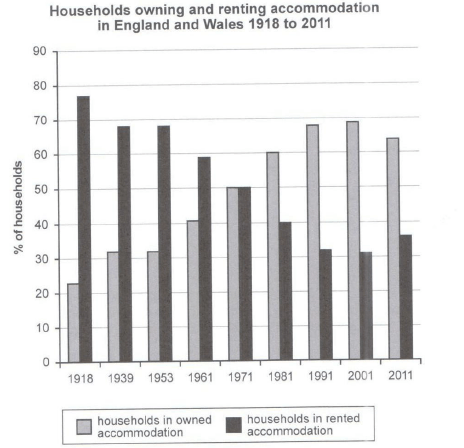
The chart below shows the percentage of households in owned and rented accommodation in England and Wales between 1918 and 2011.
Summarize the information by selecting and reporting the main features and make comparisons where relevant.
Student answer (Band 5.5)
The bar chart compares the percentage of families that how many households owned the houses and how many are living in rented places in England and Wales between 1918 to 2011.
Overall, the rented accomodation have decresed over the time while the owned numbers of households accomodation have incresed till 2001 then slightly declined. From year 1962 to 1971 the number are equal for both the owned accomodation and rented accomodation.
In period 1918 the percentage of households in rented accomodation was approximately 76% while it reduced to 68% same in year 1953 then in 1961 it decreases to 59%.In 1971 it comes to 50% and after that it started declining in till 2001 which is 32% and eventually in 2011 it roses from 32% to 35%.
In contrast the households in owned accomodation have increased started from 1918 to 22% then rises to 50% over the period of 1971. In 1981 it roses to 60% then in2001 it roses to 69% which fel
AI examiner evaluation
| Criterion | Band |
|---|---|
| Task Achievement / Task Response | 6.0 |
| Coherence and Cohesion | 6.0 |
| Lexical Resource | 5.0 |
| Grammatical Range and Accuracy | 5.0 |
| Overall | 5.5 |
Task Achievement / Task Response: Band 6.0
You identify the chart’s main contrast and give a relevant overview: renting generally declined, while ownership rose before falling slightly. You also report several key figures accurately, including the 50% crossover in 1971 and ownership reaching 69% in 2001. However, the overview says the two figures were equal from “1962 to 1971”; the chart shows equality only in 1971. Some details are also inaccurate: renting is about 32%, not 32%? Your text gives 32% in 2001, whereas the chart is about 31%; the 2011 figure is about 36%, rather than 35%. The final ownership comparison is cut off, leaving the ending trend unreported. More precise coverage of the final values and a complete account of the ownership decline in 2011 would make the summary more fully developed.
Coherence and Cohesion: Band 6.0
The response has a recognisable structure, with an introduction, an overview, and separate descriptions of rented and owned accommodation. The contrast marker “In contrast” helps signal the shift between the two series, and the figures are mostly presented in chronological order. However, some connections are unclear or mechanically expressed, such as “then it reduced to 68% same in year 1953,” and the overview’s reference to “1962 to 1971” disrupts the timeline. The final sentence ends abruptly at “which fel,” so the progression is incomplete. Use clearer links between stages and ensure each paragraph develops a complete comparison; for example, group the early years, the 1971 crossover, and the later reversal in a more deliberate sequence.
Lexical Resource: Band 5.0
You use relevant chart vocabulary, including “percentage,” “declined,” “increased,” and “in contrast,” so the reader can generally understand the trends being described. However, the range is limited and several word choices or collocations are inaccurate or repetitive. “The owned numbers of households accommodation” is not a natural way to describe the series; “the proportion of households in owner-occupied accommodation” would be clearer. “Roses” is repeatedly used instead of “rose,” and “it comes to 50%” is less precise than “fell to 50%.” There are also spelling errors such as “accomodation,” “decresed,” and “incresed.” Aim for accurate trend verbs and vary them appropriately, while checking spelling and using standard terms such as “ownership” and “rented accommodation.”
Grammatical Range and Accuracy: Band 5.0
You attempt both simple and more extended sentences, and the overall meaning is usually recoverable. However, errors in sentence structure, agreement, tense, and punctuation are noticeable. The opening phrase “the percentage of families that how many households” contains an incomplete and confusing clause. In “the rented accomodation have decresed,” the subject and verb do not agree, while “the owned numbers … have incresed” has an unclear grammatical structure. The phrase “From year 1962 to 1971 the number are equal” also has an incorrect time reference and verb form. Several sentences run together without spaces after full stops, and the final sentence is incomplete. Build clearer subject–verb patterns and proofread each sentence for tense, agreement, and punctuation.
See this exact question answered at other band scores. The same prompt compared across bands.
Browse more IELTS Writing model answers or get your own writing scored by the same AI examiner.