Band 6.0 IELTS Writing Task 1 Model Answer
Overall Band Score: 6.0 · Cambridge IELTS 13 · 2026-11-16
IELTS Writing Task 1 question
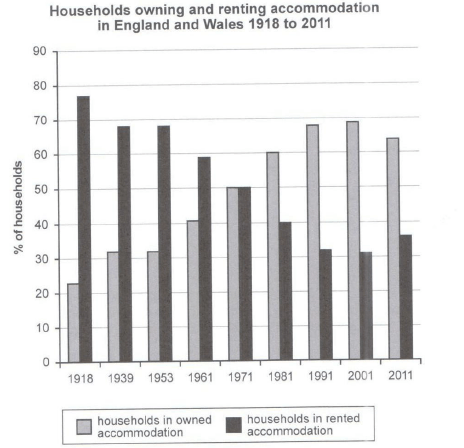
The chart below shows the percentage of households in owned and rented accommodation in England and Wales between 1918 and 2011.
Summarize the information by selecting and reporting the main features and make comparisons where relevant.
Student answer (Band 6.0)
The bar chart illustrates the percentage trends of families who lived in purchased or rented houses in England from 1918 to 2011.
The number of homeownership experienced a steady increase in 93 years with a few exceptions. The number of families renting a condominium recorded an opposite trend from homeownership declining year to year. The year 21 years between 1939 to 1953 saw a stagnant in growth for both metrics.
The year 1918 recorded families owning home at somewhat 23 % while number of families renting out was at 73%. The year 1939 a slight increase in the number of property purchase at 32% while renting delined to 68% but the trend remain unchaged during the next 21 years until 1953. In 1961 families started to own more apartments than before at about 41% and renting kept from delining. The year 1971 recorded a astonishing tie between owning and renting at 50% and tide started to move towards purchasing properties in the later years. The next 30 years saw a steady 10%,8% and 2% increase in property purchase while renting kept delining until 2011 when it saw slight increase. Overall the trend shows that more and more families are moving towards owning homes than renting one.
AI examiner evaluation
| Criterion | Band |
|---|---|
| Task Achievement / Task Response | 6.5 |
| Coherence and Cohesion | 6.0 |
| Lexical Resource | 5.5 |
| Grammatical Range and Accuracy | 5.5 |
| Overall | 6.0 |
Task Achievement / Task Response: Band 6.5
You identify the chart’s central contrast and give a clear overall account: ownership generally rose while renting fell, with the two reaching 50% in 1971 and ownership remaining higher thereafter. Several figures are accurately reported, including 23% ownership in 1918, 32% in 1939, and the 1971 tie. This covers the main features well and shows some detail beyond a basic summary. However, the overview says renting declined “year to year,” which overstates the pattern, and the 2011 rise in renting is only briefly noted. The 1918 rental figure is given as 73%, rather than approximately 77%, and the claim that renting “kept from declining” in 1961 is unclear. More precise reporting of the final reversal and the plateau around 1991–2001 would strengthen the account.
Coherence and Cohesion: Band 6.0
The response has a recognisable structure: an introduction, a broad summary, and a paragraph that follows the data chronologically. This makes the main progression easy to follow, and time references such as “In 1961,” “The year 1971,” and “The next 30 years” help organise the comparisons. However, the overview and detailed account are not always clearly separated, and some links are mechanical or unclear. For example, “The year 21 years between 1939 to 1953” is difficult to interpret, while “The next 30 years saw a steady 10%, 8% and 2% increase” compresses several dates and figures into one sentence. Use clearer transitions and group the early period, the crossover, and the later reversal into distinct stages.
Lexical Resource: Band 5.5
You use a reasonable range of topic-related vocabulary, including “homeownership,” “stagnant,” “opposite trend,” and “tie,” and the reader can generally understand the comparisons. However, several choices are inaccurate or unnatural for describing this chart. “Families who lived in purchased or rented houses” and “renting a condominium” are less suitable than standard terms such as households in owned or rented accommodation. Phrases such as “the number of homeownership” and “the tide started to move” also weaken precision. Spelling errors, including “delined,” “unchaged,” and “delining,” are noticeable. Aim for consistent, accurate chart vocabulary and check spelling; this will make your descriptions more precise and natural.
Grammatical Range and Accuracy: Band 5.5
You attempt both simple and more complex sentence forms, including clauses with “while” and time expressions, and the overall meaning is usually recoverable. Some grammatical errors remain, however. For example, “The number of homeownership experienced” has an incorrect noun structure, and “The year 1939 a slight increase” is missing a verb. In “The year 1971 recorded a astonishing tie,” the article is incorrect, while “the trend remain unchanged” has a subject–verb agreement error. Sentence boundaries and phrasing also need attention in the long final paragraph, where several changes are joined together. Practise forming complete sentences with clear subjects and verbs, and check articles, agreement, and tense consistency during revision.
See this exact question answered at other band scores. The same prompt compared across bands.
Browse more IELTS Writing model answers or get your own writing scored by the same AI examiner.