Band 4.5 IELTS Writing Task 1 Model Answer
Overall Band Score: 4.5 · Cambridge IELTS 13 · 2026-11-16
IELTS Writing Task 1 question
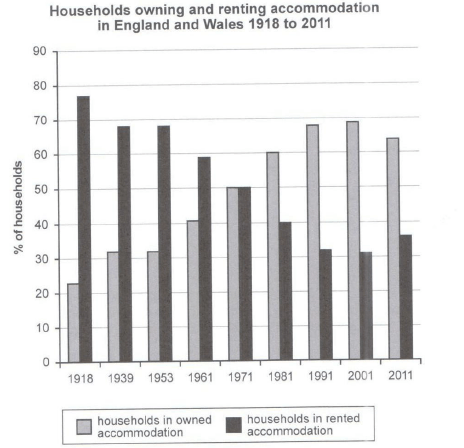
The chart below shows the percentage of households in owned and rented accommodation in England and Wales between 1918 and 2011.
Summarize the information by selecting and reporting the main features and make comparisons where relevant.
Student answer (Band 4.5)
The bar chart illustrates the compared the proportion of households in owned and rented accommodation in England and Wales between 1918 and 2011.
Overall, the highest accommodation was the rented, contrast with owned accommodation. Middle of the year both had the most balanced pattern. Though beggining of the period the households in rented accommodation was the balanced, in 1981 the households in owned accommodation was the high rate.
In 1918 t78% of people used rented accommodation, in contrasted owned only 22%, while in 1971 both were balanced percentages it was 50%.
However ,in 1981 the owner accommodation increased appromaxitaly 70%, whereas the rented accommodation fell off 40%. From 1981 to 2001 it was dicreased 32%, while in 2011 its grown up 35%. owned a was
AI examiner evaluation
| Criterion | Band |
|---|---|
| Task Achievement / Task Response | 4.5 |
| Coherence and Cohesion | 4.5 |
| Lexical Resource | 5.0 |
| Grammatical Range and Accuracy | 4.5 |
| Overall | 4.5 |
Task Achievement / Task Response: Band 4.5
You identify the two accommodation types and include the broad contrast between renting and owning, as well as the 50/50 point in 1971. However, the overview is unclear and partly inaccurate: renting was highest at the beginning, not throughout, and ownership became higher from 1981 to 2001. The statement that ownership reached about 70% in 1981 is incorrect; it was about 60%, while renting was about 40%. The final figures also need clearer reporting: in 2011 ownership was about 64% and renting about 36%. The response contains 110 words, below the required 150, so several key stages and comparisons are left undeveloped. Add a concise overview and report the main changes across the period accurately.
Coherence and Cohesion: Band 4.5
There is an attempt to organise the response into an introduction, an overview and detail paragraphs, and time markers such as “In 1918” and “in 1981” help indicate chronology. However, the progression is difficult to follow because the overview is unclear and the details are incomplete. The sentence beginning “From 1981 to 2001” does not clearly identify which accommodation type its figures describe, and the ending “owned a was” is unfinished. Linking words such as “However” and “Though” do not always express a clear relationship between the points. Use separate paragraphs for the overall trends and the key data, and make each comparison explicit so the reader can follow the changes without guessing.
Lexical Resource: Band 5.0
The response uses some relevant task vocabulary, including “proportion,” “rented accommodation,” “increased” and “fell,” so the topic is generally recognisable. However, the range is limited and several word choices or collocations are inaccurate, which sometimes makes the meaning difficult to interpret. For example, “the highest accommodation was the rented” and “both had the most balanced pattern” do not express the intended comparisons naturally. There are also spelling errors such as “beggining,” “appromaxitaly” and “dicreased,” and the phrase “grown up” is unsuitable for describing a chart trend. Aim for precise terms such as “share,” “percentage,” “rose” and “declined,” and check spelling and collocations before submitting.
Grammatical Range and Accuracy: Band 4.5
You attempt a few different sentence forms, including a contrast with “while” and a clause beginning “Though,” but control is inconsistent. Errors in sentence construction and agreement occur in examples such as “the households in rented accommodation was” and “the households in owned accommodation was the high rate.” The opening, “illustrates the compared the proportion,” is also structurally faulty, while “in 2011 its grown up” has an incorrect verb form. Punctuation and spacing are uneven, and the final fragment “owned a was” leaves the response incomplete. These problems sometimes obscure the intended meaning. Practise writing complete, controlled sentences with a clear subject and verb, and check agreement and past-tense forms when describing historical data.
See this exact question answered at other band scores. The same prompt compared across bands.
Browse more IELTS Writing model answers or get your own writing scored by the same AI examiner.