Band 5.0 IELTS Writing Task 1 Model Answer
Overall Band Score: 5.0 · Cambridge IELTS 13 · 2026-11-16
IELTS Writing Task 1 question
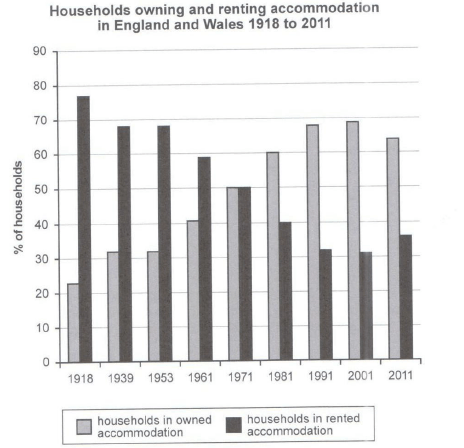
The chart below shows the percentage of households in owned and rented accommodation in England and Wales between 1918 and 2011.
Summarize the information by selecting and reporting the main features and make comparisons where relevant.
Student answer (Band 5.0)
The chart illustrates the proportion of households in owned and rented accommodation in England and Wales in the years between 1918 and 2011.
Overall, the household in rented accomoodation are the maximum compared with own households. Initial five years households in rented are declined gradually. In the middle year equal number of residents present. However,
Households in rented accommodation the highest number of residents stayed at below 80% in 1918. The lowest number of residents stayed in the year of 2001. In 1939 and 1953 are similar proportions of people lived at that period just below 70%. Then, went down in 1961 just under 60%. Another four decades are decreased dramatically below 40%.
In addition, households in owned accommodation the maximum number of members stayed in 2001 almost reached at 70%. The minimum number of members stayed in 1981 above 20%.
This year to 1961 increased gradually. Moreover, in 1971 surged approximately at 50%. Only this is year both owned accommodation, and rented households are lived percentage at 50% equally. Then surged, at 1981 approximately, at 60%.
AI examiner evaluation
| Criterion | Band |
|---|---|
| Task Achievement / Task Response | 5.5 |
| Coherence and Cohesion | 5.0 |
| Lexical Resource | 5.0 |
| Grammatical Range and Accuracy | 5.0 |
| Overall | 5.0 |
Task Achievement / Task Response: Band 5.5
You identify the two accommodation types and report several relevant comparisons, including the equal 50% shares in 1971 and the rise in ownership to a peak around 2001. However, the overview is incomplete and partly inaccurate: renting was higher only up to 1971, after which ownership became the larger category, so it is not accurate to say rented households were generally the maximum. The statement that the “initial five years” saw a decline is unclear and does not match the chart’s year intervals. Some key changes are also omitted, especially the slight fall in ownership and rise in renting from 2001 to 2011. A clearer overview of the long-term reversal and the late-period change, supported by accurate figures, would make the summary more complete.
Coherence and Cohesion: Band 5.0
The response has an introduction, an attempted overview, and separate paragraphs for rented and owned accommodation, so there is some organisation. However, progression is difficult to follow because the overview ends abruptly with “However,” and the later paragraphs do not consistently present the trends in chronological order. For example, the rented paragraph moves from 1918 to 2001, then back to 1939 and 1953. Linking phrases such as “In addition” and “Moreover” are used, but they do not always clarify the relationship between ideas. Group the two series into clear chronological stages, complete the overview, and use transitions to show contrast and change; this would create a more coherent progression.
Lexical Resource: Band 5.0
You use some task-relevant vocabulary, including “proportion,” “declined,” “increased,” and “surged,” and the reader can generally identify which accommodation type you mean. However, the range is limited and several expressions are inaccurate or repetitive. Phrases such as “the highest number of residents” and “the maximum number of members” describe people rather than the percentage of households, while “stayed at below 80%” is an awkward way to report a figure. There is also a spelling error in “accomoodation.” Use precise chart language such as “the proportion of households,” “accounted for,” and “reached a peak,” and vary verbs carefully to describe rises, falls, and stable periods.
Grammatical Range and Accuracy: Band 5.0
The response attempts a few longer structures, such as “In 1939 and 1953 are similar proportions…” and “Only this is year both owned accommodation, and rented households…,” but these are often faulty, and many sentences have errors in basic sentence construction. Examples include “the household in rented accommodation are,” where the subject and verb do not agree, and “This year to 1961 increased gradually,” which lacks a clear grammatical subject and relationship between the dates. The overview also ends with the incomplete “However,” leaving the sentence unfinished. Use complete sentences with a clear subject and verb, check agreement and tense, and practise accurate comparative structures such as “ownership rose from… to…” alongside simpler sentences.
See this exact question answered at other band scores. The same prompt compared across bands.
Browse more IELTS Writing model answers or get your own writing scored by the same AI examiner.