Band 4.5 IELTS Writing Task 1 Model Answer
Overall Band Score: 4.5 · Cambridge IELTS 13 · 2026-11-16
IELTS Writing Task 1 question
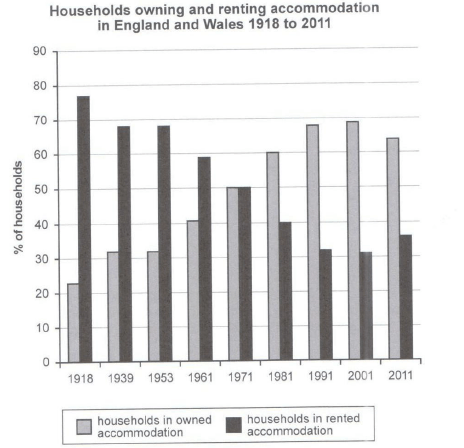
The chart below shows the percentage of households in owned and rented accommodation in England and Wales between 1918 and 2011.
Summarize the information by selecting and reporting the main features and make comparisons where relevant.
Student answer (Band 4.5)
Between 1918 and 2011.The chart illustrates the percentage of households in owned and rented accomodation in England and Walves
Overall, percentage of households in owned accomodation have high rate and with the passage of time it will reduced and the household accomodation is increased
The households in owned accomodations in 1918 is increased about 75percentage of households and overall the lowest rented accomodations is also in 1918.With the passage of time,rented accomodations will be increased and owned accomodations decreased . Between 1991and 2001 the percentage of households in owned and rented accomodations approximately same in1991to 2011,the rented rate increase about 60 to 70 percentage. Furthermore,in 1939and 1953 both rented and owned accomodations will approximately same owned accomodations about 30 percentage and household about round about 68-69 percentage
AI examiner evaluation
| Criterion | Band |
|---|---|
| Task Achievement / Task Response | 4.5 |
| Coherence and Cohesion | 4.5 |
| Lexical Resource | 5.0 |
| Grammatical Range and Accuracy | 4.5 |
| Overall | 4.5 |
Task Achievement / Task Response: Band 4.5
You identify the chart’s subject and attempt to describe changes over time, but several key figures and trends are misreported. In 1918, ownership was about 23%, not 75%, and renting was about 77%, so the claim that ownership was highest and renting lowest then reverses the data. Ownership generally rose to 69% in 2001 before falling to 64% in 2011; renting followed the opposite pattern, reaching 31% in 2001 before rising to 36%. Your statement that renting increased to 60–70% between 1991 and 2011 is inaccurate. The response also contains 111 words, below the 150-word minimum; 16 words copied from the prompt were excluded. Include a clear, accurate overview and select the main turning points and comparisons.
Coherence and Cohesion: Band 4.5
There is an attempt to organise the response by introducing the chart, giving an overall statement, and then discussing figures from different years. However, the progression is difficult to follow because the comparisons move between 1918, 1991–2011, and 1939–1953 without a clear sequence. Some linking phrases, such as “With the passage of time” and “Furthermore,” are used, but they do not make the relationships between ideas clear, and the repeated references to owned and rented accommodation make the response feel repetitive. Separate the overview from the details, then describe the earlier years and later years in chronological order. Use clear comparisons to connect the two series at each stage.
Lexical Resource: Band 5.0
You use relevant topic vocabulary, including “percentage,” “households,” “owned,” and “rented,” so the reader can recognise the subject of the chart. However, the range is limited and several phrases are inaccurate or awkward, such as “have high rate,” “it will reduced,” and “the rented rate increase.” Repeated use of “accommodations” also makes the description less precise; the chart concerns households in owned or rented accommodation. Spelling errors such as “accomodation” and “Walves” further reduce accuracy. Build a small set of precise trend expressions, such as “the proportion rose,” “reached a peak,” and “declined slightly,” and check spelling and word forms before submitting.
Grammatical Range and Accuracy: Band 4.5
The response mainly uses simple sentence patterns, with a few attempts to connect ideas using phrases such as “With the passage of time” and “Furthermore.” However, errors in verb forms, agreement, articles, and sentence boundaries are frequent and sometimes make the intended meaning unclear. For example, “percentage of households … have high rate” has faulty agreement and article use, while “it will reduced” uses an incorrect verb form. “The households … in 1918 is increased” also combines an unsuitable tense with incorrect agreement. Punctuation is inconsistent, including missing spaces after full stops and commas. Practise accurate past-tense descriptions of chart data and build longer sentences only after checking their verb forms and punctuation.
See this exact question answered at other band scores. The same prompt compared across bands.
Browse more IELTS Writing model answers or get your own writing scored by the same AI examiner.