Band 5.0 IELTS Writing Task 1 Model Answer
Overall Band Score: 5.0 · Cambridge IELTS 13 · 2026-11-18
IELTS Writing Task 1 question
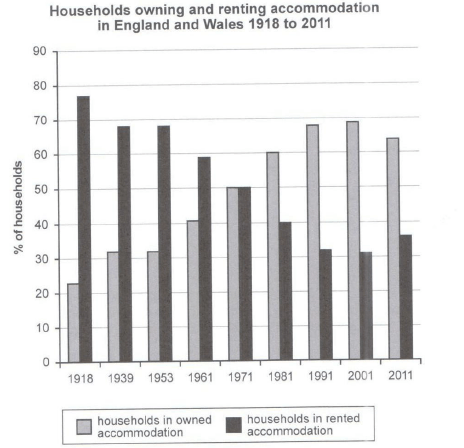
The chart below shows the percentage of households in owned and rented accommodation in England and Wales between 1918 and 2011.
Summarize the information by selecting and reporting the main features and make comparisons where relevant.
Student answer (Band 5.0)
1917This graph shows that the percentage of households in own accomodation in england and the rented householder. It's time period from 1918 to 2011.
The rented householders in 1918 is above the 70% and it is highest one of them and the higher owned householders are in 2001 and it nearly 70%. The rented householders percentage gradually below down from 1918 to 2011. And the owned householders percentages are gradually increase.
In 1918 the owned householders percentage are minium above from 20%and rented householders are above to 70% and nearly to 80%.In 1939 the rented householders percentage are are remainly decrease and stop at nearly 70% and owned householders are increased and reached the 30%. In 1953 the rented householders are remainly same and the owned householders are also remain same. IN 1961 rented householders are gradually decrease and owned householders are gradually increase. In 1971 their percentages meet at the point at 50%.
AI examiner evaluation
| Criterion | Band |
|---|---|
| Task Achievement / Task Response | 5.5 |
| Coherence and Cohesion | 5.0 |
| Lexical Resource | 5.0 |
| Grammatical Range and Accuracy | 4.5 |
| Overall | 5.0 |
Task Achievement / Task Response: Band 5.5
You identify the chart’s subject and give a broad overview: ownership generally rises while renting falls, and you note that the two figures meet at 50% in 1971. These are relevant main features. However, the account is only partial: it stops at 1971 and does not describe the later rise in ownership to a peak of about 69% in 2001, followed by a fall to 64% in 2011, or the corresponding change in renting. Some details are also imprecise, such as saying renting “gradually” declines without noting the periods when it is unchanged. Cover the full time span and select key turning points and comparisons to make the summary more complete.
Coherence and Cohesion: Band 5.0
The response has some organisation: it begins with an introduction and overview, then gives year-by-year details, and the sequence from 1918 to 1971 is generally understandable. However, the progression is limited because the description ends midway through the chart, and several sentences repeat the same ownership/renting pattern rather than grouping related information. Connectors such as “And” and repeated “In [year]” make the writing mechanical, while the relationship between the two series is not always expressed clearly. Organise the report into a concise overview and body paragraphs that group the early and later trends, using comparisons such as “whereas” or “by contrast” to guide the reader.
Lexical Resource: Band 5.0
You use some relevant chart vocabulary, including “percentage,” “increased,” “decrease,” and “reached,” so the general topic is recognisable. However, the range is limited and several repeated or inaccurate expressions make the report less clear. “Householders” refers to people, not the share of households, and “remainly decrease” is not a natural expression. There are also spelling and form errors, including “accomodation” and “minium.” Use precise terms consistently, such as “the proportion of households,” “home ownership,” and “rented accommodation,” and choose verbs that accurately describe movement or stability. This would make the comparisons clearer and more appropriate for an academic report.
Grammatical Range and Accuracy: Band 4.5
Most sentences use simple patterns, and the reader can understand the broad trend, but grammatical errors are frequent and sometimes make relationships difficult to follow. For example, “The rented householders in 1918 is” has a subject–verb agreement problem, while “the owned householders percentage are minium” contains several errors in agreement and sentence construction. Articles and plurals are also inconsistent, as in “the rented householder” and “the owned householders percentages.” The response attempts longer sentences with “and,” but these are often joined awkwardly. Practise accurate basic clauses first, then combine them with controlled comparisons, for example: “Ownership rose to 50% in 1971, while renting fell to the same level.”
See this exact question answered at other band scores. The same prompt compared across bands.
Browse more IELTS Writing model answers or get your own writing scored by the same AI examiner.